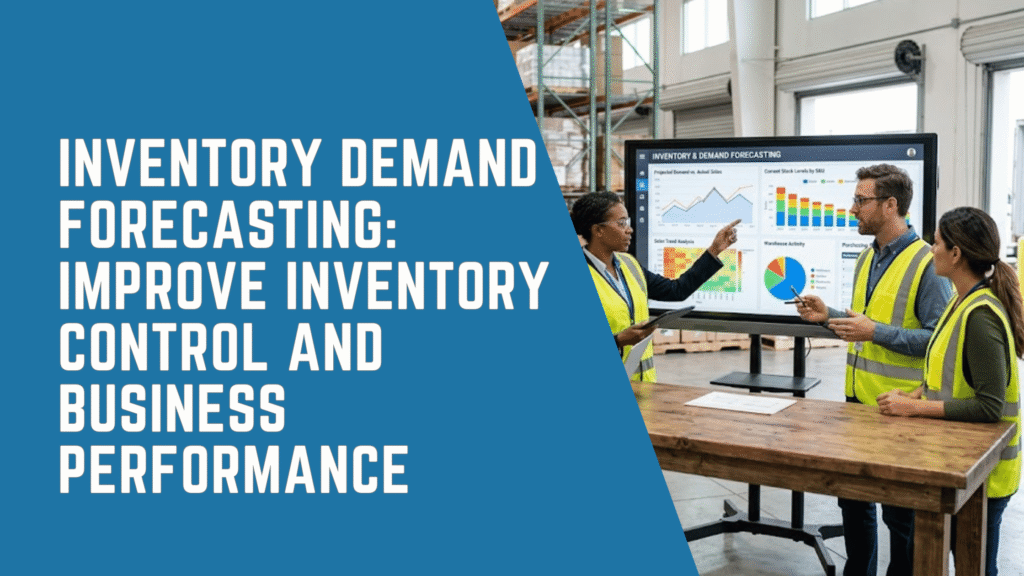
Inventory demand forecasting has become a critical capability for organizations that need to balance product availability, operational efficiency, and working capital. By analyzing sales history, seasonality, customer demand patterns, supplier lead times, and operational trends, businesses can better anticipate what inventory will be needed, where it will be required, and when it should be available.
For businesses operating in distribution, manufacturing, food and beverage, construction, or multi-location environments, forecasting accuracy can directly affect purchasing, production, replenishment, customer service, and cash flow. When demand is predicted more effectively, teams can make earlier and more informed decisions instead of reacting after shortages or inventory imbalances have already occurred.
However, many organizations still depend on spreadsheets, disconnected systems, static reorder points, and manual purchasing decisions. These methods may work when operations are relatively simple, but they become increasingly unreliable as the number of products, suppliers, customers, warehouses, and transactions grows.
As a result, businesses may carry too much of the inventory that is not selling while running out of the products customers actually need. This imbalance can lead to stockouts, excess carrying costs, rushed orders, warehouse congestion, lower margins, and unreliable financial reporting.
Inventory demand forecasting addresses these challenges by connecting demand signals with inventory control, purchasing, production, sales, finance, and reporting. Rather than functioning only as a warehouse planning exercise, forecasting becomes a broader business capability that helps finance and operations leaders align inventory decisions with service levels, cash flow, profitability, and long-term growth.
What Is Inventory Demand Forecasting?
Inventory demand forecasting is the process of estimating future product demand so a business can plan inventory levels more accurately. It uses historical sales, open orders, seasonal trends, promotions, supplier lead times, customer buying patterns, and market signals to predict what inventory will be needed, where it will be needed, and when it should be available.
In simple terms, inventory demand forecasting answers several important questions:
| Forecasting Question | Business Impact |
|---|---|
| What products are likely to sell? | Helps improve purchasing and production planning. |
| When will demand increase or decrease? | Helps reduce stockouts and overstocks. |
| Where will inventory be needed? | Supports multi-location inventory planning. |
| How much safety stock is required? | Protects service levels without tying up excess cash. |
| Which items are slow-moving? | Reduces dead stock and improves working capital. |
| Which suppliers create risk? | Helps procurement plan around lead-time variability. |
Forecasting is not simply about predicting the future. Its real value lies in improving business decisions by connecting demand data with purchasing, replenishment, production, finance, and reporting.
For example, a distributor may forecast increased demand for certain products before a seasonal sales cycle. As a result, the purchasing team can place orders earlier, the warehouse can prepare storage space, and finance can plan cash requirements. Meanwhile, leadership can evaluate whether the expected demand supports margin, revenue, and working capital goals.
Because of this, forecasting becomes much more valuable when it operates inside a connected ERP environment. Standalone spreadsheets may calculate basic projections. However, an ERP system connects forecasting to real transactions, inventory availability, supplier records, financial reporting, and operational workflows.
Why Inventory Demand Forecasting Matters for Business Performance
Inventory is one of the largest working capital investments for many businesses. Therefore, even small improvements in forecasting can have a meaningful impact on cash flow, margins, customer satisfaction, and operational efficiency.
When inventory demand forecasting is weak, organizations often experience several costly problems. First, they may overbuy slow-moving products. Second, they may understock high-demand items. Third, they may make purchasing decisions based on outdated sales data. Finally, they may struggle to explain inventory variances in financial reports.
These issues create operational and financial pressure. Excess inventory ties up cash that could support growth, hiring, debt reduction, or investment. Stockouts reduce revenue and damage customer trust. In addition, urgent purchasing often increases freight costs and lowers margins.
In contrast, stronger inventory demand forecasting helps businesses improve control over both service levels and cost. It allows teams to plan inventory based on expected demand rather than guesswork. Moreover, it gives finance leaders better visibility into the relationship between inventory, cash flow, revenue, and profitability.
The business case is especially strong for companies that manage:
- Large SKU counts
- Multiple warehouses or branches
- Seasonal demand
- Long supplier lead times
- Imported products
- Perishable or regulated inventory
- Manufacturing inputs
- Distribution networks
- Complex customer order patterns
For these businesses, inventory forecasting directly affects service performance and financial results. As a result, it should not sit only with warehouse teams. Instead, it should become part of broader ERP strategy, reporting, and business planning.
Common Inventory Control Problems Caused by Poor Forecasting
Poor forecasting often creates inventory control problems that spread across the organization. Although the symptoms may appear in the warehouse, the root cause often sits in disconnected data, manual processes, or outdated ERP workflows.
Stockouts and Lost Sales
A stockout occurs when customer demand exceeds available inventory. This can happen when demand rises unexpectedly, supplier shipments arrive late, or reorder points are inaccurate. However, many stockouts happen because businesses lack timely demand visibility.
When stockouts occur, customers may delay purchases, cancel orders, or switch suppliers. Consequently, the company loses revenue and may also lose long-term customer loyalty.
Excess Inventory and Carrying Costs
Excess inventory creates a different problem. It consumes warehouse space, increases insurance and handling costs, and ties up working capital. Furthermore, excess stock may become obsolete, damaged, expired, or discounted.
For finance leaders, excess inventory also creates reporting challenges. Inventory may appear as an asset on the balance sheet, but slow-moving stock can hide margin risk. Therefore, better forecasting supports more accurate inventory valuation and stronger financial control.
Manual Replenishment Decisions
Many growing businesses still use manual reorder calculations. However, manual methods become unreliable as SKU counts, suppliers, locations, and customer segments increase. As a result, inventory teams may rely on personal judgment rather than consistent planning logic.
Modern ERP systems can automate replenishment logic by using demand patterns, current inventory, supplier lead times, safety stock, and purchasing rules.
Disconnected Sales, Finance, and Operations Data
Forecasting becomes less reliable when sales data, inventory data, purchasing data, and financial data live in separate systems. In that environment, teams often debate which report is correct instead of acting on a shared version of the truth.
A connected ERP platform helps reduce this problem. It gives leaders real-time visibility into inventory movements, purchasing commitments, sales demand, and financial impact.
Weak Visibility Across Locations
Multi-location businesses need to know where inventory sits, where demand is rising, and where transfers may be more cost-effective than new purchases. However, disconnected systems make this difficult.
As a result, one branch may run out of stock while another location carries excess inventory. Better forecasting and ERP visibility help prevent that imbalance.
How Inventory Demand Forecasting Improves Inventory Control
Inventory demand forecasting improves inventory control by helping organizations align inventory levels with expected demand. However, the value goes beyond simple prediction. It improves how teams plan, buy, store, move, and report inventory.
1. Better Reorder Point Accuracy
Reorder points determine when a business should purchase or produce more inventory. If reorder points are too low, stockouts become more likely. If they are too high, excess inventory builds up.
Inventory demand forecasting helps refine reorder points by considering demand patterns, supplier lead times, seasonality, and safety stock requirements. Therefore, replenishment decisions become more accurate and less reactive.
2. Improved Safety Stock Planning
Safety stock protects the business from uncertainty. However, too much safety stock increases costs, while too little increases service risk.
Demand forecasting helps calculate safety stock more intelligently. For example, products with stable demand may need less safety stock. In contrast, high-value or unpredictable items may require more careful planning. As a result, businesses can protect service levels without over investing in inventory.
3. Reduced Stockouts
Accurate forecasting helps identify demand increases before inventory becomes unavailable. Therefore, procurement and operations teams can act earlier.
This is especially important for businesses with long supplier lead times. For example, a distributor importing products from overseas cannot wait until inventory is almost depleted. Instead, it needs early visibility into expected demand, supplier timelines, and purchasing commitments.
4. Lower Excess Inventory
Forecasting also helps reduce overbuying. When businesses understand future demand more clearly, they can avoid purchasing inventory that is unlikely to move.
As a result, organizations can reduce storage costs, improve inventory turns, and release cash from slow-moving stock. In addition, they can make better decisions about promotions, discounts, product rationalization, and supplier negotiations.
5. Stronger Purchasing Decisions
Purchasing teams often face pressure from sales, operations, and suppliers. However, demand forecasting gives procurement a more reliable basis for decisions.
Instead of relying only on last month’s orders or informal requests, buyers can use forecast-driven insights. Consequently, they can plan purchases around expected demand, supplier lead times, price breaks, minimum order quantities, and cash flow.
6. Better Production Planning
Manufacturers need accurate demand signals to plan materials, labour, capacity, and production schedules. If forecasts are inaccurate, production teams may build the wrong products or miss required delivery dates.
Sage X3 is especially relevant in this area because Sage positions it for connected supply chain operations, forecasting, demand planning, multi-site operations, procurement, fulfillment, and manufacturing-led environments.
7. Improved Warehouse Efficiency
Poor forecasting creates warehouse inefficiency. Fast-moving items may be placed in poor locations, while slow-moving products occupy valuable space. Meanwhile, urgent orders may interrupt normal workflows.
Better forecasting supports smarter warehouse planning. For example, teams can anticipate seasonal volume, position inventory more effectively, and reduce unnecessary handling.
8. Better Cash Flow Management
Inventory decisions directly affect cash. Therefore, forecasting should connect to finance.
When demand forecasts improve, finance leaders gain better visibility into purchasing needs, inventory investment, and working capital requirements. As a result, they can plan cash more accurately and avoid surprises.
Inventory Demand Forecasting and ERP: Why the System Matters
Forecasting can only be as strong as the data behind it. Therefore, businesses that rely on disconnected spreadsheets often struggle to build reliable forecasts.
A modern ERP environment can strengthen inventory demand forecasting by connecting the operational and financial data required for more reliable planning. Depending on the platform and business requirements, forecasting may be supported through native capabilities, specialized modules, or integrated planning applications.
ERP-based forecasting also helps teams move from reactive reporting to proactive planning. Instead of reviewing inventory shortages after they happen, leaders can identify risks before they affect customers.
ERP Capabilities That Support Better Forecasting
| ERP Capability | How It Supports Forecasting |
|---|---|
| Real-time inventory visibility | Shows accurate stock levels across locations. |
| Sales order integration | Connects demand signals to inventory planning. |
| Purchase order management | Tracks inbound supply and supplier commitments. |
| Replenishment automation | Supports timely purchasing and stock balancing. |
| Multi-location inventory | Improves transfers and regional planning. |
| Reporting dashboards | Helps leaders monitor trends and KPIs. |
| Manufacturing planning | Connects demand to materials and production. |
| Financial integration | Links inventory decisions to cash flow and margins. |
Sage 300 remains relevant for established businesses that need financial, operational, and inventory management in a scalable ERP environment. IWI describes Sage 300 as an ERP solution that streamlines financial, operational, and inventory management for businesses.
Sage X3 is a strong fit for organizations with more complex manufacturing, food and beverage, process manufacturing, supply chain, and multi-site requirements. IWI positions Sage X3 as an integrated solution for efficiency, flexibility, real-time insights, control, and sustainable growth.
Key Inventory Demand Forecasting Methods
Different businesses require different forecasting methods. Therefore, leaders should avoid assuming that one model fits every SKU, location, or industry.
Historical Demand Forecasting
Historical demand forecasting uses past sales to estimate future demand. It works well when demand is stable and seasonal patterns are clear. However, it may be less reliable when products are new, customer behaviour changes quickly, or supply chain disruption affects purchasing patterns.
Seasonal Forecasting
Seasonal forecasting identifies predictable demand cycles. For example, construction suppliers may see demand rise during certain months. Food and beverage companies may experience spikes around holidays. Retailers may plan around promotional periods.
This method helps businesses prepare earlier. As a result, they can align inventory, staffing, warehouse capacity, and cash planning with expected demand.
Moving Average Forecasting
Moving averages smooth out short-term demand fluctuations. This can help teams identify broader demand trends without overreacting to unusual spikes or drops.
However, moving averages may lag behind rapid market changes. Therefore, they should be combined with business judgment and current demand signals.
Sales Pipeline and Customer Forecasting
Some businesses forecast demand using sales pipeline data, customer contracts, recurring orders, or account-level projections. This approach is especially useful for distributors, manufacturers, and B2B companies with known customer buying patterns.
However, pipeline-based forecasts must connect to actual order history. Otherwise, optimistic sales estimates may cause overstocking.
AI-Assisted and Data-Driven Forecasting
More businesses now use advanced analytics, machine learning, and AI-assisted forecasting to identify patterns that manual methods may miss. However, technology alone does not guarantee better outcomes. Data quality, ERP configuration, planning logic, user adoption, and governance still matter.
Therefore, organizations should treat AI-assisted forecasting as part of a broader ERP and process strategy. It should support business decisions, not replace experienced judgment.
Inventory Forecasting KPIs Leaders Should Track
Strong inventory demand forecasting requires clear performance measures. Otherwise, teams may focus only on forecast accuracy while ignoring business outcomes.
Finance and operations leaders should track KPIs that connect forecasting to inventory control, cash flow, service levels, and profitability.
| KPI | Why It Matters |
|---|---|
| Forecast accuracy | Measures how closely forecasts match actual demand. |
| Inventory turnover | Shows how efficiently inventory converts into sales. |
| Stockout rate | Tracks how often items are unavailable. |
| Fill rate | Measures the ability to fulfill demand from available stock. |
| Carrying cost | Shows the cost of holding inventory. |
| Days inventory outstanding | Measures how long inventory remains on hand. |
| Gross margin by item | Helps identify profitable and unprofitable inventory. |
| Slow-moving inventory | Highlights cash tied up in low-demand products. |
| Obsolete inventory | Identifies stock that may require write-downs. |
| Supplier lead time variance | Shows procurement risk and planning uncertainty. |
However, leaders should not review these KPIs in isolation. For example, a business may improve stock availability by carrying too much inventory. That may protect service levels, but it can damage cash flow. In contrast, aggressive inventory reduction may improve working capital but increase stockout risk.
Therefore, inventory demand forecasting should support balanced decision-making. The goal is not simply to minimize inventory. Instead, the goal is to carry the right inventory, in the right location, at the right time, at the right cost.
How Forecasting Improves Financial Performance
Inventory demand forecasting has a direct impact on financial performance. Because inventory affects revenue, margin, cash flow, and working capital, better forecasting helps finance leaders manage the business more effectively.
Improved Working Capital
Inventory uses cash before it creates revenue. Therefore, excess inventory can restrict growth. Better forecasting helps reduce unnecessary purchases and frees cash for higher-value priorities.
Stronger Gross Margins
Poor forecasting often leads to discounting, expedited shipping, emergency purchasing, and obsolete stock. These issues reduce gross margins. However, better forecasting helps businesses buy more accurately and avoid unnecessary costs.
More Reliable Budgeting
Finance teams need reliable inventory projections to plan cash flow, purchasing, and profitability. Forecasting improves budget accuracy because it connects expected sales demand to inventory requirements.
Better Executive Reporting
Executives need visibility into inventory risk, customer service performance, and operational efficiency. Therefore, ERP dashboards and forecasting reports can help leadership understand what is happening before financial results are affected.
Reduced Write-Offs and Obsolescence
Slow-moving and obsolete inventory can create write-offs. In some industries, this risk is especially high. For example, food and beverage, healthcare supplies, electronics, fashion, and specialty manufacturing may face expiration, regulatory, or product lifecycle issues.
Better forecasting helps identify demand changes earlier. Consequently, businesses can adjust purchasing, promotions, and production before inventory loses value.
How Forecasting Improves Operational Performance
Inventory demand forecasting also improves day-to-day operations. When teams can anticipate demand, they can plan resources more effectively.
Better Supplier Management
Forecasting helps procurement teams communicate more clearly with suppliers. In addition, it supports better planning around lead times, minimum order quantities, price changes, and shipment schedules.
More Efficient Warehouse Planning
Warehouse teams need to know which products will move quickly. Therefore, forecasts can help improve slotting, picking efficiency, labour planning, and space utilization.
Improved Customer Service
Customers expect reliable availability and accurate delivery dates. Forecasting supports better promise dates because inventory and purchasing data become more visible.
Stronger Sales and Operations Planning
Forecasting supports sales and operations planning by aligning demand, supply, finance, and capacity decisions. As a result, leaders can resolve conflicts earlier and make coordinated decisions.
Better Multi-Location Inventory Planning
For businesses with multiple branches or warehouses, forecasting helps identify regional demand differences. Therefore, inventory can move closer to customers before shortages occur.
Recommended ERP Solution Positioning for IWI Consulting Group
For this article, IWI Consulting Group should position inventory demand forecasting as a strategic ERP capability supported by Sage X3 and Sage 300. However, the article should not present IWI solely as a software reseller. Instead, it should position IWI as an ERP consulting and implementation partner serving organizations across the United States and Canada.
IWI helps organizations assess existing processes, configure ERP systems, migrate data, improve reporting, train users, and optimize long-term ERP performance.
IWI Consulting Group is well positioned to deliver this message because it specializes in Sage ERP solutions and works with finance, operations, and IT leaders who need a partner that understands how accounting, business processes, operational requirements, and technology work together.
Sage X3 for Complex Manufacturing and Supply Chain Forecasting
Sage X3 should be positioned for organizations with more complex operational requirements. These may include manufacturers, food and beverage companies, process manufacturers, and businesses managing multi-site supply chains.
Because Sage X3 supports demand planning, forecasting, production, inventory, procurement, and supply chain management, it is well suited for organizations that need more advanced operational visibility and control.
Sage 300 for Established Inventory-Intensive Organizations
Sage 300 should be positioned for established inventory-intensive organizations that need strong financial, operational, and inventory management capabilities. It can be especially relevant for businesses already using Sage 300 that want to improve integrations, reporting, system performance, upgrades, and inventory processes.
IWI can also help organizations evaluate whether optimizing their existing Sage 300 environment or moving to another ERP platform better supports their long-term requirements.
Sage Intacct for Finance-Led Visibility
Sage Intacct should not be presented as the primary inventory management solution for this article. However, it may be mentioned for organizations where finance-led reporting, multi-entity accounting, dashboards, and integration with operational systems are the main priorities.
IWI positions Sage Intacct as a cloud-based financial management solution that supports general ledger automation, accounts payable, accounts receivable, dashboards, reporting, multi-entity consolidation, and stronger financial visibility.
Signs a Business Needs Better Inventory Demand Forecasting
Many organizations delay forecasting improvements until inventory problems become expensive. However, several warning signs show that a business has outgrown its current process.
Frequent Stockouts
If high-demand items regularly run out, the business may lack accurate demand signals or reliable reorder logic.
Too Much Slow-Moving Inventory
If warehouse shelves are full but service levels remain weak, the company may be stocking the wrong products.
Heavy Spreadsheet Dependence
Spreadsheets may work in early growth stages. However, they become risky when inventory complexity increases.
Inaccurate Inventory Reports
If teams do not trust inventory numbers, forecasting will be unreliable. Accurate data must come first.
Rush Orders and Expedited Freight
Frequent emergency orders suggest that replenishment planning is reactive.
Poor Visibility Across Locations
If one location has excess stock while another location has shortages, the company needs better multi-location planning.
Cash Flow Pressure
If cash is tied up in inventory but customers still face delays, forecasting and inventory control need attention.
Disconnected Sales and Operations Planning
If sales, purchasing, warehouse, and finance teams use different numbers, the business needs a connected ERP foundation.
Best Practices for Improving Inventory Demand Forecasting
Improving inventory demand forecasting requires more than software. It requires clean data, disciplined processes, strong governance, and leadership alignment.
1. Start with Clean Inventory Data
Forecasting depends on accurate item records, units of measure, lead times, supplier data, historical sales, and inventory balances. Therefore, data cleanup should happen before advanced forecasting rules are deployed.
2. Segment Inventory by Importance
Not every SKU deserves the same planning effort. Businesses should segment inventory by sales volume, margin, velocity, variability, and strategic importance.
For example, high-value and high-demand products may require close monitoring. In contrast, low-value and slow-moving products may need simplified rules.
3. Connect Forecasting to Financial Goals
Forecasting should support business performance. Therefore, leaders should define clear targets for inventory turns, working capital, fill rates, and margin protection.
4. Review Forecasts Regularly
Demand patterns change. As a result, forecasts must be reviewed and adjusted. A monthly or weekly review cycle can help teams respond to new information.
5. Involve Sales, Operations, Finance, and Procurement
Forecasting should not sit in one department. Sales may understand customer demand. Procurement may understand supplier risk. Operations may understand capacity. Finance may understand cash flow impact.
Therefore, cross-functional review improves forecast quality.
6. Use ERP Dashboards
Dashboards help leaders identify exceptions quickly. For example, they can show fast-moving items, stockout risks, purchase order delays, and slow-moving inventory.
7. Automate Replenishment Where Appropriate
Automation can reduce manual effort and improve consistency. However, teams should still review exceptions, unusual demand spikes, and high-risk items.
8. Work with an ERP Consulting Partner
An ERP consulting partner can help assess current processes, identify gaps, configure forecasting workflows, improve reporting, migrate data, and train users. In addition, a partner can help ensure forecasting supports the broader business strategy.
Inventory Demand Forecasting Implementation Roadmap
A structured implementation approach helps reduce risk and improve adoption.
| Phase | Key Activities | Business Outcome |
|---|---|---|
| Assessment | Review current systems, processes, reports, and inventory issues. | Clear understanding of gaps and priorities. |
| Data Review | Clean item records, suppliers, locations, units, and historical transactions. | Stronger forecasting foundation. |
| Solution Design | Define forecasting logic, dashboards, workflows, and approval processes. | Better alignment between ERP and business needs. |
| ERP Configuration | Configure inventory, purchasing, replenishment, reporting, and controls. | More consistent execution. |
| Testing | Validate forecasts, reorder points, reports, and workflows. | Lower implementation risk. |
| Training | Train finance, purchasing, warehouse, operations, and leadership teams. | Stronger adoption. |
| Go-Live | Launch forecasting-supported inventory processes. | Improved visibility and control. |
| Optimization | Review KPIs and refine planning logic. | Continuous improvement. |
Each organization will need a tailored roadmap. A distributor with multiple warehouses will not have the same requirements as a process manufacturer. Similarly, a construction supplier will not forecast demand the same way as a food and beverage manufacturer.
Before making major system changes, organizations should begin with an inventory and ERP assessment. This helps identify data gaps, process limitations, reporting requirements, and the most appropriate implementation path.
How IWI Consulting Group Can Support Inventory Forecasting Initiatives
Improving inventory demand forecasting often requires more than selecting new software. Organizations must also evaluate data quality, existing workflows, reporting limitations, integration requirements, and how inventory decisions affect finance and operations.
IWI Consulting Group helps businesses assess these areas and determine whether their current ERP environment can support more accurate, connected, and scalable inventory planning. This may include reviewing inventory processes, identifying gaps between systems and departments, and defining the reporting and operational capabilities required for better forecasting.
When system changes are needed, IWI can support ERP implementation, migration, configuration, integration, and optimization across Sage environments. The objective is to ensure that inventory, purchasing, sales, production, and financial data work together rather than remain separated across spreadsheets and disconnected applications.
Because forecasting requirements vary by industry, business model, and operational complexity, the right approach should begin with an assessment of current challenges and future goals. A distributor with multiple warehouses, for example, may require different planning capabilities than a process manufacturer or a growing construction supplier.
By aligning ERP technology with business processes and reporting needs, organizations can build a stronger foundation for inventory forecasting, working capital management, and long-term operational improvement.
FAQ: Inventory Demand Forecasting
What is inventory demand forecasting?
Inventory demand forecasting is the process of predicting future inventory needs based on sales history, demand patterns, seasonality, customer behaviour, supplier lead times, and operational data. It helps businesses plan purchasing, replenishment, production, and cash flow more accurately.
Why is inventory demand forecasting important?
Inventory demand forecasting is important because it helps businesses reduce stockouts, avoid excess inventory, improve cash flow, protect margins, and strengthen customer service. As a result, it supports better inventory control and business performance.
How does inventory demand forecasting improve inventory control?
Inventory demand forecasting improves inventory control by helping businesses maintain the right stock levels. It supports better reorder points, safety stock planning, purchasing decisions, warehouse planning, and multi-location inventory management.
What ERP system is best for inventory demand forecasting?
The best ERP system depends on the organization’s size, industry, and complexity. Sage X3 is well suited for complex manufacturing and supply chain environments. Sage 300 remains a strong option for established inventory-intensive businesses.
Can inventory demand forecasting reduce stockouts?
Yes. Inventory demand forecasting can reduce stockouts by identifying expected demand before inventory runs out. Therefore, procurement and operations teams can place orders, transfer stock, or adjust production earlier.
Can forecasting reduce excess inventory?
Yes. Forecasting can reduce excess inventory by helping businesses avoid overbuying slow-moving products. As a result, organizations can reduce carrying costs, improve inventory turns, and free cash for other priorities.
What data is needed for inventory demand forecasting?
Inventory demand forecasting typically requires sales history, current inventory levels, open sales orders, purchase orders, supplier lead times, seasonality, promotions, customer trends, and item-level data. In addition, financial data helps connect forecasts to cash flow and profitability.
Is inventory demand forecasting only for large companies?
No. Inventory demand forecasting is valuable for small, mid-sized, and large organizations. However, the need becomes more urgent as SKU counts, locations, suppliers, and customer demand patterns become more complex.
How does ERP improve demand forecasting?
ERP improves demand forecasting by connecting inventory, sales, purchasing, finance, warehouse, and production data in one system. Therefore, teams can forecast demand using more accurate and timely information.
How can IWI Consulting Group help with inventory demand forecasting?
IWI Consulting Group helps American and Canadian organizations assess ERP needs, improve inventory processes, implement solutions such as Sage X3, Sage 300, and Sage Intacct, migrate data, configure reporting, and optimize long-term ERP performance. As a result, businesses can improve inventory visibility, forecasting, and operational control.
Conclusion: Better Forecasting Creates Better Business Control
Inventory demand forecasting gives businesses a stronger foundation for inventory control, financial visibility, and operational performance. It helps leaders reduce stockouts, avoid excess inventory, improve cash flow, protect margins, and make better decisions.
However, forecasting success depends on more than a formula. It requires reliable data, connected systems, disciplined processes, and ERP workflows that reflect real business operations. Therefore, organizations that rely on spreadsheets or disconnected systems often reach a point where improvement requires a modern ERP strategy.
For businesses, IWI Consulting Group offers the ERP consulting, implementation, migration, and optimization expertise needed to support that transition. With experience across Sage Intacct, Sage 300, and Sage X3. IWI helps finance, operations, and IT leaders connect inventory planning with broader business performance.
As inventory complexity increases, organizations need forecasting processes supported by reliable data, connected systems, and regular cross-functional review. Building that foundation can improve inventory control, protect working capital, and support more scalable growth.
Ready to Improve Your Inventory Control?
Talk with IWI about your current inventory challenges and identify practical opportunities to improve forecasting, visibility, and ERP performance.