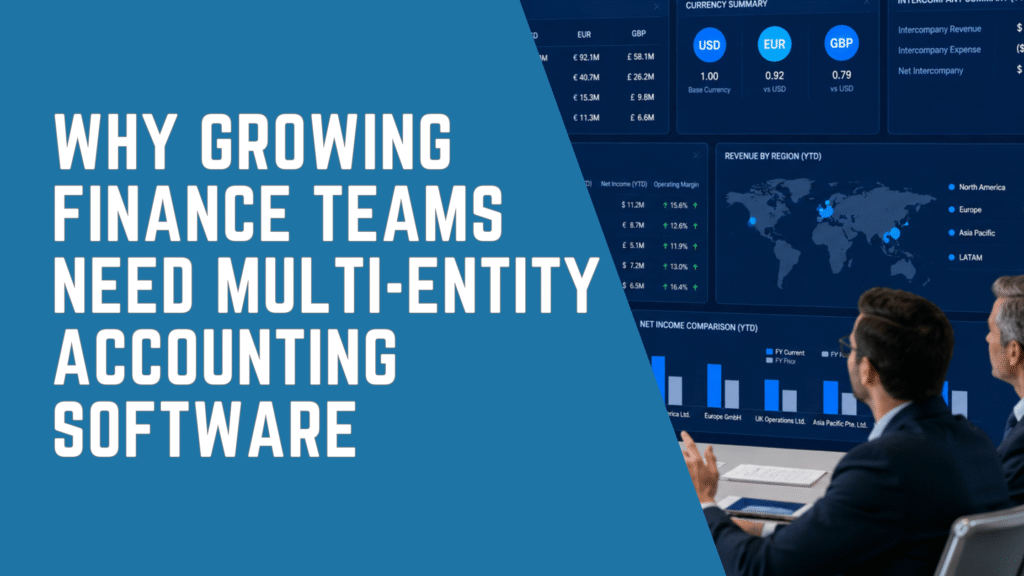
Business growth creates new opportunities, but it also introduces greater financial complexity. As organizations expand across multiple legal entities, subsidiaries, business units, locations, or international markets, finance teams need stronger systems to manage consolidated reporting, intercompany transactions, compliance requirements, and financial visibility. This is where multi-entity accounting software becomes increasingly important.
For many organizations, the warning signs appear gradually. The month-end close takes longer, consolidated reporting becomes heavily dependent on spreadsheets, and intercompany transactions become more difficult to reconcile. Leadership may also wait longer for accurate financial information, limiting the organization’s ability to make timely decisions.
The existing accounting system may not have failed. Instead, the organization may have outgrown a platform designed primarily for simpler, single-entity operations.
Multi-entity accounting software gives growing finance teams the infrastructure needed to consolidate financial data, automate intercompany accounting, strengthen internal controls, and improve visibility across the organization. Rather than spending valuable time combining spreadsheets, correcting errors, and reconciling disconnected records, finance professionals can focus on forecasting, performance analysis, strategic planning, and executive decision-making.
For CFOs, controllers, finance directors, and accounting leaders, choosing the right financial platform is more than an IT decision. It is a strategic investment that can directly affect reporting accuracy, operational efficiency, compliance, and the organization’s ability to scale.
This article explains why growing organizations may outgrow single-entity accounting systems, the warning signs that indicate it may be time to upgrade, the capabilities modern finance teams should prioritize, and how cloud-based financial management solutions can support sustainable growth.
What Is Multi-Entity Accounting Software?
Multi-entity accounting software is designed to manage accounting, reporting, and financial controls across multiple legal entities, subsidiaries, branches, locations, business units, or operating divisions within a single platform.
Unlike traditional single-entity accounting systems, these solutions allow each entity to maintain its own books while providing finance leaders with a consolidated view of the entire organization. This eliminates the need to manually combine reports from separate systems and significantly improves reporting accuracy.
- Depending on the organization, a multi-entity environment may include:
- Multiple subsidiaries under one parent company
- Regional or international offices
- Franchise locations
- Healthcare clinics or service locations
- Manufacturing plants
- Distribution branches
- Construction divisions
- Real estate holding companies
- Nonprofit funds and programs
- Professional service offices
- Shared service centers
Modern multi-entity accounting software typically includes capabilities such as:
- Automated financial consolidation
- Intercompany transaction management
- Multi-currency accounting
- Shared charts of accounts
- Dimensional reporting
- Role-based security
- Audit trails and workflow approvals
- Real-time dashboards and analytics
These capabilities help finance teams replace manual processes with standardized, automated workflows while giving executives a clearer understanding of business performance across every entity.
Why Single-Entity Accounting Systems Work—Until They Don't
For startups and small businesses operating under a single legal entity, traditional accounting software often provides everything needed to manage daily financial operations. It handles accounts payable, accounts receivable, bank reconciliations, payroll integration, and standard financial reporting efficiently and at a reasonable cost.
The challenge begins when the business grows.
Adding new subsidiaries, locations, operating divisions, or international entities introduces a level of financial complexity that single-entity systems were never built to handle. What was once a straightforward accounting process gradually becomes a patchwork of spreadsheets, manual journal entries, disconnected reports, and time-consuming reconciliations.
At first, these workarounds may seem manageable. Finance teams export reports into Excel, consolidate financial statements manually, and track intercompany balances using spreadsheets. But as more entities are added, those temporary fixes evolve into permanent processes that consume valuable time and increase operational risk.
Eventually, finance leaders begin asking questions their accounting system struggles to answer.
- Which entity is driving profitability?
- Which locations are underperforming?
- How much cash does each subsidiary hold?
- Can we view consolidated financial results before month-end?
- How should shared expenses be allocated?
- Are intercompany balances fully reconciled?
- Can we expand through acquisitions without rebuilding our finance processes?
If answering these questions requires hours of spreadsheet work, manual reconciliations, or data exports, the accounting system has become a limitation rather than a business asset.
The Growth Stages That Reveal System Limitations
Organizations rarely outgrow their accounting software overnight. Instead, limitations emerge gradually as finance operations become more sophisticated.
The table below illustrates how increasing organizational complexity places greater demands on the finance function.
| Growth Stage | Finance Challenge | Common Limitation |
|---|---|---|
| Single company | Basic bookkeeping and reporting | Traditional accounting software works well |
| Multiple locations | Compare financial performance across sites | Manual reporting and spreadsheet consolidation |
| Multiple legal entities | Separate books, taxes, and bank accounts | Difficult entity management |
| Shared services | Centralized AP, AR, payroll, and allocations | Manual intercompany accounting |
| Acquisitions | Consolidating new subsidiaries | Slow and inconsistent financial reporting |
| International expansion | Multi-currency accounting and regulatory compliance | Manual currency conversions and reconciliations |
| Executive reporting | Real-time KPIs and consolidated dashboards | Limited visibility and delayed reporting |
The issue isn’t simply that the company has become larger.
It has become more complex.
Finance is no longer responsible only for recording transactions, it must provide timely, accurate insights that help leadership make confident business decisions. Without the right financial management platform, that responsibility becomes increasingly difficult to fulfill.
Why Multi-Entity Accounting Matters
As organizations grow, finance becomes responsible for much more than recording transactions. Executives expect timely insights, accurate forecasts, stronger financial controls, and reporting that supports strategic decision-making.
A single-entity accounting system can manage day-to-day bookkeeping, but it often struggles when finance teams must oversee multiple companies, currencies, locations, or business units. The result is an increasing reliance on manual work, spreadsheet consolidations, duplicate data entry, and time, consuming reconciliations, that slows reporting and introduces unnecessary risk.
Modern multi-entity accounting software helps eliminate these challenges by centralizing financial data, automating routine accounting processes, and providing a consolidated view of the entire organization. Instead of spending valuable time gathering information from disconnected systems, finance leaders gain immediate access to reliable financial insights that support faster and more confident decisions.
For growing organizations, adopting a multi-entity platform isn’t simply about replacing accounting software, it’s about building a finance function that can scale alongside the business.
Seven Signs Your Finance Team Has Outgrown a Single-Entity Accounting System
Organizations rarely decide to replace their accounting software because it stops working. More often, the system continues to function, but finance teams are forced to create manual workarounds to keep pace with business growth.
If several of the following challenges sound familiar, it may be time to evaluate a more scalable financial management platform.
1. Financial Consolidation Depends on Spreadsheets
One of the clearest indicators is spreadsheet-based consolidation.
Finance teams export trial balances from multiple entities, manually map accounts, perform eliminations in Excel, and build consolidated financial statements outside the accounting system.
While this process may work for two or three entities, it becomes increasingly difficult as the organization expands. Multiple versions of the same spreadsheet, broken formulas, and inconsistent reporting can lead to costly errors and make audits more challenging.
Instead of spending days assembling financial reports, finance teams should be spending their time interpreting results and supporting strategic planning.
2. Month-End Close Keeps Taking Longer
Closing the books should become more efficient as finance processes mature, not slower.
As organizations add subsidiaries, business units, or international operations, finance teams often find themselves managing separate reconciliations, manual journal entries, and disconnected reporting processes for every entity.
Even small discrepancies in intercompany balances can delay the entire close process while finance teams investigate missing or mismatched transactions.
Modern multi-entity accounting software streamlines these activities through automated consolidation, standardized workflows, and real-time visibility into each entity’s financial status, helping reduce close cycles while improving reporting accuracy.
3. Intercompany Accounting Is Mostly Manual
Intercompany accounting becomes increasingly complex as related entities buy, sell, lend, allocate expenses, or share services with one another. Without automation, finance teams must manually create reciprocal journal entries, reconcile due-to and due-from balances, and eliminate intercompany transactions during consolidation.
As transaction volumes increase, so does the risk of:
- Unmatched intercompany balances
- Duplicate or missing journal entries
- Inconsistent allocations
- Incomplete audit documentation
- Delayed financial reporting
Automating these processes not only improves accuracy but also reduces the amount of manual effort required each month.
4. Reporting Takes Too Much Effort
Business leaders rarely want to see financial results for the organization as a whole.
They want answers to questions like:
- Which subsidiary is the most profitable?
- Which region has the highest operating costs?
- How is each department performing?
- Which locations are exceeding budget?
- Which business unit generates the strongest cash flow?
Traditional accounting systems often struggle to provide this level of insight without exporting data into spreadsheets or creating increasingly complex charts of accounts.
Modern financial management platforms solve this problem through dimensional reporting, allowing finance teams to analyze performance by entity, department, location, project, customer, or program without adding unnecessary complexity to the general ledger.
5. Executives Wait Too Long for Financial Answers
Today’s finance leaders are expected to deliver more than historical reports.
They need to provide timely insights that help executives make decisions about hiring, acquisitions, pricing, capital investments, expansion, and cash management.
When answering even simple questions requires exporting reports, manipulating spreadsheets, and reconciling multiple data sources, the accounting system is slowing the business down.
Reliable financial information should be available when leadership needs it—not days after the reporting period has ended.
6. Security and User Permissions No Longer Meet Business Needs
Growth usually means more people need access to financial information.
Controllers, entity managers, department heads, executives, auditors, and operational leaders all require different levels of visibility.
Unfortunately, many single-entity accounting systems provide only basic permission controls, making it difficult to restrict access by company, department, or responsibility.
A scalable financial platform supports role-based security, allowing organizations to protect sensitive financial data while ensuring each user has access to the information needed to perform their role.
7. Preparing for Audits Is Becoming More Difficult
As organizations expand, maintaining a complete audit trail becomes increasingly important.
When reconciliations, approvals, supporting documents, and financial reports are scattered across spreadsheets and disconnected systems, preparing for an audit can become a lengthy and stressful process.
Finance teams often spend valuable time rebuilding documentation instead of simply retrieving it.
Modern multi-entity accounting software simplifies audit preparation by maintaining detailed transaction histories, approval workflows, supporting documentation, and consolidated financial records in a single system.
The result is stronger compliance, improved accountability, and significantly less effort during external audits.
The Hidden Cost of Waiting Too Long
Many organizations postpone upgrading their accounting software because the current system still “gets the job done.”
What often goes unnoticed is the growing amount of manual work required to keep that system functioning.
Every exported spreadsheet, manual journal entry, duplicated report, and reconciled workbook represents time that finance professionals could spend on more strategic activities.
Over time, those hidden costs become substantial.
Increased Operational Costs
Highly skilled finance professionals spend hours each month performing repetitive administrative tasks instead of analyzing business performance, forecasting future results, or advising leadership.
Greater Risk of Errors
Manual processes increase the likelihood of incorrect formulas, duplicate entries, missed eliminations, and reporting inconsistencies that can affect financial decisions.
Slower Business Decisions
Executives depend on timely financial information to respond to market opportunities, manage cash flow, evaluate acquisitions, and plan future investments.
Delayed reporting often means delayed decisions.
Reduced Confidence in Financial Data
When multiple versions of reports exist across spreadsheets, confidence in the numbers begins to decline.
Leadership should never have to question whether the latest report is accurate.
Limited Ability to Scale
Every new subsidiary, acquisition, or international location adds another layer of complexity.
Without a scalable finance platform, business growth creates increasing operational strain rather than new opportunities.
Core Capabilities Growing Finance Teams Should Prioritize
Selecting the right accounting platform isn’t about finding software with the longest feature list.
It’s about choosing a solution that supports the organization’s current operations while remaining flexible enough to accommodate future growth.
Here are the capabilities finance leaders should prioritize.
Multi-Entity Management
The system should support multiple legal entities, subsidiaries, locations, or business units while allowing each to maintain separate financial records when required.
Automated Financial Consolidation
Consolidated reporting should happen inside the system, not through spreadsheets. Automation reduces manual effort, improves consistency, and shortens month-end close.
Intercompany Accounting Automation
The platform should automatically create reciprocal entries, reconcile intercompany balances, and simplify eliminations during consolidation.
Dimensional Reporting
Finance teams should be able to analyze financial performance by entity, department, project, customer, location, fund, or program without creating an overly complex chart of accounts.
Role-Based Security
Granular permissions help organizations protect sensitive financial information while giving users access only to the data relevant to their responsibilities.
Real-Time Dashboards and Analytics
Executives should have immediate access to KPIs, financial dashboards, cash positions, and consolidated performance without waiting for manual reports.
Multi-Currency Support
Organizations operating internationally need automated currency translation, foreign exchange adjustments, and consolidated reporting across currencies.
Integration with Business Systems
Accounting should connect seamlessly with payroll, CRM, inventory, procurement, expense management, banking, and business intelligence platforms to eliminate duplicate data entry and improve reporting accuracy.
Workflow Automation
Automated approvals, recurring journal entries, allocations, purchasing workflows, and close checklists improve consistency while reducing manual work.
Complete Audit Trails
Every transaction, approval, adjustment, and report should be traceable. Strong audit trails simplify compliance, strengthen governance, and provide confidence in financial reporting.
By prioritizing these capabilities, finance leaders can move beyond maintaining accounting records and build a finance function that delivers faster reporting, stronger controls, and better strategic insight as the organization continues to grow.
Choosing the Right Multi-Entity Accounting Solution
Once finance leaders recognize that their current accounting system can no longer support the business, the next question is often:
Which solution is the right fit?
The answer depends on more than company size. Industry, operational complexity, reporting requirements, inventory management, manufacturing processes, and future growth plans all influence which platform will deliver the greatest long-term value.
Some organizations primarily need stronger financial management and consolidation. Others require a complete ERP solution that connects finance with inventory, manufacturing, distribution, or project management.
Understanding these differences helps organizations invest in a platform that supports both today’s needs and tomorrow’s growth.
When Sage Intacct Is the Right Choice
For organizations whose biggest challenge is financial complexity rather than operational complexity, Sage Intacct is often one of the strongest cloud financial management solutions available.
It is particularly well suited for finance led organizations that need to manage multiple entities while improving reporting, visibility, and financial controls.
Many organizations choose Sage Intacct because it offers:
- Automated multi-entity consolidation
- Dimensional financial reporting
- Real-time dashboards
- Revenue recognition
- Budgeting and planning support
- Automated financial workflows
- Strong internal controls
- Multi-currency accounting
- Cloud accessibility
Because reporting dimensions replace many traditional chart-of-account workarounds, finance teams gain far greater flexibility without making the general ledger unnecessarily complex.
Sage Intacct is commonly selected by:
- Nonprofit organizations
- Healthcare providers
- Professional services firms
- SaaS companies
- Multi-location businesses
- Growing mid-market organizations
For CFOs focused on improving reporting accuracy, shortening month-end close, and strengthening financial governance, Sage Intacct provides a scalable platform designed around modern finance operations.
Comparing Your Options
Rather than asking which platform is “best,” finance leaders should ask which solution best supports their business model.
| Business Need | Recommended Solution |
|---|---|
| Multi-entity financial management | Sage Intacct |
| Financial consolidation and reporting | Sage Intacct |
| Nonprofit fund accounting | Sage Intacct |
| Healthcare financial management | Sage Intacct |
| Manufacturing ERP | Sage X3 |
| Inventory-intensive operations | Sage X3 |
| Complex manufacturing and supply chain | Sage X3 |
The goal isn’t simply to replace accounting software.
It’s to build a financial platform that supports long-term business growth without creating additional administrative work.
Planning a Successful Implementation
Selecting the right software is only the first step.
A successful ERP or financial management implementation depends just as much on planning, process improvement, and change management as it does on technology.
Organizations that invest time preparing for implementation typically experience faster adoption and better long-term results.
Define Your Organizational Structure
Before configuring the system, finance leaders should clearly define:
- Legal entities
- Subsidiaries
- Departments
- Business units
- Projects
- Locations
- Reporting dimensions
This structure becomes the foundation for financial reporting, security permissions, consolidations, and dashboards.
Simplify the Chart of Accounts
Many organizations add new general ledger accounts over time simply to compensate for reporting limitations. Implementation provides an opportunity to simplify the chart of accounts while moving reporting detail into dimensions where appropriate.
The result is cleaner financial reporting that’s easier to maintain as the business grows.
| Business Need | Recommended Solution |
|---|---|
| Multi-entity financial management | Sage Intacct |
| Financial consolidation and reporting | Sage Intacct |
| Nonprofit fund accounting | Sage Intacct |
| Healthcare financial management | Sage Intacct |
| Manufacturing ERP | Sage X3 |
| Inventory-intensive operations | Sage X3 |
| Complex manufacturing and supply chain | Sage X3 |
Standardize Intercompany Processes
Intercompany accounting should follow consistent rules across the organization.
Finance teams should document processes for:
- Shared expenses
- Management fees
- Inventory transfers
- Loans between entities
- Cost allocations
- Internal billing
Clear policies allow automation to replace manual journal entries while improving reporting accuracy.
Prepare for Data Migration
Data migration involves much more than moving account balances.
Organizations should determine:
- Historical data requirements
- Open transactions
- Customer and vendor records
- Fixed assets
- Reporting dimensions
- Entity structures
- Budget information
Careful planning helps reduce implementation risks while ensuring financial continuity.
Redesign Reporting
One of the biggest implementation mistakes is recreating old spreadsheet reports inside new software.
Instead, finance teams should ask:
“What information does leadership actually need to make decisions?”
Design reports around business objectives rather than legacy accounting processes.
Typical reports include:
- Consolidated financial statements
- Entity-level profit and loss reports
- Cash flow dashboards
- Department performance
- Budget versus actual reporting
- KPI dashboards
- Executive board reports
Train Users by Role
Different users require different training.
Controllers, executives, AP clerks, finance managers, and department leaders each interact with the system differently.
Role-specific training accelerates adoption while reducing errors during the transition.
Build for Future Growth
The implementation should support where the organization expects to be in three to five years, not just where it is today.
Consider future:
- Acquisitions
- New legal entities
- International expansion
- Additional business units
- Currency requirements
- Regulatory changes
Designing for scalability today prevents expensive reconfiguration later.
How Different Industries Benefit from Multi-Entity Accounting
Although the underlying challenges are similar, every industry manages financial complexity differently.
Nonprofits
Organizations managing multiple programs, grants, or funds benefit from consolidated reporting while maintaining visibility into individual funding sources.
Healthcare
Healthcare groups often operate multiple clinics, practices, or service lines that require separate reporting while giving executives a consolidated financial view.
Professional Services
Consulting firms, engineering companies, and legal practices frequently need profitability reporting by office, project, client, and entity.
Manufacturing
Manufacturers require financial management that integrates with production planning, inventory, purchasing, and supply chain operations across multiple facilities.
Distribution
Distribution businesses benefit from centralized financial reporting while tracking profitability across warehouses, branches, and operating companies.
Construction
Construction firms often manage multiple legal entities, projects, equipment assets, and intercompany transactions simultaneously, making automation essential.
SaaS and Technology
Growing software companies commonly operate across multiple countries and currencies while managing subscription revenue, making consolidation and dimensional reporting increasingly valuable.
Real Estate
Property owners frequently manage separate legal entities for individual assets while requiring portfolio wide financial visibility for investors and stakeholders.
Why Organizations Partner with IWI Consulting Group
Technology alone doesn’t solve finance challenges. Successful digital transformation requires experienced advisors who understand accounting processes, ERP implementation, reporting requirements, and long-term business strategy.
IWI Consulting Group helps organizations modernize finance operations through consulting, implementation, migration, optimization, and ongoing ERP support. With more than two decades of experience delivering Sage solutions, IWI works closely with finance and operational leaders to design systems that improve visibility, automate manual processes, and support sustainable growth.
Services include:
- ERP assessments and roadmap planning
- [Sage Intacct](https://erp.iwigroup.ca/sage-intacct/overview/) implementation
- [Sage 300](https://iwigroup.ca/software/sage-300/) consulting
- [Sage X3](https://erp.iwigroup.ca/sage-x3/sage-x3-overview/) implementation
- Legacy system migration
- Financial reporting design
- Dashboard development
- Data migration
- System integrations
- Ongoing ERP optimization and support
Rather than simply implementing software, IWI helps organizations build finance systems that are scalable, efficient, and aligned with long-term business objectives.
Whether your organization is replacing spreadsheets, upgrading from legacy accounting software, or preparing for rapid growth, choosing the right implementation partner is just as important as selecting the right technology.
The Business Case for Multi-Entity Accounting Software
Investing in multi-entity accounting software isn’t simply about replacing an outdated accounting system; it’s about enabling the finance function to support business growth more effectively.
As organizations expand, manual processes become increasingly costly. Finance teams spend more time consolidating reports, reconciling intercompany transactions, and maintaining spreadsheets than providing the strategic insights executives need.
Modern financial management platforms help organizations shift their focus from administrative work to business performance.
Faster Financial Close
Automation reduces manual consolidations, standardizes accounting workflows, and shortens month-end close, allowing finance teams to deliver timely financial results.
Better Business Decisions
Real-time dashboards and consolidated reporting provide executives with accurate information when they need it, enabling faster and more confident decisions.
Stronger Financial Controls
Automated approvals, audit trails, and role-based permissions improve governance while reducing the risk of manual errors.
Greater Productivity
By eliminating repetitive tasks, finance professionals can spend more time on forecasting, budgeting, financial analysis, and strategic planning.
Scalable Growth
Whether expanding into new markets, acquiring another business, or adding operating entities, a scalable financial platform allows organizations to grow without rebuilding their accounting processes.
Ultimately, the greatest return on investment isn’t just operational efficiency, it’s giving leadership greater confidence in every financial decision.
Is It Time to Upgrade?
Every organization reaches a point where its accounting software begins limiting growth instead of supporting it.
Consider the following questions:
- Do you manage multiple legal entities or subsidiaries?
- Does financial consolidation rely on spreadsheets?
- Are intercompany transactions handled manually?
- Is month-end close taking longer than it should?
- Do executives wait too long for financial reports?
- Is your chart of accounts becoming increasingly difficult to manage?
- Are audits requiring significant manual preparation?
- Do you expect acquisitions or expansion within the next few years?
If you answered yes to several of these questions, your finance team has likely outgrown a traditional single-entity accounting system.
The next step isn’t simply purchasing new software—it’s evaluating which solution best supports your organization’s future.
Partner with IWI Consulting Group
Selecting and implementing ERP software is one of the most important technology decisions a growing organization can make. However, choosing the right platform is only part of the equation.
A successful ERP implementation also requires experienced advisors who understand financial management, operational workflows, reporting requirements, technology environments, and long-term business strategy.
At IWI Consulting Group, we help organizations across the United States and Canada evaluate, implement, optimize, and support ERP and financial management solutions. Our goal is to improve visibility, automate manual processes, streamline operations, and build a stronger foundation for sustainable growth.
Whether your organization is considering Sage Intacct, Sage X3, or Sage 300, our consultants work closely with finance and operational leaders to recommend the solution that best aligns with your business requirements and objectives, not simply the platform with the most features.
If your finance team spends more time managing spreadsheets, correcting data, and preparing reports than analyzing business performance, it may be time to consider a more connected and scalable approach.
Frequently Asked Questions
What is multi-entity accounting software?
Multi-entity accounting software enables organizations to manage accounting, reporting, and financial operations across multiple legal entities, subsidiaries, locations, or business units within a single platform. It supports consolidated reporting while allowing each entity to maintain separate financial records.
When should a company move to multi-entity accounting software?
Organizations should consider upgrading when they begin managing multiple entities, rely heavily on spreadsheets for financial consolidation, struggle with intercompany accounting, or need faster and more detailed financial reporting.
What is the difference between multi-entity accounting software and ERP?
Multi-entity accounting software primarily focuses on financial management capabilities such as general ledger accounting, consolidation, intercompany transactions, multi-currency management, reporting, budgeting, and financial controls.
An ERP system connects financial management with broader operational processes such as inventory, procurement, manufacturing, distribution, construction, project management, or supply chain operations. Organizations whose primary challenge is financial complexity may prefer a finance-focused platform such as Sage Intacct. Businesses that need finance and operations managed within the same system may be better suited to Acumatica or Sage X3.
How does multi-entity accounting software improve reporting?
Multi-entity accounting software centralizes financial information and automates consolidation, helping finance teams produce accurate reports without manually combining spreadsheets from separate entities. Dimensional reporting also allows organizations to analyze performance by entity, department, location, project, customer, fund, or business unit without creating an unnecessarily complex chart of accounts.
Does multi-entity accounting software automate intercompany accounting?
Many modern multi-entity accounting platforms can automate reciprocal journal entries, due-to and due-from transactions, intercompany reconciliations, allocations, and consolidation eliminations. The level of automation depends on the selected platform, system configuration, business processes, and implementation scope.
Can multi-entity accounting software support multiple currencies and countries?
Yes. Many multi-entity accounting platforms support transactions in multiple currencies, automated currency conversion, foreign exchange adjustments, and consolidated reporting in a selected reporting currency. Organizations operating internationally should also evaluate local tax, regulatory, banking, localization, and reporting requirements, as these capabilities vary between platforms and countries.
Is Sage Intacct suitable for multi-entity organizations?
Yes. Sage Intacct is particularly well suited to finance-led organizations that need to manage multiple entities, automate consolidations, report across dimensions, strengthen financial controls, and provide executives with real-time visibility. It is often a strong fit when financial complexity is the primary challenge and extensive manufacturing, inventory, or construction functionality is not required.
How long does a multi-entity accounting software implementation take?
Implementation can take anywhere from several weeks to several months, depending on the number of entities, data migration requirements, integrations, reporting complexity, workflows, currencies, and training needs.
A finance-focused implementation is generally less complex than a full ERP deployment that includes manufacturing, inventory, distribution, construction, or supply chain operations. A detailed assessment is necessary to establish a realistic timeline and implementation plan.
How much does multi-entity accounting software cost?
The total investment typically includes software subscriptions, implementation services, data migration, integrations, reporting configuration, training, and ongoing support. Pricing is also influenced by the number of entities, users, modules, currencies, and operational requirements.
A tailored assessment is the most reliable way to estimate the initial investment, ongoing costs, and long-term total cost of ownership.
How can IWI Consulting Group help?
IWI Consulting Group helps organizations assess their current finance environment, define multi-entity requirements, select the right platform, and plan a practical implementation roadmap. Our team supports software selection, data migration, consolidation design, intercompany workflows, reporting, integrations, training, and ongoing optimization across Sage Intacct, Sage X3, Sage 300, and Acumatica.
Conclusion
Growth should create new opportunities—not more spreadsheets, longer close cycles, and increasingly complex manual processes.
The need for multi-entity accounting software is not determined by company size alone. It emerges when financial complexity begins to exceed the capabilities of the current system. Multiple legal entities, manual consolidations, intercompany transactions, expanding reporting requirements, and international operations are all signs that finance needs a more scalable foundation.
The right platform can help organizations shorten the close, improve reporting accuracy, strengthen financial controls, and give leadership a clearer view of performance across the business.
For CFOs and finance leaders, this is not simply an accounting software replacement. It is an opportunity to redesign financial processes, eliminate unnecessary manual work, and prepare the organization for its next stage of growth.
If your team is still relying on spreadsheets to consolidate entities or reconcile intercompany transactions, an ERP and finance systems assessment can help identify the right platform, implementation scope, and roadmap for moving forward.