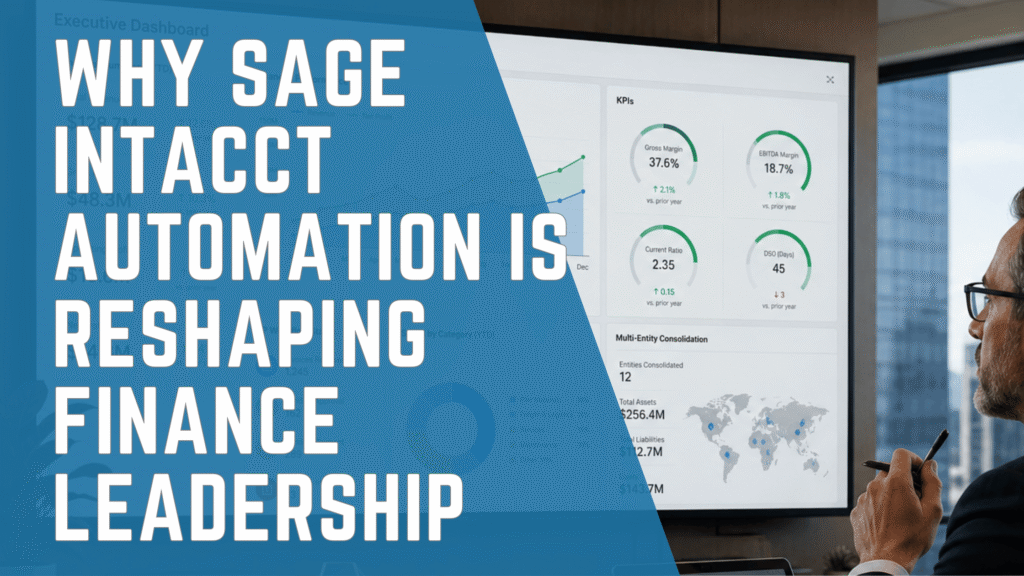
Sage Intacct automation is fundamentally changing how CFOs, Controllers, and Finance Directors manage financial operations, reporting, and decision-making. Finance teams are under increasing pressure to close books faster, improve reporting accuracy, and deliver real-time insights across complex organizational structures.
However, many organizations still rely on manual processes, disconnected spreadsheets, and legacy accounting systems. As a result, financial close cycles are delayed, reporting is inconsistent, and strategic decision-making becomes reactive rather than proactive.
Therefore, automation within Sage Intacct has become a critical enabler of modern finance transformation. It allows organizations to streamline accounts payable, automate financial close processes, and improve reporting accuracy across multiple entities.
In addition, CFOs are now expected to act as strategic partners to the business. Consequently, finance systems must evolve from transactional tools into intelligent automation platforms that support growth, scalability, and real-time decision-making.
This article explores how Sage Intacct automation transforms finance operations and explains how IWI Consulting Group helps organizations design and implement scalable financial automation strategies.
CFO Challenges Driving the Need for Financial Automation
Finance leaders face increasing complexity across reporting, compliance, and operational execution. However, many of these challenges stem from outdated systems and manual workflows.
1. Slow and Inefficient Financial Close Cycles
Many finance teams still rely on manual reconciliations and spreadsheet-driven close processes. Consequently, month-end close cycles extend beyond acceptable timeframes.
2. Fragmented Accounts Payable Processes
AP workflows often involve email approvals, manual invoice entry, and inconsistent tracking. Therefore, errors, duplicate payments, and delayed processing frequently occur.
3. Limited Real-Time Financial Visibility
Legacy systems often provide delayed financial data. As a result, CFOs make decisions based on outdated reports rather than live financial insights.
4. Multi-Entity Reporting Complexity
Organizations operating across multiple subsidiaries struggle with consolidation and intercompany eliminations. Moreover, manual processes increase risk and reduce accuracy.
5. Reporting Bottlenecks
Finance teams depend heavily on IT or external consultants for reporting. Therefore, generating insights becomes slow and inefficient.
6. Scaling Limitations of Legacy Systems
As organizations grow, traditional accounting systems cannot support increasing transaction volumes and complexity. Consequently, operational inefficiencies increase.
These challenges highlight the urgent need for financial automation ERP systems that streamline workflows and improve financial intelligence.
What Is Sage Intacct Automation?
Sage Intacct automation refers to the use of intelligent workflows, rules-based processing, and cloud ERP capabilities within financial systems to eliminate manual tasks and improve accuracy.
Within Sage Intacct, automation applies to:
- Accounts payable processing
- Financial close and consolidation
- Revenue recognition
- Expense management
- Reporting and analytics
- Approval workflows
- Multi-entity accounting
However, automation is not simply about efficiency. It is about transforming finance into a real-time strategic function that supports business growth.
Moreover, automation ensures consistency, reduces human error, and improves compliance across all financial processes.
Core Pillars of Sage Intacct Automation
1. Accounts Payable Automation
Accounts payable is one of the most impactful areas of automation.
With Sage Intacct automation, organizations can:
- Automatically capture and code invoices
- Route approvals based on rules and thresholds
- Match purchase orders with invoices
- Reduce manual data entry
- Improve payment tracking and visibility
As a result, finance teams gain stronger control over cash flow and vendor management.
However, the most significant benefit is the elimination of manual bottlenecks that slow down finance operations.
2. Financial Close Automation
Financial close is traditionally one of the most time-consuming finance processes.
With automation, Sage Intacct enables:
- Automated reconciliations
- Standardized close workflows
- Automated journal entries
- Consolidation across entities
- Audit-ready documentation
Consequently, organizations reduce close cycles significantly while improving accuracy.
In addition, CFOs gain confidence in financial reporting quality.
3. Financial Reporting Automation
Reporting automation enables real-time visibility into financial performance.
Capabilities include:
- Automated income statements and balance sheets
- Custom dashboards for KPIs
- Multi-dimensional reporting views
- Drill-down transaction analysis
- Real-time financial updates
Therefore, executives no longer wait for month-end reports to make decisions. Moreover, reporting becomes more consistent and reliable.
4. Workflow and Approval Automation
Workflow automation ensures financial governance is standardized.
Examples include:
- Expense approval routing
- Purchase requisition approvals
- Vendor onboarding workflows
- Budget approval processes
As a result, organizations reduce delays and strengthen internal controls. However, workflows also improve accountability through full audit tracking.
5. Multi-Entity Automation
Multi-entity organizations face complex consolidation challenges.
Sage Intacct automation enables:
- Intercompany transaction elimination
- Automated consolidation reporting
- Multi-currency management
- Standardized chart of accounts structures
Therefore, CFOs gain a unified financial view across all business units. In addition, reporting becomes significantly more efficient.
Strategic Benefits of Sage Intacct Automation for CFOs
1. Real-Time Financial Intelligence
CFOs gain immediate access to financial performance data. Consequently, decision-making becomes proactive rather than reactive.
2. Increased Finance Team Productivity
Automation eliminates repetitive manual tasks. Therefore, finance teams focus more on analysis and strategy.
3. Faster Financial Close Cycles
Organizations significantly reduce month-end close timelines while improving accuracy.
4. Stronger Compliance and Audit Readiness
Automated audit trails ensure transparency and regulatory compliance.
5. Scalable Financial Operations
As businesses grow, automation ensures finance systems scale without added complexity.
6. Improved Cash Flow Management
AP automation and real-time visibility enhance forecasting and liquidity management.
CFO Decision-Making with Sage Intacct Automation
CFOs require accurate, real-time data to support strategic planning. Therefore, automation plays a central role in modern financial leadership.
With Sage Intacct automation, CFOs can:
- Monitor financial KPIs in real time
- Improve forecasting accuracy
- Identify cost optimization opportunities
- Enhance board reporting quality
- Align financial data with business strategy
Moreover, automation ensures financial leaders always operate with up-to-date insights.
Industry Use Cases for Sage Intacct Automation
Professional Services – Improves project accounting, billing automation, and profitability tracking.
SaaS Companies – Automates subscription billing, revenue recognition, and ARR reporting.
Nonprofits – Enhances fund accounting, grant tracking, and compliance reporting.
Multi-Entity Enterprises – Streamlines consolidation, intercompany transactions, and global reporting.
Why Legacy Systems Fail Without Automation
Legacy accounting systems struggle to support modern financial complexity.
As a result:
- Manual processes dominate finance operations
- Reporting delays become frequent
- Data inconsistencies increase
- Scalability is limited
In contrast, Sage Intacct provides a modern cloud-native automation framework designed for scalability and efficiency.
Implementation Considerations for Sage Intacct Automation
Successful automation requires more than software deployment.
Key factors include:
- Process redesign and optimization
- Workflow configuration strategy
- Data migration planning
- Reporting structure alignment
- Change management execution
Moreover, organizations must ensure finance teams are fully trained to adopt automation effectively.
How IWI Consulting Group Enables Finance Transformation
Implementing ERP automation requires deep financial and technical expertise.
IWI Consulting Group is a Canadian ERP advisory firm with over 22 years of experience and more than 500 successful ERP implementations. The firm specializes in Sage Intacct implementation, optimization, and finance transformation consulting.
In addition, IWI supports organizations through:
- End-to-end ERP implementation
- Financial process redesign
- Automation strategy development
- Multi-entity ERP configuration
- Advanced reporting and dashboard design
However, IWI’s value extends beyond implementation. It serves as a long-term strategic partner helping CFOs continuously optimize finance operations.
Moreover, the firm ensures ERP systems align with business strategy and deliver measurable ROI.
ROI of Sage Intacct Automation
Organizations adopting financial automation typically achieve:
- 30–70% faster financial close cycles
- Reduced AP processing costs
- Improved reporting accuracy
- Lower audit preparation time
- Increased finance team productivity
Therefore, the financial return is both operational and strategic. In addition, CFOs gain stronger forecasting and planning capabilities.
The Future of Finance: Automation-Driven ERP
Finance is rapidly evolving toward automation and intelligence.
Future developments in Sage Intacct include:
• AI-enhanced financial reporting
• Predictive analytics and forecasting
• Smarter workflow automation
• Deeper system integrations
• Real-time financial intelligence layers
As a result, finance teams will increasingly shift from transactional processing to strategic advisory roles.
Conclusion: Sage Intacct Automation as a CFO Imperative
Sage Intacct automation is no longer optional for growing organizations. It is a foundational requirement for finance transformation, operational efficiency, and strategic decision-making. It enables CFOs to eliminate manual processes, improve visibility, and scale financial operations effectively.
However, successful implementation requires the right strategy, expertise, and advisory support. That is why organizations across Canada rely on IWI Consulting Group to guide their finance transformation journey.
If your organization is struggling with manual financial processes, slow reporting cycles, or limited visibility, now is the time to explore Sage Intacct automation. IWI Consulting Group helps CFOs and finance leaders design and implement scalable ERP automation strategies that deliver measurable business impact.
Contact IWI Consulting Group today to begin your Sage Intacct finance transformation journey.
FAQ: Sage Intacct Automation
What is Sage Intacct automation?
It is the use of built-in ERP workflows and tools to automate financial processes such as AP, reporting, and close management.
How does Sage Intacct improve financial reporting?
It provides real-time dashboards and automated financial statements with drill-down capabilities.
Can Sage Intacct automate accounts payable?
Yes, it automates invoice capture, approvals, and payment workflows.
How does automation improve financial close?
It reduces manual reconciliations and automates consolidation across entities.
Is Sage Intacct suitable for multi-entity businesses?
Yes, it is designed specifically for multi-entity financial management.
What industries benefit most from Sage Intacct automation?
Professional services, SaaS, nonprofits, and multi-entity organizations benefit significantly.
Does automation improve compliance?
Yes, it provides audit trails and standardized workflows for better compliance.
How does automation support CFO decision-making?
It delivers real-time financial data and KPI dashboards for strategic decisions.
What ROI can organizations expect?
Organizations typically see faster close cycles, reduced costs, and improved efficiency.
How does IWI Consulting Group support implementation?
They provide ERP advisory, implementation, and finance transformation services focused on Sage Intacct.