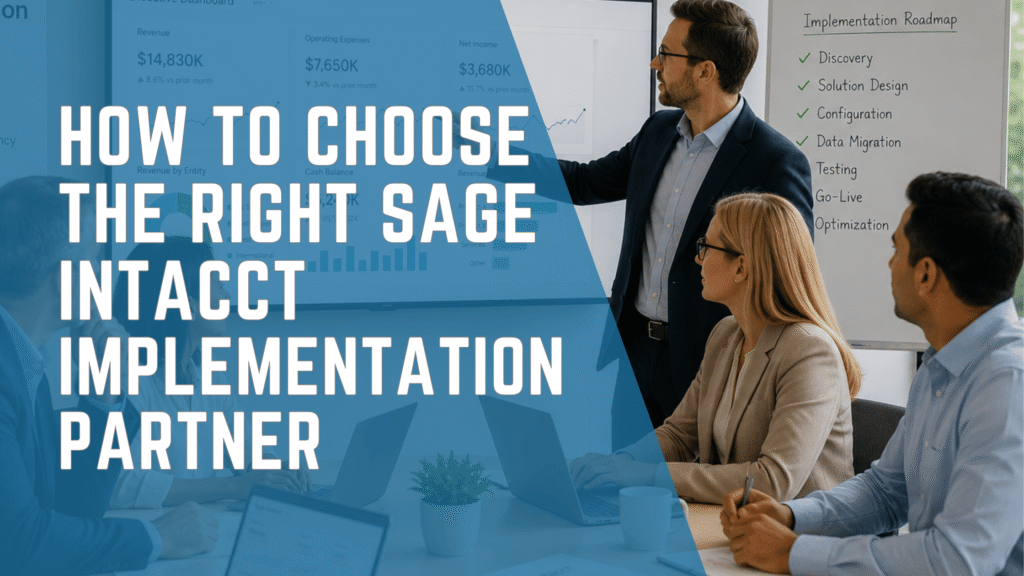
Choosing the right Sage Intacct implementation partner is one of the most important decisions an organization will make during a financial management transformation.
Sage Intacct provides powerful cloud accounting, multi-entity management, automation, reporting, and integration capabilities. However, the software alone does not guarantee a successful implementation. The experience, methodology, and consulting capabilities of the implementation partner will influence how the system is designed, how accurately data is migrated, how quickly employees adopt the platform, and how effectively the solution supports future growth.
For CFOs, Controllers, Finance Directors, CIOs, IT leaders, and ERP project managers, selecting a Sage Intacct implementation partner should receive the same level of attention as selecting the software itself.
This guide explains:
- What a Sage Intacct implementation partner does
- Why partner selection affects project success
- What to evaluate when comparing Sage Intacct partners
- Which questions to ask during the selection process
- Common implementation risks and warning signs
- What influences implementation costs and timelines
- Why post-go-live support matters
- How the right partner can maximize the value of Sage Intacct
What Is a Sage Intacct Implementation Partner?
A Sage Intacct implementation partner is a consulting organization that helps businesses plan, configure, deploy, integrate, and optimize Sage Intacct.
The role of the partner typically extends far beyond installing or configuring software. An experienced partner helps the organization translate business requirements into a scalable financial management environment.
Depending on the project, a Sage Intacct implementation partner may provide:
- Business process assessment
- Financial and operational discovery
- Solution architecture
- Sage Intacct configuration
- Chart of accounts and dimension design
- Multi-entity setup
- Workflow and approval automation
- Data cleansing and migration
- Third-party integrations
- Reporting and dashboard development
- Project governance
- User acceptance testing
- Administrator and end-user training
- Change management
- Go-live support
- Post-implementation optimization
The right partner should understand not only how Sage Intacct works, but also how finance, reporting, controls, approvals, integrations, and operational processes work across the organization.
Why Your Sage Intacct Implementation Partner Matters
Organizations often spend months comparing ERP features but much less time evaluating the company that will implement the selected system.
That can be a costly mistake.
Sage Intacct must be configured around the organization’s entities, financial structure, reporting dimensions, workflows, integrations, users, controls, and business objectives. Many of the decisions made during implementation will affect the organization for years after go-live.
An experienced Sage Intacct implementation partner can help an organization:
- Redesign inefficient financial processes
- Improve month-end close procedures
- Establish scalable entity and dimension structures
- Automate approvals and recurring activities
- Improve management reporting
- Connect finance with operational systems
- Migrate legacy data accurately
- Reduce implementation risk
- Prepare users for new responsibilities
- Support future expansion and system optimization
An inexperienced partner may focus only on replicating the current accounting environment inside Sage Intacct.
Simply recreating existing workflows can transfer outdated processes, unnecessary complexity, and reporting limitations into the new system. This may lead to poor adoption, inefficient processes, additional consulting costs, and avoidable rework after launch.
A qualified Sage Intacct implementation partner should therefore act as both a technical specialist and a strategic business advisor.
Define Your Requirements Before Selecting a Partner
Before comparing implementation partners, organizations should clearly identify the problems they expect Sage Intacct to solve.
Common signs that an organization may need a modern cloud financial management platform include:
- Financial reporting takes too long
- Month-end close depends on manual spreadsheets
- Multiple entities are difficult to consolidate
- Approvals are managed through email
- Finance teams repeatedly enter the same information
- Leadership lacks real-time financial visibility
- Existing accounting software cannot support growth
- Acquisitions have created disconnected systems
- Reporting structures do not reflect how the business operates
- Integrations between finance and operational platforms are limited
- Audit preparation requires significant manual effort
- Users rely on offline reports and workarounds
Organizations should document these challenges before meeting with potential partners.
A clear requirements document allows each Sage Intacct implementation partner to evaluate the same business needs. It also makes it easier to compare recommendations, project scopes, timelines, and pricing.
Without clearly defined requirements, proposals may be based on assumptions and may not include all the services required for a successful implementation.
What to Look for in a Sage Intacct Implementation Partner
Not every Sage Intacct implementation partner provides the same level of experience, consulting, or support.
Certifications are important, but organizations should also evaluate industry knowledge, implementation methodology, data migration capabilities, integration expertise, project governance, training, and post-go-live services.
The following criteria can help finance and IT leaders compare potential partners.
1 - Proven Sage Intacct Implementation Experience
Direct Sage Intacct experience should be one of the first areas evaluated.
A qualified Sage Intacct implementation partner should be able to demonstrate successful projects involving organizations with similar financial, operational, and reporting complexity.
Ask potential partners:
- How many Sage Intacct implementations has your team completed?
- How long have you been implementing cloud financial systems?
- How many projects involved multiple legal entities?
- What is the typical size and complexity of your projects?
- Which Sage Intacct certifications do your consultants hold?
- Have you migrated clients from our current accounting system?
- Do you have experience with our required modules?
- Can you provide references from comparable organizations?
- What challenges have you encountered during previous projects?
- How were those challenges resolved?
Organizations should also confirm who will actually be assigned to the implementation.
The experience of the salesperson or solution consultant involved during the evaluation process may not reflect the experience of the project manager and consultants who will perform the implementation.
Ask for information about:
- Assigned project manager
- Functional consultants
- Technical consultants
- Integration resources
- Data migration specialists
- Training resources
- Executive sponsor
- Availability of senior consultants
A strong Sage Intacct implementation partner should be transparent about the team, responsibilities, and experience level of the people assigned to the project.
2 - Industry and Business Process Knowledge
Different industries have different financial structures, reporting requirements, operational processes, and compliance considerations.
A Sage Intacct implementation partner with relevant industry experience can often identify risks and requirements more quickly than a partner using a generic approach.
Examples include:
| Industry | Common Requirements |
|---|---|
| Nonprofit | Fund accounting, grant tracking, restricted funds, program reporting, and donor visibility |
| Professional Services | Project accounting, time and expense management, utilization, and project profitability |
| Healthcare | Multi-location reporting, departmental visibility, financial controls, and compliance |
| Financial Services | Multi-entity accounting, allocations, reporting controls, and auditability |
| Hospitality | Location-level reporting, centralized accounting, and operational integrations |
| Software and Technology | Subscription billing, revenue recognition, multi-entity growth, and SaaS metrics |
| Construction | Project accounting, job costing, retainage, and subcontractor workflows |
| Distribution | Purchasing, inventory visibility, order management, and warehouse integrations |
| Manufacturing | Production costing, supply chain visibility, inventory planning, and operational integration |
Industry expertise allows implementation consultants to recommend relevant practices instead of applying the same configuration to every organization.
However, the partner should also be transparent about where Sage Intacct’s native capabilities end.
Some requirements may require:
- Additional Sage modules
- Sage Intacct Marketplace applications
- Integration platforms
- Third-party operational software
- Custom API development
- A different ERP solution
For example, advanced manufacturing, warehouse management, construction operations, inventory planning, and specialized industry workflows may require complementary applications.
A trustworthy Sage Intacct implementation partner should explain what Sage Intacct can support natively, what requires an integration, and what may be better addressed outside the platform.
3 - A Comprehensive Discovery Process
Discovery is the foundation of a successful Sage Intacct implementation.
A partner should not recommend a final architecture, timeline, or implementation cost after only a short introductory conversation.
A proper discovery process should involve representatives from finance, IT, operations, and other departments affected by the project.
Discovery should examine:
- Business objectives
- Current accounting processes
- Chart of accounts
- Entity and ownership structures
- Reporting requirements
- Financial dimensions
- Approval workflows
- Internal controls
- Budgeting processes
- Revenue recognition requirements
- Data sources
- Existing integrations
- Compliance requirements
- User roles and permissions
- Current system limitations
- Growth plans
- Acquisition strategy
- Future reporting needs
The objective should not be to document only how the organization operates today.
A strategic Sage Intacct implementation partner should help determine which processes should be:
- Retained
- Simplified
- Standardized
- Automated
- Integrated
- Redesigned
- Eliminated
A rushed discovery process often leads to missed requirements, inaccurate estimates, change orders, project delays, and reporting limitations after go-live.
4 - A Structured Implementation Methodology
Discovery and Assessment
The partner documents business requirements, current processes, financial structures, reporting needs, integrations, risks, and project priorities.
Solution Design
The organization and implementation partner agree on how Sage Intacct will be structured.
This may include:
- Legal entities
- Chart of accounts
- Dimensions
- Reporting hierarchies
- Approval workflows
- User roles
- Permissions
- Internal controls
- Integrations
- Data migration scope
- Reporting requirements
The design should be documented and approved before extensive configuration begins.
System Configuration
Sage Intacct is configured according to the approved solution design.
Configuration may include:
- General ledger
- Accounts payable
- Accounts receivable
- Cash management
- Purchasing
- Order management
- Multi-entity consolidation
- Allocations
- Dimensions
- Dashboards
- Reporting
- Approval workflows
- User permissions
- Data Migration
Legacy data is extracted, cleansed, mapped, imported, tested, reconciled, and approved.
Integration Development
Connections between Sage Intacct and CRM, payroll, banking, expense, operational, or industry-specific systems are configured and tested.
User Acceptance Testing
End users test realistic business scenarios to verify that Sage Intacct supports required processes and reporting.
Training
Administrators and users receive training based on their roles and responsibilities.
Go-Live and Hypercare
The implementation partner supports final migration, validation, issue resolution, and the transition to the new environment.
Post-Go-Live Optimization
After users begin working in the system, the partner helps improve reports, dashboards, workflows, integrations, and processes.
A structured methodology improves accountability and reduces the likelihood that important implementation activities will be overlooked.
5 - Data Migration Expertise
Data migration is one of the most complex and high-risk parts of a Sage Intacct implementation.
Legacy systems often contain:
- Duplicate vendors
- Duplicate customers
- Inactive records
- Inconsistent naming conventions
- Outdated charts of accounts
- Incorrect classifications
- Incomplete information
- Unreconciled balances
- Historical records that are no longer required
Migrating every record without reviewing its quality can recreate old problems inside the new system.
An experienced Sage Intacct implementation partner should help determine:
- Which data should be migrated
- How much historical detail is necessary
- Which records should be archived
- How data will be cleaned
- How accounts and dimensions will be mapped
- How balances will be reconciled
- Who will validate the migrated information
- What data will remain available outside Sage Intacct
Typical migration activities may include:
- Chart of accounts mapping
- Vendor master data
- Customer master data
- Open accounts payable balances
- Open accounts receivable balances
- General ledger balances
- Fixed asset records
- Employee information
- Project data
- Multi-entity financial information
- Selected historical transactions
Multiple test migrations should normally be completed before the final production migration.
Each migration cycle should:
- Identify errors
- Validate mapping decisions
- Reconcile balances
- Test reports
- Confirm data completeness
- Obtain business-user approval
Organizations should ask exactly how many migration cycles are included in the partner’s proposal.
6 - Sage Intacct Integration Capabilities
Few organizations use a financial management system in isolation.
Sage Intacct may need to connect with:
- Customer relationship management platforms
- Payroll systems
- Human resources applications
- Expense management software
- Accounts payable automation platforms
- Banking and payment solutions
- E-commerce systems
- Project management applications
- Business intelligence tools
- Inventory systems
- Warehouse management software
- Industry-specific operational platforms
A Sage Intacct implementation partner should evaluate these applications during discovery and recommend an appropriate integration architecture.
Depending on the requirement, the recommended approach may involve:
- Native Sage Intacct functionality
- A prebuilt Marketplace integration
- An integration platform
- API development
- Batch data exchange
- Process redesign
The partner should also explain:
- What information will move between systems
- Which system will be the source of record
- How frequently information will synchronize
- How errors will be monitored
- Who will maintain the integration
- What additional licensing may be required
- How future system changes will be managed
Integration should not be treated as an afterthought. It should be included in the solution design and implementation scope from the beginning.
7 - Clear Implementation Scope
A detailed implementation scope protects both the organization and the partner.
Before signing an agreement, organizations should understand:
- What is included
- What is excluded
- Which modules will be implemented
- How many entities are included
- How many users are included
- Which integrations are included
- How many reports are included
- How many dashboards are included
- How many migration cycles are included
- How much historical data will be migrated
- What training will be provided
- What project management services are included
- What go-live support is included
- What post-go-live support is included
The scope should also define responsibilities.
For example:
- Who cleans the legacy data?
- Who prepares data extracts?
- Who approves configuration?
- Who performs user testing?
- Who coordinates internal users?
- Who makes final design decisions?
- Who approves scope changes?
The statement of work should identify assumptions, dependencies, milestones, deliverables, and acceptance criteria.
A proposal that provides a total price without explaining the included services may create uncertainty and unexpected costs later.
8 - Project Governance and Communication
Successful ERP projects require clear communication and timely decision-making.
A Sage Intacct implementation partner should establish a governance structure that identifies:
- Executive sponsors
- Project managers
- Functional leads
- Technical resources
- Decision-makers
- Issue owners
- Escalation procedures
- Status-reporting processes
- Risk-management procedures
- Approval responsibilities
- Change-control procedures
The partner should also explain how the project will be managed.
Important questions include:
- How often will project meetings occur?
- How will milestones be tracked?
- How will risks be documented?
- How will unresolved decisions be escalated?
- How will project status be communicated?
- How will scope changes be approved?
- What tools will be used to manage tasks and documentation?
Without defined governance, projects may lose momentum because stakeholders provide conflicting requirements or important decisions remain unresolved.
9 - Training and Change Management
A Sage Intacct implementation affects people, responsibilities, and established processes.
Employees may be concerned about:
- Learning a new system
- Changes to daily responsibilities
- New approval workflows
- Different reporting structures
- Increased automation
- Data accuracy
- Changes to financial controls
A technically successful implementation may still fail to deliver the expected value if users are not prepared to adopt the new environment.
A strategic Sage Intacct implementation partner should support adoption through:
- Executive alignment
- Stakeholder communication
- Role-based training
- Administrator training
- User documentation
- Process guides
- User acceptance testing
- Practice in a test environment
- Go-live assistance
- Post-launch coaching
Training should not be limited to showing users where to click.
Users should understand:
- Why processes are changing
- How their responsibilities will change
- How to complete daily tasks
- How to respond to errors
- How reporting will improve
- Where to obtain support
The training approach should be included in the project scope rather than added shortly before go-live.
10 - Post-Go-Live Support
Go-live is the beginning of the Sage Intacct lifecycle, not the end.
After users begin working in the system, organizations may identify opportunities to improve:
- Reports
- Dashboards
- Approval workflows
- Permissions
- Integrations
- Allocations
- Automation
- Entity structures
- Budgeting processes
- Management reporting
- User training
Organizations may also add new entities, locations, departments, currencies, applications, and users.
Before selecting a Sage Intacct implementation partner, ask:
- What support is included after go-live?
- How long does hypercare last?
- How are support requests submitted?
- Are response expectations defined?
- Is additional training available?
- Can the partner support future optimization?
- Will the original consultants remain involved?
- Does the partner offer system health assessments?
- Can the partner support new entities and integrations?
A long-term partner can help the organization continue to improve its Sage Intacct environment as business requirements evolve.
Sage Intacct Implementation Partner Evaluation Scorecard
Organizations can use the following scorecard to compare potential implementation partners.
| Evaluation Area | What to Verify | Potential Warning Sign |
|---|---|---|
| Sage Intacct Experience | Relevant implementations, certifications, and customer references | General ERP experience without Sage Intacct depth |
| Industry Knowledge | Understanding of reporting, compliance, and operational needs | Generic configuration for every industry |
| Discovery Process | Structured workshops involving finance, IT, operations, and key stakeholders | A final proposal provided after one brief introductory call |
| Solution Design | Documented entities, dimensions, workflows, reporting structures, and controls | Configuration begins without an approved solution design |
| Data Migration | Data cleansing, mapping, test migrations, validation, and reconciliation | Migration is treated as a simple data import |
| Integration Expertise | Experience with required applications, APIs, middleware, and integration architecture | Integrations are discussed only after configuration has started |
| Project Governance | Defined roles, milestones, communication processes, risk management, and escalation procedures | Unclear ownership and irregular project reporting |
| Training | Role-based user training, administrator training, documentation, and test-environment practice | Only one generic training session is included |
| Scope Clarity | Detailed inclusions, exclusions, assumptions, responsibilities, and acceptance criteria | A low project price without clearly defined deliverables |
| Post-Go-Live Support | Defined hypercare, technical support, training, and optimization services | The relationship ends immediately after go-live |
| Customer References | References from organizations with similar industries, systems, and project complexity | References are unrelated to the organization’s requirements |
| Consulting Approach | Business process improvement, strategic planning, and long-term optimization | The partner focuses only on software configuration |
Organizations may also assign a score to each category and weight the categories according to project priorities.
For example, a complex multi-entity organization may give greater weight to data migration, consolidation, integration, and reporting experience.
Questions to Ask a Sage Intacct Implementation Partner
A structured interview can help distinguish a strategic consulting partner from a software reseller.
Experience and Resources
- How many Sage Intacct implementations has your team completed?
- Which industries do you specialize in?
- Can you provide relevant customer references?
- Who will be assigned to our implementation?
- How many projects will those consultants manage simultaneously?
Discovery and Design
- What does your discovery process include?
- Which stakeholders should participate?
- How do you document requirements?
- How do you identify process-improvement opportunities?
- How do you determine whether a requirement should be configured, integrated, redesigned, or excluded?
- What solution-design documents will we receive?
Data Migration
- What data do you recommend migrating?
- How much historical information should be retained?
- How many test migration cycles are included?
- Who is responsible for data cleansing?
- How will data accuracy be approved?
- What happens if migration issues are discovered near go-live?
Integrations
- Which integrations are included?
- Have you integrated Sage Intacct with our existing systems?
- Will you use native integrations, middleware, APIs, or custom development?
- Who will monitor integration failures?
Project Management
- Who will manage the project?
- How often will status meetings occur?
- How are milestones tracked?
- What is the escalation process?
- How are delays and dependencies managed?
Training and Adoption
- How will administrators be trained?
- Is training role-based?
- Is post-go-live training available?
- How do you support organizational change?
Scope and Cost
- What assumptions were used to prepare the estimate?
- What is excluded from the proposal?
- What normally results in a change order?
- Is the project fixed-fee, time-and-materials, or hybrid?
- Are project management, training, migration, and go-live support included?
- How are additional requests approved?
Post-Go-Live Support
- What happens immediately after go-live?
- How are support requests managed?
- What response expectations are available?
- Can you support reporting and workflow improvements?
- Do you offer ongoing optimization services (future entities and integrations)?
Red Flags When Selecting a Sage Intacct Implementation Partner
Organizations should watch for warning signs during the evaluation process.
A Generic Implementation Plan
Every organization has different entities, processes, reporting requirements, integrations, and controls.
A partner that proposes the same approach for every client may not provide the flexibility required for long-term success.
Limited Discovery
A final proposal developed after a short introductory conversation may be based on assumptions rather than documented requirements.
This can result in incomplete scope, inaccurate pricing, change orders, and project delays.
An Unrealistically Short Timeline
A fast implementation may be possible for a simple project, but the timeline should still allow for discovery, configuration, migration, testing, training, and approvals.
The partner should explain the assumptions that make the proposed timeline achievable.
A Low Price Without Detailed Scope
A low estimate may exclude important services such as:
- Data cleansing
- Historical data migration
- Custom reports
- Integrations
- Project management
- User training
- Administrator training
- Go-live support
- Post-launch optimization
Organizations should compare included deliverables rather than evaluating only the total price.
Minimal User Involvement
Users should participate throughout discovery, design validation, testing, and training.
The finance team should not see the configured system for the first time shortly before go-live.
No Change-Control Process
New requirements often emerge during implementation.
Without a documented process for reviewing scope changes, organizations may face unexpected costs and timeline delays.
No Defined Post-Go-Live Support
A Sage Intacct implementation partner should explain what happens after launch.
The organization should not be left without assistance for reporting, workflow, adoption, integration, or configuration issues.
Avoiding Difficult Questions
A reliable partner should be willing to discuss:
- Implementation risks
- Previous project challenges
- Scope exclusions
- Client responsibilities
- Potential additional costs
- Product limitations
- Situations where Sage Intacct may not be the right fit
Transparency during the evaluation process is a strong indicator of how the partner will communicate during implementation.
How Long Does a Sage Intacct Implementation Take?
Sage Intacct implementation timelines vary according to business complexity and project scope.
Factors that influence the timeline include:
- Number of entities
- Number of users
- Data quality
- Historical data requirements
- Number of integrations
- Approval-workflow complexity
- Reporting requirements
- Availability of internal stakeholders
- Customization needs
- Training requirements
- Testing cycles
- Speed of decision-making
A relatively straightforward project may be completed within a few months. A more complex multi-entity implementation may require additional time for design, data preparation, integrations, testing, and training.
Organizations should be cautious when a Sage Intacct implementation partner provides a firm timeline before completing an adequate discovery process.
How Much Does a Sage Intacct Implementation Cost?
The cost of a Sage Intacct implementation depends on the size and complexity of the project.
Common cost factors include:
| Cost Factor | Potential Impact |
|---|---|
| Number of Entities | Additional configuration, consolidation design, intercompany setup, and testing |
| Number of Users | More security configuration, user management, testing, and training |
| Data Migration | Additional effort for cleansing, mapping, importing, validating, and reconciling data |
| Integrations | Additional solution design, development, licensing, testing, and ongoing maintenance |
| Reporting | Consulting effort for custom reports, dashboards, financial statements, and management reporting |
| Workflow Automation | Additional configuration and testing for approvals, notifications, and automated processes |
| Industry Requirements | Possible need for specialized modules, marketplace applications, or third-party solutions |
| Change Management | Additional stakeholder communication, documentation, training, and adoption support |
| Project Timeline | Accelerated implementation timelines may require additional consultants and project resources |
Implementation proposals may use different commercial models:
- Fixed-fee
- Time and materials
- Phased implementation
- Hybrid pricing
When comparing proposals, verify whether each Sage Intacct implementation partner has included the same deliverables.
A lower estimate may exclude data cleansing, reports, integration work, training, project management, or post-go-live support.
The objective should not be to select the lowest initial cost. It should be to understand the total investment required to achieve the desired business outcomes.
Why Long-Term Partnership Matters
A Sage Intacct implementation is the beginning of an ongoing business relationship.
As organizations evolve, they may require:
- New legal entities
- Additional locations
- New currencies
- New users
- Updated approval workflows
- Enhanced dashboards
- Additional integrations
- New reporting requirements
- Process automation
- Regulatory changes
- User onboarding
- System optimization
A long-term Sage Intacct implementation partner already understands the organization’s original design, reporting structures, integrations, and business objectives.
This knowledge allows the partner to provide more relevant guidance as new requirements emerge.
| Industry | Typical ERP Requirements |
|---|---|
| Manufacturing | Inventory management, production costing, supply chain visibility |
| Distribution | Warehouse management, purchasing, inventory optimization |
| Professional Services | Project accounting, resource planning, time and expense tracking |
| Nonprofits | Fund accounting, grant management, donor reporting |
| Healthcare | Financial controls, compliance, multi-location reporting |
| Construction | Job costing, project accounting, subcontractor management |
Why Choose IWI Consulting Group as Your Sage Intacct Implementation Partner?
Choosing a Sage Intacct implementation partner requires confidence in both technical expertise and strategic consulting capabilities.
IWI Consulting Group combines Sage Intacct product knowledge with more than two decades of ERP consulting experience and experience supporting more than 500 ERP projects.
The team works with finance, operations, and IT leaders to understand business requirements before configuring the software.
IWI’s Sage Intacct implementation services include:
- Business process assessment
- Financial and operational discovery
- Solution architecture
- Implementation planning
- Sage Intacct configuration
- Data migration and validation
- Integration consulting
- Reporting and dashboard development
- User and administrator training
- Change management support
- Go-live assistance
- Post-implementation optimization
- Ongoing ERP support
Rather than treating Sage Intacct as a standard software deployment, IWI helps organizations determine how entities, dimensions, workflows, reports, integrations, permissions, and controls should be designed.
The objective is to create an environment that supports current requirements while remaining scalable for future growth.
IWI also provides experience across Sage 300, Sage X3, legacy ERP migrations, reporting, integrations, and system optimization.
This broader perspective helps organizations evaluate not only how Sage Intacct should be implemented, but whether the proposed solution architecture is appropriate for their financial and operational requirements.
Conclusion
Selecting the right Sage Intacct implementation partner requires more than comparing certifications, timelines, and project prices.
Organizations should evaluate how each potential partner approaches:
- Discovery
- Business process design
- Solution architecture
- Project governance
- Data migration
- Integrations
- User training
- Change management
- Go-live support
- Long-term optimization
The right Sage Intacct implementation partner will not simply configure the software.
They will help reduce implementation risk, improve user adoption, establish scalable financial processes, and create a stronger foundation for reporting and growth.
Taking the time to compare methodologies, resources, scope, references, and ongoing support can significantly improve the return on a Sage Intacct investment.
Frequently Asked Questions (FAQ)
What does a Sage Intacct implementation partner do?
A Sage Intacct implementation partner helps businesses plan, configure, deploy, integrate, and optimize Sage Intacct.
Services may include business process consulting, solution design, data migration, integrations, reporting, user training, change management, go-live assistance, and ongoing support.
Why is choosing the right Sage Intacct implementation partner important?
The implementation partner influences how the system is designed, how accurately data is migrated, how well users adopt new processes, and how effectively Sage Intacct supports future growth.
An experienced partner can reduce project risk, improve financial processes, and help the organization obtain greater long-term value from the platform.
What should businesses look for in a Sage Intacct implementation partner?
Organizations should evaluate:
- Sage Intacct experience
- Product certifications
- Industry knowledge
- Discovery capabilities
- Implementation methodology
- Data migration expertise
- Integration experience
- Project governance
- Training services
- Scope transparency
- Customer references
- Post-go-live support
The strongest partners combine technical product knowledge with financial and operational consulting experience.
How should organizations compare Sage Intacct implementation partners?
Organizations should use consistent evaluation criteria and ask each partner to respond to the same requirements.
Compare the proposed methodology, assigned resources, implementation scope, migration cycles, integrations, reports, training, assumptions, exclusions, timeline, pricing model, and post-go-live support.
The lowest price does not necessarily represent the best overall value.
How long does a Sage Intacct implementation typically take?
The timeline depends on the number of entities, users, integrations, migration requirements, workflows, reports, and testing cycles.
A straightforward implementation may take a few months, while a more complex multi-entity project may require additional planning, testing, and training.
How much does a Sage Intacct implementation cost?
Implementation cost depends on project scope, number of entities, number of users, data migration complexity, integrations, reporting requirements, workflow automation, training, and support.
Organizations should request a detailed proposal that clearly identifies included and excluded services.
Can a Sage Intacct implementation partner migrate legacy data?
Yes. Experienced partners can support migrations from QuickBooks, Sage 50, Sage 300, Microsoft Dynamics GP, and other accounting or ERP platforms.
Migration services may include cleansing, mapping, test imports, reconciliation, validation, and final production migration.
How many data migration tests should be completed?
The number of migration tests depends on data complexity and quality.
Organizations should generally expect multiple test migrations before go-live. Each cycle should validate mappings, identify errors, reconcile balances, and confirm reporting accuracy.
The number of included cycles should be defined in the implementation scope.
What support should a Sage Intacct implementation partner provide after go-live?
Post-go-live services may include hypercare, issue resolution, technical support, additional training, report development, workflow optimization, new integrations, entity expansion, and periodic system assessments.
The support model and response expectations should be defined before the project begins.
Why choose IWI Consulting Group as a Sage Intacct implementation partner?
IWI Consulting Group combines Sage Intacct expertise with more than two decades of ERP consulting experience.
IWI supports organizations through discovery, solution design, implementation, data migration, integrations, training, go-live, optimization, and ongoing support.
Its consultative approach focuses on improving financial visibility, reducing manual processes, supporting user adoption, and building a scalable ERP environment.
Looking for a Sage Intacct Implementation Partner?
Choosing the right Sage Intacct implementation partner is one of the first steps toward a successful financial transformation.
Whether your organization is replacing entry-level accounting software, moving away from a legacy ERP, or modernizing a complex multi-entity financial environment, IWI Consulting Group can help assess your requirements and develop a realistic implementation roadmap.
A Sage Intacct assessment can help your organization evaluate:
- Current financial processes
- Business entities
- Reporting requirements
- Approval workflows
- Required integrations
- Data migration needs
- Project risks
- Implementation priorities
- Expected investment
- Recommended timeline
Contact IWI Consulting Group to discuss your Sage Intacct implementation and determine the appropriate scope, architecture, and next steps.