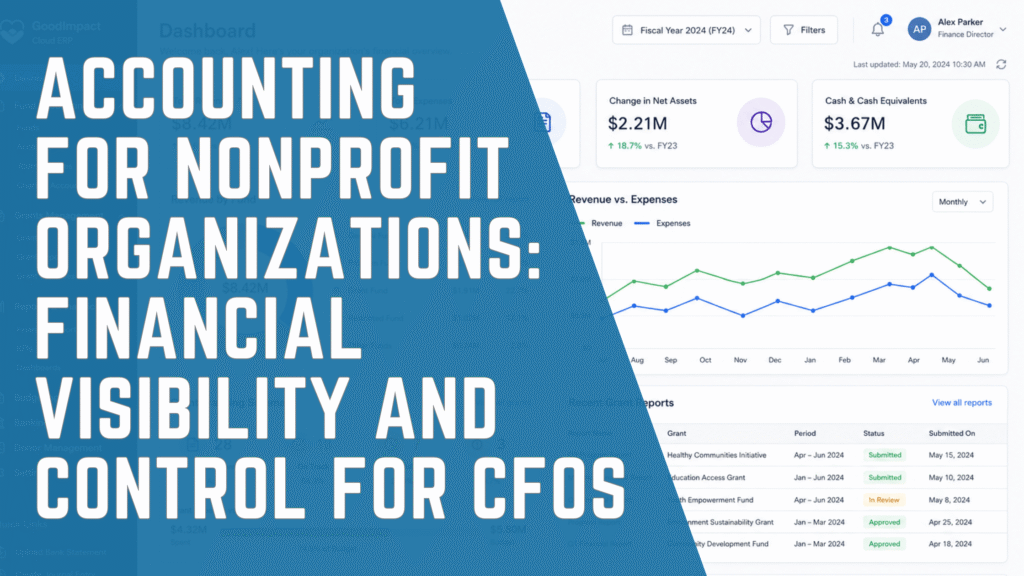
Accounting for nonprofit organizations has evolved significantly over the past decade as regulatory requirements, donor expectations, and operational complexity continue to increase. Today, CFOs and Finance Directors must manage not only traditional financial reporting but also fund restrictions, grant compliance, and multi-entity accountability.
Many nonprofits still rely on outdated systems such as spreadsheets or entry-level accounting tools that were never designed for fund-based financial structures. As a result, financial leaders struggle with fragmented reporting, delayed month-end closes, and limited visibility into financial performance.
Stakeholders now expect real-time transparency. Donors, boards, and regulators require detailed reporting that clearly demonstrates how resources are allocated and spent. Therefore, organizations must modernize their financial systems to remain compliant, efficient, and competitive.
Modern ERP platforms like Sage Intacct play a critical role in improving accounting for nonprofit organizations by enabling real-time financial intelligence and automation.
The Financial Complexity Behind Nonprofit Accounting
Nonprofit accounting is fundamentally different from for-profit financial management. Therefore, CFOs must navigate a unique set of challenges that directly impact reporting accuracy and operational efficiency.
1. Fund Accounting Requirements
Unlike traditional accounting, nonprofits must track funds based on donor restrictions. For example, a grant may be restricted for specific programs, timelines, or geographic regions. Consequently, finance teams must ensure funds are allocated correctly and reported accurately.
However, many legacy systems cannot properly enforce fund restrictions, which leads to manual tracking and increased risk of error.
2. Grant Management Complexity
Grant funding introduces additional complexity because each grant may have separate reporting requirements, compliance rules, and timelines. Moreover, nonprofits often manage multiple grants simultaneously, increasing administrative burden. As a result, CFOs face difficulties consolidating financial data across programs while maintaining compliance.
3. Multi-Entity and Program Reporting
Many nonprofit organizations operate across multiple locations, programs, or even countries. Therefore, consolidated reporting becomes essential for board-level visibility. In contrast, basic accounting systems struggle to provide real-time consolidation, which delays decision-making and reduces transparency.
4. Donor Expectations and Transparency
Today’s donors expect detailed insights into how their contributions are used. Furthermore, they increasingly demand impact-based reporting rather than simple financial summaries. Because of this shift, nonprofits must adopt systems that can connect financial data with program outcomes.
Why Traditional Accounting Systems Fail Nonprofit Organizations
Although many nonprofits still use entry-level accounting systems, these tools are no longer sufficient for modern financial requirements.
Key Limitations of Legacy Systems
- Limited fund accounting capabilities
- Manual reconciliation processes
- Lack of real-time reporting
- Poor multi-entity consolidation
- High dependency on spreadsheets
- Weak audit trails
Therefore, finance teams spend more time managing data instead of analyzing it. Moreover, month-end close processes become increasingly slow and error-prone. Consequently, CFOs lack timely insights needed for strategic decision-making. In contrast, modern cloud ERP systems are designed to eliminate these inefficiencies and centralize financial operations.
The Role of ERP in Modern Accounting for Nonprofit Organizations
Enterprise Resource Planning (ERP) systems are designed to unify financial, operational, and reporting functions within a single platform. For nonprofit organizations, this creates a significant shift in how financial data is managed.
Key Benefits of ERP for Nonprofits
- Centralized financial data management
- Automated fund accounting
- Real-time reporting dashboards
- Streamlined grant tracking
- Improved audit readiness
- Enhanced donor reporting capabilities
Furthermore, ERP systems reduce reliance on manual spreadsheets and disconnected tools. As a result, CFOs gain better visibility into financial performance across programs, grants, and departments.
Why Sage Intacct Is Built for Nonprofit Financial Management
Nonprofit organizations require a financial system that is flexible, scalable, and audit-ready. This is where Sage Intacct stands out as a leading solution.
Specifically designed with strong fund accounting capabilities, it enables nonprofits to manage complex financial structures with ease.
Core Capabilities for Nonprofits
1. Advanced Fund Accounting
Sage Intacct enables organizations to track funds by restriction, donor, and purpose. Therefore, finance teams can ensure full compliance with donor requirements.
2. Grant Management and Tracking
Grants can be tracked from allocation to expenditure, providing full visibility into remaining balances and compliance status.
3. Real-Time Financial Reporting
Unlike legacy systems, reports are updated in real time. Consequently, CFOs always have access to accurate financial data.
4. Multi-Dimensional Reporting
Organizations can report by program, department, location, or funding source. In addition, this flexibility supports board-level reporting and strategic planning.
5. Automated Compliance and Audit Trails
Every transaction is fully traceable. As a result, audit preparation becomes significantly more efficient.
Financial Leadership Perspective: How CFOs Benefit from Modern Nonprofit Accounting Systems
CFOs in nonprofit organizations are increasingly expected to act as strategic advisors rather than just financial controllers. Therefore, they require systems that support decision-making at a higher level.
Improved Financial Visibility
With real-time dashboards, CFOs gain immediate insights into cash flow, fund utilization, and program performance. Moreover, this visibility supports faster and more informed decisions.
Better Budget Control
Budgeting becomes more accurate when financial data is centralized. Therefore, organizations can better align spending with strategic goals.
Enhanced Forecasting
Modern ERP systems allow CFOs to forecast financial performance based on real-time data. Consequently, nonprofits can proactively manage funding gaps or surpluses.
Operational Challenges Solved by Modern Nonprofit Accounting Systems
Challenge 1: Manual Data Entry
Manual processes increase the risk of human error. However, ERP automation reduces redundancy and improves accuracy.
Challenge 2: Delayed Reporting
Many nonprofits experience delays in month-end reporting. In contrast, real-time ERP systems eliminate reporting bottlenecks.
Challenge 3: Lack of Integration
Disconnected systems create inefficiencies. Therefore, integrated ERP platforms unify financial and operational data.
Challenge 4: Compliance Risks
Nonprofits must comply with strict reporting standards. Consequently, audit-ready systems significantly reduce compliance risk.
Why Nonprofit Organizations Need Cloud-Based ERP Systems
Cloud ERP has become the standard for modern nonprofit financial management. Specifically, it provides scalability, accessibility, and security.
Key Advantages
- Remote access to financial data
- Automatic system updates
- Enhanced data security
- Lower IT infrastructure costs
- Scalable architecture for growing organizations
In addition, cloud ERP enables nonprofits to expand operations without increasing administrative complexity.
How IWI Consulting Group Supports Nonprofit Financial Transformation
With more than 22 years of experience and over 500 successful projects delivered, IWI Consulting Group helps nonprofit organizations modernize financial operations through strategic ERP implementation and advisory services.
Key Areas of Expertise
- ERP selection and advisory
- Nonprofit system implementation
- Data migration from legacy systems
- Financial process optimization
- Training and change management
- Ongoing ERP support
Furthermore, IWI Consulting Group works closely with CFOs and Finance Directors to ensure ERP systems align with organizational goals. As a result, nonprofits achieve improved financial transparency, operational efficiency, and long-term scalability.
Implementation Considerations for Nonprofit ERP Projects
Implementing a new ERP system requires careful planning and execution. Therefore, CFOs should consider the following factors:
1. Data Migration Strategy
Legacy data must be cleaned and structured before migration. Consequently, proper planning reduces implementation risk.
2. Change Management
Staff adoption is critical. Therefore, training and communication must be prioritized.
3. Reporting Requirements
Organizations must define reporting structures early in the process.
4. Integration Needs
ERP systems should integrate with donor management and CRM platforms.
Business Impact: What Changes After ERP Implementation
After implementing a modern ERP system like Sage Intacct, nonprofit organizations typically experience significant improvements.
Operational Improvements
- Faster month-end close cycles
- Reduced manual workload
- Improved data accuracy
- Streamlined grant reporting
Financial Improvements
- Better budget control
- Improved forecasting accuracy
- Enhanced donor reporting
- Stronger audit readiness
Strategic Improvements
- Increased financial transparency
- Better board-level decision-making
- Improved funding efficiency
The Future of Accounting for Nonprofit Organizations
The future of nonprofit accounting is increasingly driven by automation, AI, and real-time analytics. Therefore, organizations that adopt modern ERP systems will be better positioned for long-term sustainability. Moreover, CFOs will play a more strategic role in guiding mission-driven outcomes through financial intelligence. In contrast, organizations relying on outdated systems risk falling behind in transparency, efficiency, and donor trust.
Conclusion: Building Financial Strength in Nonprofit Organizations
Accounting for nonprofit organizations is no longer just about compliance. It is now a strategic function that drives transparency, efficiency, and mission success.
Modern ERP systems such as Sage Intacct enable nonprofits to manage complexity, improve reporting accuracy, and scale operations effectively.
With the right technology and advisory partner, organizations can transition from fragmented systems to a unified financial management environment that supports long-term sustainability.
Nonprofit organizations facing challenges with financial visibility, grant tracking, or outdated accounting systems should take the next step toward modernization.
IWI Consulting Group helps CFOs, Finance Directors, and Controllers design and implement ERP solutions that improve financial control, streamline reporting, and support organizational growth. With deep expertise in Sage Intacct and nonprofit financial transformation, IWI ensures a smooth path from legacy systems to modern cloud ERP.
Contact IWI Consulting Group today to begin your nonprofit ERP assessment and discover how your finance team can achieve real-time visibility, stronger compliance, and more strategic financial leadership.
In summary, accounting for nonprofit organizations is no longer just about compliance but about enabling strategic financial leadership and operational transparency.
FAQ: Accounting for Nonprofit Organizations
What is accounting for nonprofit organizations?
It is a financial management system focused on tracking restricted funds, donations, grants, and program spending while ensuring compliance and transparency.
Why is nonprofit accounting different from for-profit accounting?
Nonprofits must manage fund restrictions and donor requirements, whereas for-profit organizations focus on profitability and shareholder value.
What is the best ERP for nonprofit accounting?
Cloud ERP systems like Sage Intacct are widely used because they offer strong fund accounting and real-time reporting.
How does fund accounting work in nonprofits?
Fund accounting separates financial resources based on donor restrictions, ensuring proper allocation and reporting.
Can nonprofit organizations use QuickBooks?
Yes, but it may not scale well for complex fund tracking, multi-entity reporting, or grant management.
How does ERP improve nonprofit financial reporting?
ERP systems provide real-time dashboards, automated reporting, and consolidated financial visibility.
What are the biggest challenges in nonprofit accounting?
Common challenges include manual reporting, grant tracking complexity, and lack of financial visibility.
How does Sage Intacct help nonprofits?
It provides advanced fund accounting, grant tracking, automated reporting, and real-time financial dashboards.
What is grant management in nonprofit accounting?
It is the process of tracking, managing, and reporting on funds received from grants.
How does IWI Consulting Group support nonprofit organizations?
IWI Consulting Group helps nonprofits implement ERP systems, migrate data, and optimize financial processes for better transparency and efficiency.