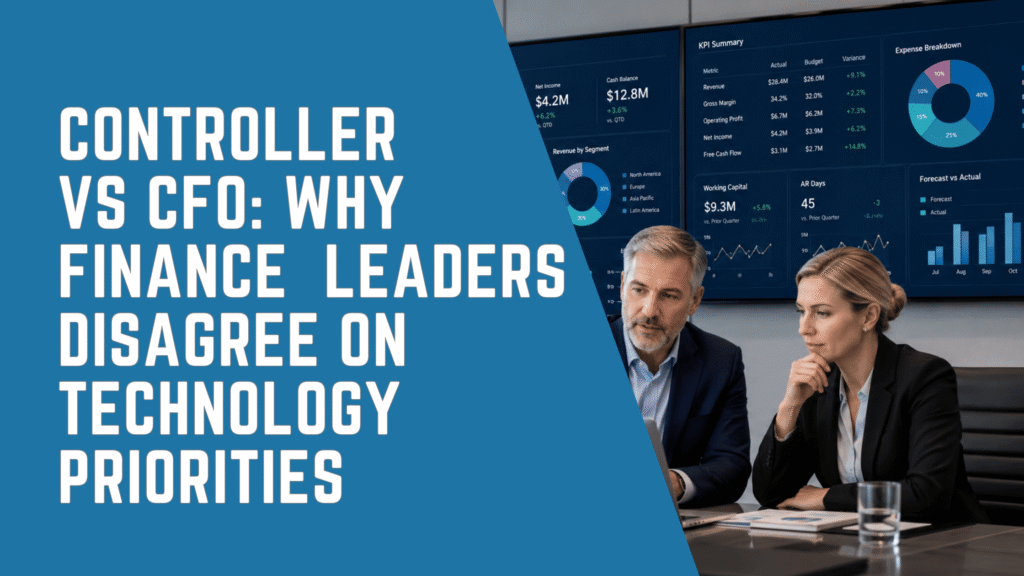
The Controller vs CFO discussion is often misunderstood because both roles contribute to financial leadership but approach technology decisions from different perspectives. Controllers typically focus on financial accuracy, compliance, internal controls, reconciliations, and month-end close efficiency. CFOs, on the other hand, are generally more focused on forecasting, strategic planning, financial visibility, scalability, and executive decision-making.
These different responsibilities naturally shape their technology priorities. A Controller may prioritize stronger approval workflows, reliable audit trails, accounting automation, and consistent financial reporting. Meanwhile, a CFO may place greater emphasis on real-time dashboards, scenario planning, consolidated reporting, cash flow visibility, and business intelligence.
Neither perspective is more important than the other. Accurate financial data and efficient accounting processes provide the foundation for effective forecasting and strategic decision-making. At the same time, strong financial controls create greater value when leaders can use the resulting information to guide business performance and future growth.
Disagreements often arise when finance technology is treated as a simple software purchase rather than a broader business transformation initiative. Without a shared strategy, organizations may invest in tools that solve immediate accounting problems but fail to support executive reporting, or they may prioritize advanced analytics without first improving the quality and reliability of the underlying data.
This article examines the key differences between Controller and CFO technology priorities, the reasons disagreements occur, and how modern ERP systems can connect financial control, operational efficiency, reporting, forecasting, and strategic visibility.
Understanding the Controller vs CFO Relationship
The Controller and CFO both play important roles in financial leadership. However, their responsibilities are not the same. The Controller usually manages accounting operations, financial controls, reporting accuracy, compliance, internal processes, and transactional discipline. In contrast, the CFO oversees financial strategy, capital planning, forecasting, risk management, stakeholder communication, and long-term business performance.
This difference shapes how each leader evaluates technology. For example, a Controller may look at whether a system can reduce manual journal entries, improve reconciliations, simplify intercompany accounting, and strengthen audit readiness. Meanwhile, a CFO may ask whether the same system can support growth, improve margins, forecast cash flow, and deliver real-time executive reporting.
As a result, both leaders can support finance modernization while still disagreeing on what should come first. The Controller may see process reliability as the foundation. The CFO may see decision intelligence as the priority. Therefore, technology planning must connect both perspectives.
A healthy Controller vs CFO relationship does not require both leaders to think the same way. Instead, it requires a shared understanding of how operational accuracy supports strategic insight. Without clean data, CFO dashboards lose credibility. On the other hand, without executive visibility, accounting improvements may not translate into better business decisions.
Modern ERP creates this connection. It provides the financial controls that Controllers need while delivering the real-time visibility that CFOs require. Consequently, ERP becomes more than a back-office system. It becomes a finance leadership platform.
Controller vs CFO Responsibilities: Where the Priorities Differ
The Controller’s role is deeply connected to accounting execution. Specifically, Controllers oversee the systems and processes that ensure financial information is complete, accurate, timely, and compliant. Therefore, they often focus on the daily realities of finance operations.
Common Controller responsibilities include:
- General ledger management
- Accounts payable and accounts receivable oversight
- Month-end and year-end close
- Financial statement preparation
- Compliance and audit support
- Internal controls
- Reconciliations
- Accounting process standardization
- Tax reporting support
- Transaction-level accuracy
The CFO’s responsibilities are broader and more strategic. Although the CFO depends on accurate financial data, the role focuses on how that data supports decisions. In addition, CFOs must communicate financial performance to executives, boards, lenders, investors, and business leaders.
Common CFO responsibilities include:
- Financial strategy
- Budgeting and forecasting
- Cash flow management
- Profitability analysis
- Capital allocation
- Risk management
- Executive reporting
- Board reporting
- Growth planning
- Finance transformation
Because these responsibilities differ, technology priorities naturally differ as well. The Controller may ask whether a new ERP system can enforce approval rules, prevent duplicate data entry, and support clean audit trails. However, the CFO may ask whether it can support multi-year planning, real-time KPIs, scenario modelling, and scalable reporting.
Neither perspective is wrong. In fact, both are essential. The challenge appears when organizations prioritize one perspective while ignoring the other.
Why Controllers Often Prioritize Control, Accuracy, and Process Efficiency
Controllers usually carry responsibility for the reliability of financial information. Because of this, they often approach technology decisions with a practical and risk-aware mindset. Their first question is not always whether a system looks modern. Instead, they want to know whether it will reduce errors, protect data integrity, and improve accounting efficiency.
For many Controllers, legacy accounting systems create daily friction. For example, finance teams may rely on spreadsheets to reconcile accounts, track approvals, manage consolidations, or create management reports. As transaction volumes grow, these manual processes become harder to control. Consequently, the risk of errors, delays, and inconsistent reporting increases.
Controllers often prioritize technology that can:
- Automate recurring journal entries
- Improve month-end close workflows
- Strengthen audit trails
- Reduce manual reconciliations
- Standardize approval processes
- Support compliance requirements
- Improve transaction-level reporting
- Reduce spreadsheet dependency
- Create consistent financial statements
- Improve data accuracy across entities or locations
These priorities are not just accounting preferences. They directly affect business performance. If month-end close takes too long, leaders receive outdated information. If data quality is poor, forecasts become unreliable. In addition, if approval workflows are weak, the organization may face compliance, fraud, or spending control risks.
Therefore, Controllers often view ERP investment as a way to create discipline and trust. They want systems that support repeatable processes and accurate reporting. As a result, they may resist technology projects that seem focused only on executive dashboards without fixing the underlying accounting workflows.
This is a valid concern. Dashboards are only useful when the data behind them is accurate. Therefore, Controller priorities should be treated as foundational requirements in any finance technology strategy.
Why CFOs Often Prioritize Visibility, Forecasting, and Strategic Insight
CFOs operate at a different level of financial leadership. Although accuracy matters, CFOs must also help the organization look forward. Therefore, they often prioritize technology that improves visibility, forecasting, performance management, and strategic decision-making.
A CFO may be less focused on the mechanics of daily accounting and more focused on questions such as:
- Which product lines are most profitable?
- How will cash flow change over the next six months?
- Which locations are underperforming?
- How quickly can the company scale?
- Which investments will improve margins?
- How can finance support growth without adding unnecessary headcount?
- What risks could affect revenue, liquidity, or profitability?
Because of this, CFO technology priorities often include dashboards, analytics, budgeting tools, forecasting capabilities, multi-entity consolidation, and real-time reporting. In addition, CFOs often want finance systems that integrate with operations, inventory, sales, payroll, procurement, and project management.
Legacy systems often limit this visibility. For example, QuickBooks, Sage 50, Sage BusinessVision, Microsoft GP, or heavily customized legacy ERP environments may not provide the reporting depth needed for a growing organization. As a result, CFOs may depend on exported data, spreadsheet models, and delayed reports.
This creates a strategic problem. When finance teams spend too much time preparing data, CFOs have less time to analyze it. Therefore, modern ERP becomes essential for finance transformation.
CFOs often prioritize technology that can:
- Deliver real-time financial dashboards
- Improve forecasting and budgeting
- Support multi-entity reporting
- Provide consolidated financial visibility
- Improve cash flow management
- Connect finance and operations data
- Support growth and scalability
- Improve board and executive reporting
- Enable faster decision-making
- Reduce reliance on manual reporting
These goals are highly strategic. However, they still depend on strong accounting processes. Therefore, CFO priorities should be connected to Controller priorities rather than treated as a separate initiative.
The Root Cause of Controller vs CFO Technology Disagreements
Controller vs CFO disagreements often happen because each leader is trying to solve a different problem. The Controller may be trying to reduce operational risk. Meanwhile, the CFO may be trying to improve strategic agility. Both goals are important, yet they can compete for budget, time, and attention.
The disagreement usually becomes visible during technology planning. For example, the Controller may want to replace manual accounts payable processes first. However, the CFO may want better forecasting and executive dashboards. The Controller may prioritize audit readiness. Meanwhile, the CFO may prioritize growth reporting and scalability.
Several root causes commonly drive these disagreements:
1. Different Measures of Success
Controllers often measure success through accuracy, close speed, compliance, and process consistency. In contrast, CFOs measure success through insight, agility, forecast accuracy, cash flow visibility, and business performance.
Therefore, the same technology project can look different to each leader. A Controller may see value in automation that reduces errors. However, a CFO may see value in reporting that improves strategic decisions.
2. Different Levels of System Interaction
Controllers and their teams usually work inside the ERP or accounting system every day. They experience every inefficient workflow, duplicate entry, manual approval, and reporting limitation. As a result, they often understand system pain points at a detailed level.
CFOs may interact with the system through reports, dashboards, and summarized outputs. Therefore, they may focus more on the quality and timeliness of insights than on the detailed accounting workflows behind those insights.
3. Different Risk Perspectives
Controllers often focus on compliance risk, data integrity risk, and process control risk. Meanwhile, CFOs often focus on strategic risk, financial risk, liquidity risk, and scalability risk.
Both risk perspectives matter. However, technology discussions can become difficult when one side frames risk operationally and the other frames it strategically.
4. Different Time Horizons
Controllers often focus on immediate process pain points, especially during month-end close, audits, reporting cycles, and compliance deadlines. CFOs often focus on future-state capabilities, growth plans, acquisitions, expansion, and long-term finance transformation.
As a result, Controllers may prioritize what needs to be fixed now. In contrast, CFOs may prioritize what the business will need next.
5. Different Views of ERP Value
Controllers may view ERP as a system of record. CFOs may view ERP as a platform for decision-making. However, modern ERP must serve both purposes. It should provide accurate financial records and support strategic visibility.
Because of this, technology disagreements often reveal a deeper issue. The organization may not have a shared finance technology roadmap.
How ERP Bridges the Gap Between Controller and CFO Priorities
Modern ERP helps align Controller and CFO priorities because it connects transactional accuracy with strategic insight. Instead of forcing finance leaders to choose between process control and executive visibility, ERP can support both.
For Controllers, ERP provides structured workflows, automated accounting processes, audit trails, role-based permissions, and consistent reporting logic. Therefore, finance teams can reduce manual work and improve financial accuracy.
For CFOs, ERP provides real-time dashboards, consolidated reporting, budgeting support, operational visibility, and scalable financial management. As a result, leadership can make decisions based on timely and trusted data.
A well-designed ERP system can help organizations improve:
- Financial reporting
- Month-end close
- Budgeting and forecasting
- Cash flow visibility
- Multi-entity consolidation
- Intercompany accounting
- Inventory reporting
- Project accounting
- Approval workflows
- Compliance and audit readiness
- Operational analytics
- Executive dashboards
However, ERP success depends on implementation strategy. Technology alone does not resolve leadership misalignment. Therefore, organizations need to define goals, workflows, reporting requirements, integrations, data migration needs, and change management plans before implementation begins.
This is where IWI Consulting Group provides value. IWI helps organizations evaluate ERP requirements from both the Controller and CFO perspective. In addition, IWI supports ERP implementation, migration, optimization, reporting design, and long-term support across Sage Intacct, Sage 300, and Sage X3
The right ERP strategy helps finance leaders move from disagreement to alignment. It gives Controllers confidence in data accuracy. Meanwhile, it gives CFOs confidence in strategic insight.
Technology Priorities: Controller vs CFO Comparison Table
The following table shows how Controllers and CFOs often approach finance technology priorities differently.
| Area | Controller Priority | CFO Priority | ERP Alignment Opportunity |
|---|---|---|---|
| Reporting | Accurate financial statements | Real-time executive dashboards | Standardized reporting and analytics |
| Month-End Close | Faster reconciliations and entries | Earlier access to results | Automated close workflows |
| Compliance | Audit trails and internal controls | Risk management and governance | Role-based controls and approval workflows |
| Forecasting | Reliable historical data | Predictive planning and scenarios | Integrated budgeting and forecasting |
| Data Quality | Clean transaction-level records | Trusted decision-ready information | Single source of financial truth |
| Growth | Scalable accounting processes | Scalable financial strategy | Cloud ERP and multi-entity support |
| Automation | Reduce manual accounting tasks | Improve finance team productivity | Workflow automation and integrations |
| Cash Flow | Accurate AR and AP reporting | Forward-looking cash visibility | Real-time cash flow dashboards |
| Integrations | Reduce duplicate data entry | Connect finance with operations | ERP integrations across departments |
| Performance | Close speed and reporting accuracy | Profitability and business KPIs | Financial and operational analytics |
This comparison highlights a key point. Controllers and CFOs do not usually disagree because they have conflicting goals. Instead, they disagree because they define technology value differently.
Therefore, finance technology planning should not start with software demos. It should start with a shared business case.
Why Legacy Accounting Systems Intensify Technology Disagreements
Technology disagreements become more common when finance teams rely on systems that no longer match business complexity. As organizations grow, entry-level accounting software or outdated ERP systems may struggle to support reporting, controls, integrations, and scalability.
For example, a company may have started with QuickBooks, Sage 50, Sage BusinessVision, or another basic accounting platform. Initially, these systems may have worked well. However, growth often introduces new requirements such as multiple entities, complex approvals, inventory visibility, project reporting, intercompany transactions, and advanced reporting.
As these needs increase, Controllers and CFOs may experience different symptoms.
Controllers may notice:
- Too many manual workarounds
- Spreadsheet-heavy reconciliations
- Limited audit trails
- Slow month-end close
- Duplicate data entry
- Weak approval workflows
- Difficulty enforcing controls
- Increased reporting errors
CFOs may notice:
- Limited visibility into performance
- Delayed financial reporting
- Poor forecasting accuracy
- Lack of consolidated reporting
- Difficulty analyzing profitability
- Limited operational insight
- Challenges supporting growth
- Inability to make fast decisions
Because the pain shows up differently, each leader may recommend different solutions. The Controller may want process automation. Meanwhile, the CFO may want better analytics. However, both pain points often have the same root cause: the finance system has been outgrown.
This is why ERP migration should be evaluated strategically. Replacing a legacy system is not only an accounting upgrade. It is an opportunity to redesign finance operations, improve reporting, and create scalable business infrastructure.
IWI Consulting Group has experience supporting migrations from QuickBooks, Sage 50, Sage BusinessVision, Microsoft GP, and other legacy systems. Therefore, IWI can help organizations assess whether their current platform still supports operational and strategic needs.
The Role of Financial Visibility in Controller and CFO Alignment
Financial visibility is one of the most important areas where Controller and CFO priorities overlap. Controllers need visibility into transactions, reconciliations, account balances, approvals, and financial statements. Meanwhile, CFOs need visibility into trends, forecasts, margins, cash flow, and business performance.
However, visibility means different things to each leader. For Controllers, visibility often means knowing whether the numbers are accurate and traceable. For CFOs, visibility often means knowing what the numbers reveal about the future of the business.
Modern ERP supports both forms of visibility. It allows finance teams to drill down from high-level dashboards into transaction-level details. As a result, CFOs can review performance metrics while Controllers can verify the underlying data.
This connection is critical. Without drill-down visibility, executives may question whether reports are reliable. Without summary dashboards, finance teams may struggle to communicate insights quickly. Therefore, ERP reporting should be designed to serve multiple levels of the organization.
Effective financial visibility includes:
- Real-time financial statements
- Budget-to-actual reporting
- Cash flow dashboards
- Department and location reporting
- Project or job profitability
- Inventory and cost visibility
- Multi-entity consolidation
- Exception reporting
- KPI dashboards
- Drill-down transaction analysis
When visibility improves, finance discussions become more productive. Controllers can spend less time defending data quality. Meanwhile, CFOs can spend more time interpreting results and advising the business.
Consequently, financial visibility becomes a shared priority rather than a source of disagreement.
Month-End Close: A Common Source of Controller vs CFO Tension
Month-end close often exposes the difference between Controller and CFO priorities. Controllers focus on completing the close accurately and efficiently. CFOs focus on receiving timely results that support decisions. Therefore, delays can create tension.
For Controllers, month-end close may involve journal entries, reconciliations, accruals, eliminations, review processes, reporting packages, and compliance checks. If systems are manual or fragmented, the close process becomes time-consuming. In addition, the team may need to work late hours or rely on spreadsheets to complete reporting.
For CFOs, a slow close creates a strategic visibility problem. If financial results arrive too late, leaders may miss opportunities to adjust spending, improve margins, manage cash flow, or address performance issues. As a result, the CFO may push for faster reporting.
However, speed without accuracy is risky. Controllers may resist aggressive close timelines if the underlying systems do not support automation and control. Therefore, the real solution is not simply to pressure the finance team. Instead, the organization needs better processes and technology.
ERP can improve month-end close through:
- Automated recurring entries
- Account reconciliation support
- Workflow approvals
- Intercompany automation
- Consolidation tools
- Standardized close checklists
- Real-time reporting
- Audit trails
- Role-based access
- Integrated subledger data
As a result, Controllers gain efficiency and control. Meanwhile, CFOs gain faster access to reliable financial results. This is one of the clearest examples of how ERP can align both roles.
Reporting Automation: Where Finance Teams Often Find Common Ground
Reporting automation is often one of the strongest opportunities for Controller and CFO alignment. Both roles usually want better reporting, although they may want different outputs.
Controllers often need accurate financial statements, variance reports, compliance reports, and audit-ready schedules. CFOs often need executive dashboards, board packages, cash flow forecasts, profitability reports, and strategic KPIs.
Without automation, both leaders suffer. Controllers spend too much time preparing reports manually. Meanwhile, CFOs wait too long for insights. In addition, spreadsheet-based reporting increases the risk of version control issues, formula errors, and inconsistent definitions.
Modern ERP can automate reporting by connecting financial data directly to reporting structures. Therefore, finance teams can reduce manual exports and improve consistency. In addition, dashboards can update more frequently, giving leaders better access to current information.
Reporting automation can support:
- Financial statements
- Departmental reporting
- Location reporting
- Multi-entity consolidation
- Budget-to-actual reporting
- Cash flow reporting
- KPI dashboards
- Board reporting
- Audit schedules
- Operational performance reporting
However, reporting automation requires thoughtful design. Organizations must define reporting dimensions, account structures, approval workflows, business units, and performance metrics before implementation. Otherwise, the ERP system may reproduce old reporting problems in a new platform.
IWI Consulting Group helps organizations design reporting structures that support both accounting operations and executive decision-making. In addition, IWI helps finance teams reduce spreadsheet dependency and improve reporting confidence through ERP implementation and optimization.
How Sage Intacct Supports Controller and CFO Priorities
Sage Intacct is often a strong fit for organizations that need advanced cloud financial management. It is especially relevant for finance teams that require multi-entity accounting, dimensional reporting, automation, and strong financial visibility.
For Controllers, Sage Intacct can support accounting efficiency through automated workflows, approvals, audit trails, and financial reporting. In addition, dimensional accounting can help reduce chart of accounts complexity while improving reporting flexibility.
For CFOs, Sage Intacct can support real-time dashboards, multi-entity visibility, consolidated reporting, and financial performance management. Therefore, it can help leadership move beyond static financial statements and into more dynamic decision-making.
Sage Intacct is often relevant for:
- Nonprofits
- Professional services firms
- Healthcare organizations
- SaaS companies
- Multi-entity organizations
- Growing mid-market finance teams
In a Controller vs CFO technology discussion, Sage Intacct can help both leaders achieve their goals. The Controller gains stronger control and automation. Meanwhile, the CFO gains better visibility and reporting agility.
IWI Consulting Group supports Sage Intacct implementation, migration, reporting design, and long-term optimization for organizations. With this expertise, IWI can help finance teams evaluate whether Sage Intacct aligns with their operational and strategic requirements.
How Sage 300 Supports Finance and Operations Alignment
Sage 300 remains a practical ERP solution for organizations that need robust accounting, inventory, distribution, construction, manufacturing, or multi-location capabilities. It is especially relevant for companies that require strong financial management alongside operational control.
Controllers often value Sage 300 because it supports core accounting processes, transaction visibility, reporting, and operational workflows. In addition, it can support organizations with more complex inventory, job costing, or multi-location needs.
CFOs may value Sage 300 because it can provide stronger visibility into financial and operational performance than basic accounting systems. Furthermore, it can support growing organizations that need more structure without immediately moving to a larger enterprise ERP environment.
Sage 300 is often relevant for:
- Distribution companies
- Manufacturing businesses
- Construction organizations
- Inventory-intensive companies
- Multi-location businesses
- Organizations with complex operational reporting needs
In Controller vs CFO discussions, Sage 300 can help connect accounting control with operational visibility. Therefore, it can be a strong option when finance technology decisions must account for inventory, job costing, supply chain, or multi-location complexity.
IWI Consulting Group provides Sage 300 implementation, support, upgrades, and optimization. As a result, organizations can improve both accounting efficiency and business visibility while protecting the value of their ERP investment.
How Sage X3 Supports Complex Finance and Operational Requirements
Sage X3 is often suited for organizations with complex operations, manufacturing processes, supply chains, or industry-specific requirements. It can support companies that need stronger control across finance, production, inventory, procurement, and distribution.
Controllers may prioritize Sage X3 when financial reporting must connect with operational complexity. For example, process manufacturing, food and beverage, and supply chain organizations often need accurate costing, inventory valuation, production reporting, and compliance-related visibility.
CFOs may prioritize Sage X3 because it can provide broader enterprise visibility. In addition, it can help leadership understand how production, inventory, procurement, and logistics affect profitability and cash flow.
Sage X3 is often relevant for:
- Manufacturing companies
- Food and beverage businesses
- Process manufacturers
- Supply chain organizations
- Complex distribution environments
- Companies with advanced operational requirements
In Controller vs CFO technology planning, Sage X3 can help both leaders move beyond finance-only thinking. It connects financial management with operational performance. Therefore, it is often a strong fit when financial results depend heavily on production, inventory, and supply chain activity.
IWI Consulting Group supports Sage X3 implementation and advisory services for organizations that require deeper ERP functionality. Because of this, IWI can help finance and operations leaders align system capabilities with business complexity.
Building a Shared Finance Technology Roadmap
Controller vs CFO disagreements become easier to manage when organizations create a shared finance technology roadmap. This roadmap should define how technology will improve accounting operations, reporting, decision-making, scalability, and business performance.
A strong roadmap should begin with business requirements, not software features. First, finance leaders should identify current pain points. Second, they should define future-state goals. Finally, they should prioritize technology initiatives based on business impact, risk, and implementation readiness.
A shared roadmap should address:
- Current accounting process issues
- Month-end close bottlenecks
- Reporting gaps
- Forecasting requirements
- Compliance needs
- Data migration risks
- Integration requirements
- ERP platform options
- User training needs
- Change management
- Long-term support requirements
This process helps Controllers and CFOs speak the same language. For example, a Controller’s request for automated reconciliations can be connected to the CFO’s need for faster reporting. Similarly, a CFO’s request for dashboards can be connected to the Controller’s need for clean data and standardized reporting dimensions.
A shared roadmap also helps CEOs, COOs, and IT Directors understand the business case for ERP investment. Instead of seeing finance technology as a departmental request, leadership can see it as infrastructure for growth, visibility, and operational efficiency.
IWI Consulting Group helps organizations assess ERP requirements and create practical implementation plans. In addition, IWI supports long-term ERP optimization so finance technology continues to evolve with the business.
Questions Finance Leaders Should Ask Before Choosing ERP
Before selecting or replacing an ERP system, Controllers and CFOs should align on the questions that matter most. This reduces the risk of choosing software that solves only part of the problem.
Important questions include:
- What financial processes create the most manual work?
- Where does reporting lack accuracy, speed, or consistency?
- Which decisions are delayed because information is unavailable?
- How long does month-end close take today?
- What controls, approvals, and audit trails are required?
- Does the organization need multi-entity or multi-location reporting?
- What systems must integrate with ERP?
- What data must be migrated from legacy systems?
- Which KPIs should executives see in real time?
- What support will finance teams need after implementation?
These questions help connect Controller and CFO priorities. In addition, they help organizations avoid choosing ERP based only on surface-level features.
The best ERP decision should support both operational execution and strategic leadership. Therefore, finance teams should evaluate platforms based on reporting, automation, scalability, controls, integrations, industry fit, implementation complexity, and long-term support.
A qualified ERP consulting partner can help structure this evaluation. IWI Consulting Group brings ERP expertise across Sage Intacct, Sage 300, and Sage X. Consequently, IWI can help organizations compare options and select a solution that fits both finance and operational requirements.
Common Mistakes in Controller vs CFO Technology Decisions
Finance technology projects can underperform when organizations do not align priorities early. Although both Controllers and CFOs want better outcomes, several common mistakes can create problems.
Mistake 1: Choosing Software Before Defining Requirements
Many organizations begin with product demos before they fully understand their needs. However, demos often highlight attractive features rather than business requirements. As a result, teams may choose software that does not fit their processes.
Mistake 2: Prioritizing Dashboards Without Fixing Data Quality
Executive dashboards can provide valuable insight. However, dashboards are unreliable when the underlying accounting data is inconsistent. Therefore, reporting strategy must include data structure, workflows, and controls.
Mistake 3: Treating ERP as an Accounting-Only Project
ERP affects finance, operations, inventory, procurement, sales, projects, and leadership reporting. Consequently, organizations should not treat ERP as only a finance department system.
Mistake 4: Underestimating Change Management
Even strong ERP systems can fail when users do not adopt new processes. Therefore, training, communication, and support must be part of the implementation plan.
Mistake 5: Ignoring Long-Term Scalability
A system may solve today’s issues but fail to support future growth. Because of this, CFOs and Controllers should evaluate how ERP will support expansion, integrations, reporting complexity, and transaction volume.
Mistake 6: Not Involving IT Early Enough
ERP decisions affect data security, integrations, infrastructure, access control, and system governance. Therefore, IT Directors should be included early in the process.
Avoiding these mistakes requires structured planning. In addition, it requires a consulting partner that understands both finance operations and executive strategy.
How IWI Consulting Group Helps Align Controllers and CFOs
IWI Consulting Group helps organizations align finance technology decisions with business priorities. Rather than positioning ERP as a simple software purchase, IWI approaches ERP as a strategic transformation initiative.
With more than 22 years of experience and over 500 successful projects delivered, IWI understands the needs of Controllers, CFOs, CEOs, COOs, IT Directors, and operations leaders. In addition, IWI brings deep expertise across Sage Intacct, Sage 300, and Sage X3.
IWI supports organizations through:
- ERP assessment and advisory
- ERP implementation
- ERP migration
- ERP optimization
- Reporting and dashboard design
- Financial process automation
- Data migration planning
- System integration guidance
- ERP training and support
- Long-term technology partnership
IWI also has experience with migrations from QuickBooks, Sage 50, Sage BusinessVision, Microsoft GP, and other legacy systems. Therefore, organizations that have outgrown their current accounting or ERP environment can receive practical guidance on the next best platform.
For Controllers, IWI helps improve accounting efficiency, controls, reporting accuracy, and close processes. For CFOs, IWI helps improve visibility, scalability, forecasting readiness, and executive reporting. As a result, IWI helps finance leaders move from competing priorities to a shared ERP strategy.
Conclusion: Controller vs CFO Alignment Starts With a Shared ERP Strategy
The Controller vs CFO technology discussion is not about choosing one leader’s priorities over the other. Instead, it is about recognizing that finance operations and finance strategy depend on each other. Controllers need accurate data, strong controls, efficient workflows, and reliable reporting. Meanwhile, CFOs need visibility, forecasting, scalability, and insight that supports better decisions.
When organizations rely on outdated systems, these priorities can appear to conflict. However, modern ERP can bring them together. By connecting accounting automation, financial reporting, operational data, and executive dashboards, ERP helps finance leaders build a stronger foundation for growth.
Sage Intacct, Sage 300, and Sage X3 each support different business needs. Therefore, the right solution depends on the organization’s industry, complexity, growth plans, reporting requirements, and current technology environment.
IWI Consulting Group helps organizations evaluate these decisions with a strategic and practical approach. With more than 22 years of experience, over 500 successful projects delivered, and deep expertise across Sage ERP solutions, IWI supports Controllers, CFOs, and executive teams through ERP implementation, migration, optimization, and long-term support.
As a result, finance leaders can move beyond technology disagreements and build a shared roadmap for accuracy, visibility, automation, and scalable growth.
FAQ: Controller vs CFO Technology Priorities
What is the main difference between a Controller and a CFO?
The main difference is that the Controller usually manages accounting operations, compliance, controls, and financial reporting accuracy. In contrast, the CFO focuses on financial strategy, forecasting, cash flow, executive reporting, and long-term business performance. Therefore, both roles are important, but they evaluate technology from different perspectives.
Why do Controllers and CFOs disagree on technology priorities?
Controllers and CFOs often disagree because they solve different problems. Controllers usually prioritize process control, close efficiency, audit trails, and accounting accuracy. However, CFOs often prioritize financial visibility, forecasting, dashboards, scalability, and strategic decision-making.
How does ERP help align Controller vs CFO priorities?
ERP helps align both roles by connecting accurate accounting processes with real-time financial insight. As a result, Controllers gain stronger controls and automation, while CFOs gain better reporting, forecasting, and visibility.
What technology does a Controller usually prioritize?
A Controller usually prioritizes accounting automation, approval workflows, reconciliations, audit trails, compliance reporting, month-end close tools, and financial statement accuracy. These capabilities help reduce risk and improve finance team efficiency.
What technology does a CFO usually prioritize?
A CFO usually prioritizes dashboards, forecasting, budgeting, cash flow visibility, multi-entity reporting, profitability analysis, and scalable ERP systems. These capabilities support strategic planning and executive decision-making.
When should a company replace its accounting system or legacy ERP?
A company should consider replacement when reporting becomes too manual, month-end close takes too long, spreadsheets create risk, integrations are limited, or leadership lacks real-time visibility. In addition, growing companies may need ERP when entry-level systems can no longer support complexity.
Is Sage Intacct a good ERP option for Controllers and CFOs?
Sage Intacct can be a strong option for finance teams that need cloud financial management, multi-entity accounting, dimensional reporting, automation, and real-time visibility. Therefore, it can support both Controller and CFO priorities.
How can companies reduce conflict between Controllers and CFOs during ERP selection?
Companies can reduce conflict by defining shared goals before reviewing software. For example, they should document reporting needs, accounting pain points, forecasting requirements, integration needs, compliance requirements, and scalability goals. As a result, ERP selection becomes more objective.
How does IWI Consulting Group support finance technology decisions?
IWI Consulting Group supports finance technology decisions through ERP assessment, implementation, migration, optimization, reporting design, and long-term support. In addition, IWI specializes in Sage Intacct, Sage 300, Sage X3, and Acumatica for Canadian and American organizations.