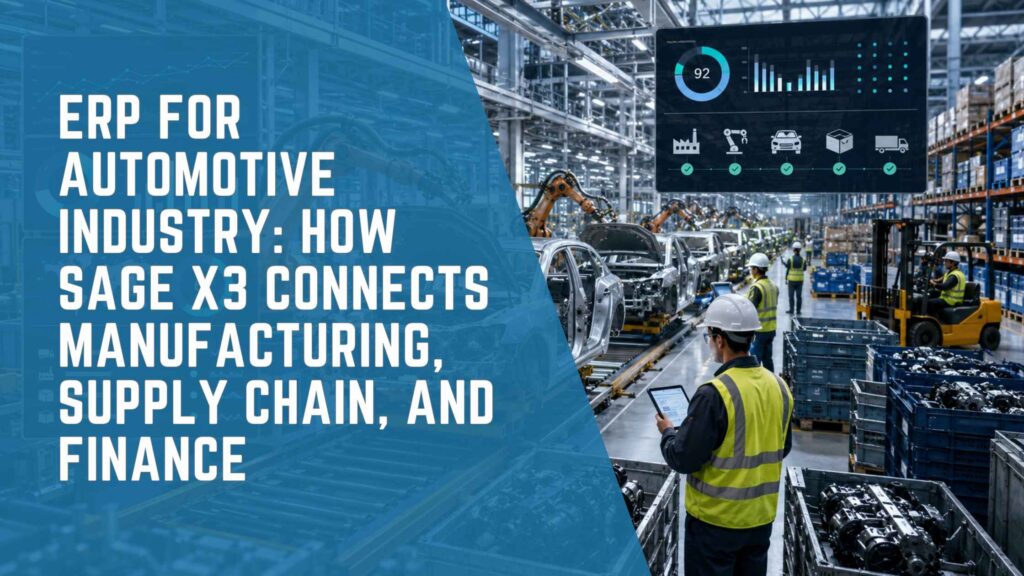
Automotive manufacturers must coordinate complex supply chains, production schedules, inventory, quality standards, customer requirements, and financial performance, often across multiple plants, warehouses, suppliers, and distribution channels. When these operations rely on disconnected systems, visibility gaps can lead to material shortages, production delays, excess inventory, inaccurate costing, and slower decisions.
For operations leaders, supply chain managers, plant managers, and IT directors, processing transactions is no longer enough. They need timely, reliable information about materials, production capacity, work orders, supplier performance, quality, costs, and profitability.
This article explores how ERP for the automotive industry creates a connected operational environment by bringing manufacturing, supply chain, inventory, purchasing, finance, and reporting together. It also explains how Sage X3 can help mid-market and complex automotive manufacturers improve visibility, coordinate multi-site operations, and make more informed decisions across the business.
Why Automotive Manufacturers Need a Modern ERP System
Automotive manufacturing depends on coordination.
A production schedule cannot operate effectively without accurate inventory information. Likewise, procurement teams cannot make informed purchasing decisions without understanding demand, lead times, supplier commitments, and available stock.
However, many automotive companies still manage parts of their operations through separate accounting applications, spreadsheets, manufacturing systems, warehouse tools, and custom databases. As a result, information may move between departments slowly or require manual reconciliation.
Several operational challenges commonly emerge:
- Limited visibility into inventory across plants and warehouses
- Difficulty coordinating purchasing with production requirements
- Complex bills of materials and product configurations
- Frequent engineering or component changes
- Supplier lead-time uncertainty
- Production scheduling constraints
- Manual quality-control processes
- Limited traceability of components and finished products
- Inconsistent costing information
- Difficulty comparing plant or product-line performance
- Spreadsheet-based operational reporting
- Disconnected financial and manufacturing data
Consequently, leadership teams may spend significant time determining what happened instead of deciding what should happen next.
Modern automotive ERP software addresses this problem by creating a shared operational system. Production, procurement, inventory, finance, and management teams can work from consistent data rather than maintaining separate versions of operational information.
Core ERP Requirements for Automotive Manufacturing
Not every ERP platform provides the same depth of manufacturing functionality. Therefore, automotive companies should evaluate systems according to operational requirements rather than accounting features alone.
A strong ERP for automotive manufacturing should support the following areas:
| Automotive Requirement | ERP Capability | Business Outcome |
|---|---|---|
| Complex production | BOMs, routings, work orders, and production planning | Better production control |
| Material availability | Inventory and requirements planning | Reduced material shortages |
| Supplier management | Purchasing and procurement visibility | Better supplier coordination |
| Multi-site operations | Centralized plant and warehouse data | Improved enterprise visibility |
| Quality management | Inspection and quality-control workflows | More consistent product quality |
| Traceability | Lot, batch, and serial tracking | Faster investigation and control |
| Cost management | Production and inventory costing | Better margin visibility |
| Financial control | Integrated accounting and reporting | Stronger financial oversight |
| Demand changes | Forecasting and planning capabilities | Faster response to market changes |
| Management reporting | Real-time dashboards and operational data | Faster decision-making |
In addition, automotive manufacturers should evaluate scalability. A system that works for one location may become difficult to manage after additional plants, warehouses, entities, or product lines are added.
Therefore, ERP selection should consider where the organization expects to operate several years from now, not only its current requirements.
Connecting Production and Shop-Floor Operations
Production sits at the center of automotive manufacturing. Consequently, manufacturing ERP software must provide more than basic inventory transactions.
Operations teams need visibility into what should be produced, which components are required, which work orders are active, and where capacity constraints exist.
Sage X3 includes production capabilities such as bill-of-material planning, work-order management, shop-floor control, quality control, production tracking, and manufacturing visibility. Sage also supports single- and multi-level bills of materials, version management, and product or BOM changes.
These capabilities matter because automotive products frequently involve large numbers of components and dependencies.
For example, when a component specification changes, manufacturing teams need confidence that the correct bill of materials reaches production. Meanwhile, purchasing teams need visibility into resulting material requirements.
Connected production data can also give plant managers a clearer view of work in progress. As a result, managers can identify production issues earlier rather than waiting for end-of-day reports or spreadsheet updates.
Furthermore, centralized production information can improve coordination across multiple manufacturing locations. Sage X3 supports multi-site manufacturing and consolidated visibility into schedules, work orders, and capacity while allowing individual sites to maintain appropriate operating configurations.
Improving Automotive Supply Chain and Inventory Visibility
Automotive manufacturers operate within highly interconnected supply chains. A delayed component can affect an entire production schedule. Conversely, excessive inventory can consume working capital and increase storage requirements.
Therefore, supply chain visibility is a core ERP requirement. Sage X3 connects purchasing, inventory, sales, manufacturing, and supply chain processes. It also provides centralized inventory visibility across multiple sites and warehouses, helping teams understand stock positions and movements across the organization.
For supply chain managers, this creates several potential improvements. First, planners can compare material requirements with available inventory. Second, procurement teams can review purchasing requirements in the context of production demand. Finally, operations teams can identify whether inventory already exists at another location before placing additional supplier orders.
This connected environment can help reduce both shortages and unnecessary inventory. In addition, supplier information can become part of broader operational planning. Purchasing teams can review outstanding orders and supplier activity instead of maintaining separate procurement spreadsheets. Consequently, manufacturers gain a clearer picture of expected material availability.
Supporting Quality Control and Product Traceability
Quality issues can become expensive quickly in automotive manufacturing.
Therefore, organizations need the ability to identify materials, production activity, and affected products without manually reconstructing information from multiple systems.
Sage X3 provides quality-control and traceability capabilities within its production environment. For example, the platform supports serial-number management, batch and sub-batch tracking, inventory status controls, and quality checks within manufacturing processes.
For automotive manufacturers, traceability can support more efficient investigations when component or quality issues arise. Instead of searching through spreadsheets, warehouse records, production logs, and accounting transactions, teams can maintain more connected records across operations.
Furthermore, quality information becomes part of the ERP environment rather than an isolated activity. This approach helps operations leaders evaluate quality alongside production, inventory, supplier, and cost information.
Creating Better Financial and Operational Reporting
Manufacturing performance cannot be evaluated only through production volumes. Leadership teams also need to understand costs, margins, inventory value, purchasing trends, and financial results.
However, reporting becomes difficult when manufacturing and accounting operate in separate systems. Finance teams may need to export data, reconcile spreadsheets, and manually assemble management reports.
An integrated ERP changes that process. Sage X3 connects financial management with production and supply chain operations. Its financial capabilities include accounting, budgets, fixed assets, financial reporting, and support for multi-company, multi-currency, and multi-tax environments.
Consequently, automotive companies can build reporting around both operational and financial performance.
Management may monitor metrics such as:
- Inventory levels and turnover
- Production costs
- Material usage
- Purchase commitments
- Work in progress
- Supplier performance
- Manufacturing variances
- Product or category margins
- On-time production
- Plant performance
- Quality trends
As a result, finance and operations teams can evaluate performance using a more consistent data foundation.
Why Modern ERP Matters as Automotive Operations Grow
Operational complexity usually increases faster than company size.
A manufacturer may begin with one plant and a manageable number of suppliers. However, additional facilities, product lines, customers, warehouses, or acquisitions can quickly create new data and process requirements.
Legacy systems often respond poorly to that complexity. Consequently, organizations add spreadsheets, custom applications, manual approvals, and point solutions around the ERP.
Over time, those workarounds can become difficult to maintain.
Modern ERP systems take a different approach. They connect operational processes while providing a scalable technology foundation for expansion.
In addition, ERP technology continues to evolve. In June 2026, Sage announced additional Sage X3 enhancements focused on AI, operational intelligence, manufacturing visibility, and reducing manual work for manufacturers and distributors.
However, technology alone does not create transformation. Manufacturers still need well-designed processes, reliable data, appropriate integrations, and an implementation strategy aligned with operational objectives.
Why Sage X3 Fits Complex Automotive Manufacturing Environments
Sage X3 is particularly relevant for mid-sized and larger manufacturers whose requirements have moved beyond entry-level accounting or basic ERP systems.
The platform brings production, supply chain, inventory, purchasing, sales, and finance together. Moreover, Sage positions X3 for discrete manufacturers operating across multiple sites, regions, and supply chains.
For automotive manufacturers, several characteristics stand out:
- Manufacturing depth: Supports BOMs, production planning, work orders, shop-floor activity, and quality processes.
- Supply chain integration: Connects purchasing, inventory, manufacturing, and sales information.
- Multi-site capability: Supports manufacturers operating multiple plants, warehouses, entities, or regions.
- Inventory visibility: Provides centralized information across inventory locations.
- Traceability: Supports serial, batch, and production-related tracking requirements.
- Financial management: Connects operational activity with accounting and financial reporting.
- Scalability: Supports more complex organizations as operations expand.
- Integration potential: Can connect with other business applications where specialized systems remain necessary.
Therefore, Sage X3 can provide an alternative for automotive companies that have outgrown entry-level systems but want to avoid relying on a fragmented collection of operational applications.
The best fit still depends on manufacturing processes, transaction volumes, integrations, reporting requirements, and growth plans. Consequently, companies should complete a detailed ERP assessment before selecting a platform.
Building an Automotive ERP Implementation Strategy
Selecting ERP software represents only one part of an automotive ERP initiative.
Implementation decisions can have an equally significant effect on the outcome.
First, project teams should document current manufacturing, inventory, procurement, quality, finance, and reporting processes. This analysis helps identify unnecessary workarounds and determines which processes should change.
Second, teams should examine data carefully. Item records, bills of materials, supplier information, inventory balances, costing data, and customer records often require cleanup before migration.
Furthermore, integration requirements should be identified early. Automotive manufacturers may operate warehouse systems, EDI platforms, production equipment, engineering applications, customer portals, or specialized planning solutions.
Finally, reporting requirements should form part of the original implementation scope. Plant managers, supply chain teams, finance leaders, and executives need different views of operational performance.
Therefore, a successful implementation should align system configuration with decision-making requirements rather than simply recreating the legacy environment.
How IWI Consulting Group Supports Automotive ERP Transformation
Automotive ERP projects require both software expertise and an understanding of complex operational processes.
IWI Consulting Group is a North American ERP consulting and implementation partner specializing in Sage X3, Sage 300, and Sage Intacct. With more than 25 years of experience and over 500 successful projects delivered, IWI helps organizations evaluate, implement, migrate, optimize, and support ERP environments.
For automotive manufacturers considering Sage X3, IWI can support areas such as:
- ERP requirements assessment
- Business process review
- Sage X3 implementation
- ERP configuration and optimization
- Manufacturing and supply chain process design
- Data migration
- Reporting strategy
- System integrations
- User adoption and training
- Post-implementation ERP support
In addition, IWI brings migration experience from systems such as QuickBooks, Sage 50, Sage BusinessVision, and Microsoft Dynamics GP.
This approach positions ERP as an ongoing business platform rather than a one-time software installation. Consequently, automotive manufacturers can align technology decisions with operational efficiency, financial visibility, scalability, and long-term growth.
Choosing the Right ERP for Automotive Manufacturing
Automotive manufacturers operate in an environment where production, inventory, supply chain, quality, and finance continuously affect one another. Therefore, disconnected systems can restrict visibility just when leadership teams need better information.
A modern ERP for automotive industry operations can provide a more connected foundation. It can help manufacturers coordinate production, control inventory, improve traceability, strengthen reporting, and manage increasingly complex multi-site operations.
Sage X3 offers manufacturing, supply chain, inventory, traceability, and financial capabilities that align with many of these requirements. However, the value of the system ultimately depends on proper ERP selection, implementation, process design, and ongoing optimization.
For automotive manufacturers evaluating their next ERP platform, an ERP assessment can help determine whether Sage X3 fits current requirements and future growth plans.
Frequently Asked Questions About ERP for the Automotive Industry
What is the best ERP for the automotive industry?
The best ERP depends on the manufacturer’s size, production model, number of locations, supply chain complexity, reporting needs, and integration requirements. Sage X3 can be a strong option for mid-market and complex manufacturers that need integrated production, inventory, supply chain, quality, and financial management.
How much does automotive ERP software cost?
Automotive ERP pricing varies according to software licensing or subscription structure, number of users, functional requirements, implementation complexity, integrations, data migration, and training. Therefore, manufacturers should evaluate total implementation and operating costs rather than software pricing alone.
Can Sage X3 scale across multiple automotive plants?
Yes. Sage X3 supports multi-site and multi-company operations, making it suitable for manufacturers that need centralized visibility while operating multiple plants, warehouses, or business entities. The exact configuration should align with each company’s organizational structure and manufacturing processes.
What data needs to be migrated when implementing automotive ERP?
Typical migration data includes customers, suppliers, items, inventory balances, bills of materials, pricing, open transactions, financial balances, and selected historical information. However, the migration scope should be determined during implementation planning because moving unnecessary or inaccurate legacy data can increase project complexity.
Can automotive ERP integrate with other manufacturing systems?
Modern ERP platforms can integrate with other business and manufacturing applications. Automotive companies may require connections with EDI platforms, warehouse systems, engineering applications, production technologies, customer portals, or specialized planning tools. Therefore, integration requirements should be documented before implementation.
How does ERP improve reporting for automotive manufacturers?
ERP connects operational and financial information within a common system. Consequently, leadership teams can analyze inventory, production, purchasing, costs, margins, work in progress, supplier activity, and financial results without depending as heavily on manually consolidated spreadsheets.