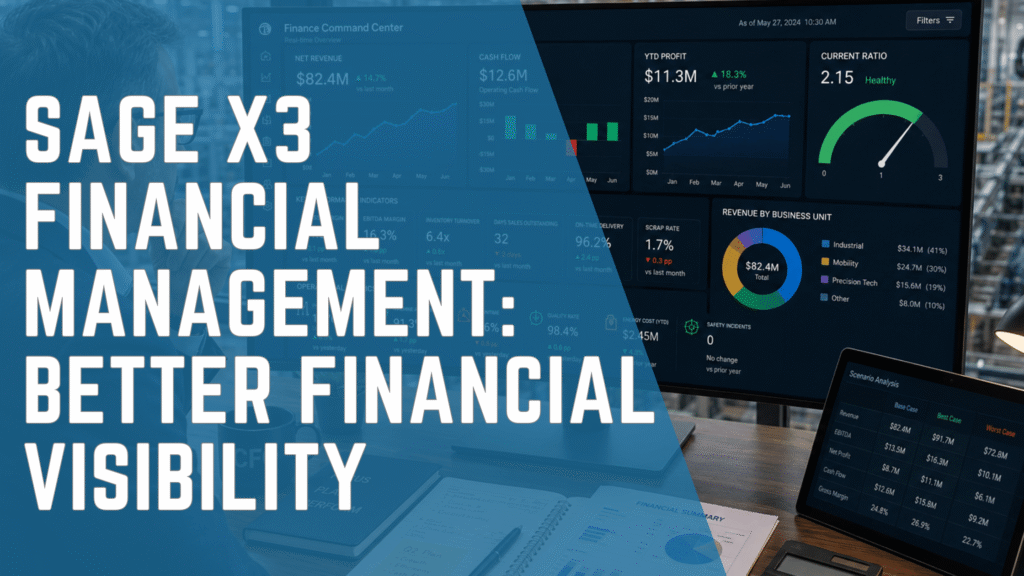
Every strategic decision starts with one question: Do we have accurate, up-to-date financial data? For CFOs, Sage X3 financial management is about more than accounting, it is about having the financial visibility needed to guide growth, manage risk, and make confident decisions.
For today’s CFOs, delayed reports and disconnected systems create more than operational headaches—they limit the ability to forecast cash flow, control costs, identify risks, and respond quickly to changing business conditions. As organizations grow, gaining a complete picture of financial performance across multiple departments, locations, and business units becomes increasingly difficult.
By bringing finance, operations, inventory, procurement, manufacturing, and reporting together in a single ERP platform, Sage X3 gives finance leaders real-time visibility into the metrics that drive business performance. Instead of spending valuable time consolidating data from multiple systems, CFOs can focus on analyzing insights, improving profitability, and supporting strategic growth.
This article explores how Sage X3 empowers CFOs with greater financial visibility, faster reporting, and the intelligence needed to make confident business decisions in an increasingly complex operating environment.
Why Financial Visibility Has Become a Strategic Priority
Financial reporting has evolved significantly over the past decade. While historical reports remain important, executive teams increasingly require predictive insights that support proactive decision-making.
Rather than simply answering what happened last month, finance departments are now expected to explain:
- What is happening today?
- Why is it happening?
- What risks are emerging?
- Which business units are performing best?
- Where are margins declining?
- How can profitability improve?
Consequently, CFOs need technology capable of delivering continuous visibility across the entire organization.
Without integrated financial management, organizations frequently experience:
| Business Challenge | Impact on Finance |
|---|---|
| Manual reporting | Slow month-end close |
| Spreadsheet dependency | Increased risk of errors |
| Disconnected systems | Limited visibility |
| Delayed financial information | Slower decision-making |
| Multiple versions of reports | Reduced confidence in data |
| Poor operational visibility | Difficulty identifying performance issues |
| Limited forecasting | Reactive financial planning |
The Growing Expectations Placed on Today's CFO
The responsibilities of CFOs continue expanding beyond accounting and compliance.
Today’s finance leaders often oversee:
- Corporate strategy
- Business performance analysis
- Budget planning
- Cash flow optimization
- Risk management
- Technology investments
- Digital transformation
- Operational performance
- Supply chain profitability
- Capital planning
Because of these broader responsibilities, CFOs require access to reliable information that extends well beyond the general ledger.
They need visibility into:
- Sales performance
- Manufacturing costs
- Procurement spending
- Inventory valuation
- Customer profitability
- Project costs
- Supply chain efficiency
- Operational KPIs
- Cash position
- Working capital
Sage X3 financial management centralizes this information within a unified ERP environment, enabling finance leaders to analyze financial and operational performance together rather than in isolation.
What Is Sage X3 Financial Management?
Sage X3 financial management is the financial core of the Sage X3 ERP platform, designed for organizations with complex operational and financial requirements. It integrates accounting, budgeting, purchasing, inventory, manufacturing, sales, and supply chain data into a single source of truth.
Instead of relying on multiple disconnected systems, finance teams can manage critical financial processes through one centralized platform.
Core financial capabilities include:
- General ledger
- Accounts payable
- Accounts receivable
- Fixed assets
- Cash management
- Bank reconciliation
- Budget management
- Cost accounting
- Multi-company accounting
- Multi-currency management
- Financial consolidation
- Tax management
- Intercompany transactions
- Financial reporting
- Compliance management
However, the real value extends beyond accounting automation. Because every operational transaction feeds directly into financial reporting, executives receive a continuously updated picture of organizational performance.
A Single Source of Truth for Financial Decision-Making
One of the biggest challenges facing finance departments is inconsistent data.
- Sales may use one reporting system.
- Operations may use another.
- Manufacturing may rely on production software.
- Finance often exports everything into spreadsheets before preparing executive reports.
This fragmented process creates several problems:
- Duplicate data
- Reporting delays
- Manual reconciliation
- Version control issues
- Human error
- Reduced confidence in reports
Sage X3 eliminates these issues by integrating financial and operational data into one centralized database.
Every transaction updates financial information in real time.
This means CFOs always work with current data rather than outdated reports.
As a result, leadership teams can:
- Monitor profitability continuously
- Compare business units instantly
- Evaluate operational performance
- Analyze departmental spending
- Track working capital
- Improve forecasting accuracy
The result is faster, more confident decision-making supported by consistent and reliable financial information.
Real-Time Visibility Across the Entire Organization
One of the greatest advantages of Sage X3 financial management is real-time reporting.
Traditional accounting systems often require finance teams to wait until month-end before obtaining a complete picture of business performance. Modern organizations cannot afford this delay.
- Business conditions change daily.
- Customer demand shifts.
- Raw material costs fluctuate.
- Exchange rates move.
- Inventory levels change constantly.
Consequently, executives need immediate visibility into financial performance.
With Sage X3, CFOs can monitor:
- Revenue trends
- Gross margin
- Operating expenses
- Cash flow
- Accounts receivable
- Accounts payable
- Inventory valuation
- Manufacturing costs
- Budget performance
- Profitability by product
- Profitability by customer
- Regional financial performance
- Multi-company results
Instead of waiting for scheduled reports, finance leaders gain continuous insight into key financial indicators. This enables quicker responses to changing market conditions and supports more agile strategic planning.
How Sage X3 Financial Management Gives CFOs Better Visibility into Business Performance
Transform Financial Reporting from Historical to Real-Time
Many finance departments spend significant time preparing reports instead of analyzing them. Data is exported from multiple systems, reconciled manually, and formatted into executive dashboards. By the time reports reach leadership, the information may already be outdated.
Sage X3 financial management changes this process by providing real-time reporting directly from a centralized ERP database. Because financial and operational transactions are captured within a single platform, reports reflect current business activity without requiring extensive manual consolidation.
As a result, finance leaders can shift their focus from gathering data to interpreting trends and advising executive teams.
Benefits of Real-Time Financial Reporting
| Traditional Reporting | Sage X3 Financial Management |
|---|---|
| Spreadsheet-driven | ERP-driven reporting |
| Manual consolidations | Automated data consolidation |
| Static monthly reports | Real-time dashboards |
| Multiple data sources | Single source of truth |
| Time-consuming updates | Live financial information |
| High risk of errors | Improved data accuracy |
This shift enables CFOs to spend more time on strategic initiatives rather than administrative reporting tasks.
Executive Dashboards That Support Better Decisions
Executive leaders require information that is clear, timely, and actionable. Instead of reviewing lengthy financial reports, they benefit from dashboards that highlight the metrics most relevant to organizational performance.
Sage X3 provides configurable dashboards that present financial and operational KPIs in an intuitive format. Consequently, CFOs can identify trends, exceptions, and opportunities without navigating multiple applications.
Typical executive dashboards include:
- Revenue performance
- Gross profit trends
- Operating margin
- EBITDA
- Working capital
- Cash position
- Inventory value
- Accounts receivable aging
- Accounts payable aging
- Budget versus actual performance
- Manufacturing costs
- Department profitability
Because dashboards refresh automatically, executives can monitor performance throughout the reporting period rather than waiting for month-end results.
Monitor Key Performance Indicators with Confidence
Every organization tracks different success metrics. However, finance leaders consistently rely on a core set of KPIs to evaluate business performance. Sage X3 financial management allows organizations to monitor these indicators continuously.
Common Financial KPIs for CFOs
| KPI | Business Value |
|---|---|
| Revenue Growth | Measures sales performance |
| Gross Margin | Evaluates profitability |
| Operating Margin | Assesses operational efficiency |
| EBITDA | Measures operating performance |
| Cash Flow | Indicates financial health |
| Days Sales Outstanding (DSO) | Evaluates receivable efficiency |
| Days Payable Outstanding (DPO) | Measures payment strategy |
| Inventory Turnover | Optimizes working capital |
| Current Ratio | Evaluates liquidity |
| Return on Assets (ROA) | Measures asset utilization |
Instead of calculating these metrics manually, Sage X3 automatically derives them from live transactional data. Therefore, finance leaders gain immediate insight into organizational performance while reducing the likelihood of reporting errors.
Improve Cash Flow Visibility Across the Organization
Cash flow remains one of the most important responsibilities for every CFO. Even profitable organizations can face operational challenges if cash flow is poorly managed. Without integrated financial information, monitoring liquidity often requires combining reports from accounting, banking, procurement, sales, and inventory systems.
Sage X3 simplifies this process by consolidating relevant financial information into one environment.
Finance teams can monitor:
- Daily cash balances
- Outstanding receivables
- Vendor obligations
- Future payment schedules
- Customer collections
- Inventory investments
- Purchase commitments
- Operational spending
- Capital expenditures
As a result, CFOs gain a clearer understanding of cash availability and can make informed financing and investment decisions.
How Sage X3 Supports Cash Flow Management
- Automated receivable tracking
- Improved collection visibility
- Integrated payable management
- Bank reconciliation automation
- Cash forecasting
- Liquidity monitoring
- Working capital analysis
- Payment scheduling
Consequently, organizations can improve financial stability while reducing unnecessary borrowing costs.
Strengthen Budgeting and Forecasting
Traditional budgeting often becomes outdated shortly after approval. Market conditions, customer demand, supply chain disruptions, and changing costs can quickly alter financial assumptions.
Modern finance departments require forecasting capabilities that adapt to changing business conditions. Sage X3 financial management supports continuous financial planning through integrated budgeting and forecasting.
Finance teams can:
- Develop annual budget
- Monitor departmental spending
- Compare actual versus budget
- Identify budget variances
- Update rolling forecasts
- Analyze future scenariosSupport strategic planning
Because operational data is integrated with financial information, forecasting becomes significantly more accurate. For example, increased production costs immediately affect profitability forecasts, allowing finance leaders to respond before margins decline.
Gain Visibility Across Multiple Companies and Locations
Many growing organizations operate multiple legal entities, business units, warehouses, or international subsidiaries. Managing financial performance across these operations can become increasingly complex when each entity uses separate accounting systems.
Sage X3 financial management supports:
- Multi-company accounting
- Multi-site operations
- Multi-legislation compliance
- Multi-currency transactions
- Multi-language environments
- Intercompany accounting
- Financial consolidation
Consequently, CFOs can evaluate enterprise-wide performance while maintaining visibility into individual business units.
Advantages of Multi-Entity Financial Management
| Capability | CFO Benefit |
|---|---|
| Consolidated Reporting | Faster executive reporting |
| Intercompany Automation | Reduced reconciliation |
| Currency Conversion | Improved global visibility |
| Standardized Reporting | Consistent financial analysis |
| Shared Chart of Accounts | Better governance |
| Centralized Controls | Improved compliance |
This level of visibility enables leadership teams to compare performance across regions while maintaining consistent reporting standards.
Connect Financial Performance with Operational Performance
Financial reports alone rarely explain why business performance changes.
- Revenue may decline because of supply chain delays.
- Margins may shrink because of increased manufacturing costs.
- Cash flow may tighten because inventory levels increase unexpectedly.
Therefore, CFOs need operational context alongside financial information.
Sage X3 integrates finance with:
- Manufacturing
- Procurement
- Inventory management
- Supply chain
- Sales
- Distribution
- Customer service
- Project management
This integration allows finance leaders to understand the operational drivers behind financial outcomes.
For example, if inventory carrying costs increase, the finance team can immediately analyze purchasing patterns, warehouse utilization, and production schedules to identify the root cause. As a result, decision-making becomes faster and more informed.
Improve Manufacturing Cost Visibility
For manufacturers, production costs directly influence profitability. However, many organizations struggle to identify where costs increase until after financial statements are completed.
Sage X3 provides detailed visibility into manufacturing expenses, including:
- Material costs
- Labor costs
- Machine utilization
- Production efficiency
- Scrap and waste
- Overhead allocation
- Work-in-progress
- Finished goods valuation
Because these metrics integrate directly with financial reporting, CFOs can monitor profitability at a much more detailed level.
This visibility helps organizations:
- Reduce waste
- Improve production planning
- Protect profit margins
- Optimize inventory investment
- Increase operational efficiency
Rather than reacting after month-end, finance leaders can work proactively with operations teams to improve performance.
Enable Better Collaboration Between Finance and Operations
Historically, finance and operations have worked with separate systems and different reporting methods. This separation often creates conflicting data, delays, and misaligned priorities.
Sage X3 helps bridge this gap by providing a unified platform where finance and operational teams access the same information.
Benefits include:
- Shared business metrics
- Consistent reporting
- Faster cross-functional decision-making
- Greater transparency
- Reduced manual data sharing
- Improved accountability
Consequently, CFOs, operations managers, and executive leadership can collaborate using trusted, real-time information.
How Sage X3 Financial Management Gives CFOs Better Visibility into Business Performance
Strengthen Financial Compliance and Risk Management
As organizations grow, maintaining compliance with accounting standards, tax regulations, and internal governance becomes increasingly complex. CFOs must balance operational agility with robust financial controls to reduce risk and protect the organization.
Sage X3 financial management helps finance teams establish standardized processes and improve governance across the enterprise.
Key capabilities include:
- Role-based security and user permissions
- Comprehensive audit trails
- Workflow approvals
- Electronic document management
- Tax and regulatory compliance support
- Financial controls across multiple entities
- Segregation of duties
- Automated validation rules
Because every financial transaction is recorded within a centralized ERP environment, organizations can improve transparency and simplify internal and external audits. As a result, finance teams spend less time gathering supporting documentation and more time focusing on strategic financial management.
Automate Routine Financial Processes
Manual finance processes consume valuable time and increase the likelihood of errors. Activities such as invoice processing, bank reconciliations, journal entries, and approvals often require repetitive work that limits the finance team’s ability to contribute strategically.
Sage X3 automates many of these routine processes, enabling finance professionals to focus on analysis and decision-making.
Examples of automation include:
- Automated journal entries
- Invoice matching
- Approval workflows
- Bank reconciliations
- Recurring transactions
- Financial allocations
- Currency revaluations
- Intercompany processing
Benefits of Financial Automation
| Manual Process | Sage X3 Automation Benefit |
|---|---|
| Invoice Approvals | Faster processing and improved controls |
| Bank Reconciliation | Reduced manual effort |
| Month-End Close | Shorter closing cycles |
| Intercompany Accounting | Automated eliminations and reconciliation |
| Financial Allocations | Consistent and accurate distribution |
| Approval Routing | Better governance and accountability |
By reducing administrative tasks, finance teams can dedicate more time to forecasting, business partnering, and performance improvement.
Support Data-Driven Decision-Making with Advanced Analytics
Modern CFOs are expected to provide insights that guide business strategy, not just report historical results. Access to timely analytics enables finance leaders to identify trends, evaluate performance, and respond quickly to changing market conditions.
Sage X3 integrates financial and operational data, making it easier to analyze:
- Revenue by product line
- Customer profitability
- Inventory carrying costs
- Manufacturing efficiency
- Procurement spending
- Gross margin by region
- Budget variances
- Working capital trends
Because these insights are generated from a unified data source, decision-makers can rely on consistent and accurate information. Furthermore, organizations can build customized reports and dashboards that align with executive priorities and industry-specific KPIs.
Scale Financial Operations as the Business Grows
Growth introduces new financial complexities, including additional business units, locations, currencies, and regulatory requirements. Systems that work well for smaller organizations often struggle to support expanding operations.
Sage X3 is designed to scale alongside growing businesses by supporting:
- Multi-company structures
- International operations
- Multi-currency accounting
- Multi-language environments
- High transaction volumes
- Complex approval workflows
- Advanced financial reporting
Consequently, organizations can continue using a single ERP platform as they expand into new markets or acquire additional entities. This scalability helps reduce the need for costly system replacements while maintaining consistent financial governance across the organization.
Why Sage X3 Is an Ideal Solution for Manufacturing and Distribution CFOs
Organizations in manufacturing, food and beverage, wholesale distribution, and other inventory-intensive industries face unique financial challenges.
Finance leaders must manage:
- Fluctuating raw material costs
- Inventory valuation
- Production efficiency
- Supply chain disruptions
- Customer demand variability
- Regulatory compliance
- Margin pressure
Sage X3 connects financial management with manufacturing, inventory, procurement, and supply chain operations. This integration enables CFOs to understand how operational performance directly affects financial outcomes.
For example:
- Rising material costs can immediately be reflected in profitability analysis.
- Inventory levels can be evaluated alongside working capital metrics.
- Production delays can be linked to revenue forecasts.
- Procurement spending can be monitored against departmental budgets.
This level of operational visibility allows finance leaders to collaborate more effectively with operations, procurement, and executive management.
How IWI Consulting Group Helps Organizations Maximize Sage X3
Selecting an ERP platform is only one step in a successful digital transformation. Achieving long-term value depends on thoughtful implementation, process optimization, user adoption, and ongoing support.
IWI Consulting Group has more than 22 years of experience delivering ERP consulting services across Canada and has successfully completed 500+ ERP projects. Rather than acting solely as a software reseller, IWI works as a strategic consulting partner that helps organizations align technology investments with business objectives.
For organizations implementing or optimizing Sage X3, IWI provides services such as:
- ERP assessments
- Business process analysis
- Solution design
- Sage X3 implementation
- Data migration
- Financial process optimization
- System integration
- User training
- Ongoing ERP support
- Continuous improvement planning
By combining deep ERP expertise with industry knowledge, IWI helps finance leaders improve reporting, automate processes, and gain greater visibility into business performance.
Frequently Asked Questions
1. What is Sage X3 financial management?
Sage X3 financial management is the financial component of the Sage X3 ERP platform. It integrates accounting, budgeting, cash management, reporting, procurement, manufacturing, and operational data into a single system, providing finance teams with real-time visibility into business performance.
2. How does Sage X3 improve financial visibility?
Sage X3 consolidates financial and operational information into one centralized platform. As a result, CFOs can monitor KPIs, profitability, cash flow, and business performance using real-time dashboards and reports.
3. Is Sage X3 suitable for multi-company organizations?
Yes. Sage X3 supports multi-company, multi-site, multi-currency, and multi-language operations, making it well suited for organizations with complex structures and international operations.
4. Can Sage X3 automate finance processes?
Yes. Sage X3 automates routine financial activities such as invoice processing, journal entries, approval workflows, bank reconciliations, and intercompany transactions, helping finance teams improve efficiency and reduce manual work.
5. How does Sage X3 support budgeting and forecasting?
The platform enables organizations to create budgets, compare actual performance against forecasts, monitor variances, and update rolling forecasts using integrated financial and operational data.
6. Which industries benefit most from Sage X3 financial management?
Sage X3 is particularly well suited for manufacturing, food and beverage, wholesale distribution, chemicals, industrial equipment, and other organizations with complex operational and financial requirements.
7. How does Sage X3 help with financial reporting?
Sage X3 provides configurable reports and dashboards that deliver real-time financial insights, helping finance leaders reduce reporting cycles and improve decision-making.
8. Does Sage X3 support compliance and audit requirements?
Yes. Sage X3 includes audit trails, workflow approvals, role-based security, and financial controls that help organizations strengthen governance and simplify compliance.
9. Can Sage X3 scale as a business grows?
Absolutely. Sage X3 is designed to support expanding organizations with increasing transaction volumes, additional business units, international operations, and evolving reporting requirements.
10. Why should Canadian organizations work with IWI Consulting Group for Sage X3?
IWI Consulting Group combines more than 22 years of ERP consulting experience with over 500 successful projects delivered across Canada. The team provides strategic guidance, implementation expertise, migration services, optimization, training, and long-term support to help organizations maximize the value of their Sage X3 investment.
Conclusion
For today’s CFOs, visibility is no longer a competitive advantage—it is a business necessity. Organizations that rely on fragmented systems and manual reporting often struggle to respond quickly to changing market conditions, manage risk effectively, or identify opportunities for growth.
Sage X3 financial management addresses these challenges by bringing financial and operational data together within a unified ERP platform. Real-time reporting, automated workflows, advanced analytics, and scalable multi-entity capabilities empower finance leaders to move beyond transactional accounting and become strategic partners to the business.
For Canadian organizations seeking to modernize their finance function, Sage X3 offers the tools needed to improve decision-making, strengthen financial governance, and support sustainable growth. With the guidance of an experienced implementation partner such as IWI Consulting Group, businesses can confidently transform their financial operations and build a foundation for long-term success.
Conclusion
For today’s CFOs, visibility is no longer a competitive advantage—it is a business necessity. Organizations that rely on fragmented systems and manual reporting often struggle to respond quickly to changing market conditions, manage risk effectively, or identify opportunities for growth.
Sage X3 financial management addresses these challenges by bringing financial and operational data together within a unified ERP platform. Real-time reporting, automated workflows, advanced analytics, and scalable multi-entity capabilities empower finance leaders to move beyond transactional accounting and become strategic partners to the business.
For Canadian organizations seeking to modernize their finance function, Sage X3 offers the tools needed to improve decision-making, strengthen financial governance, and support sustainable growth. With the guidance of an experienced implementation partner such as IWI Consulting Group, businesses can confidently transform their financial operations and build a foundation for long-term success.