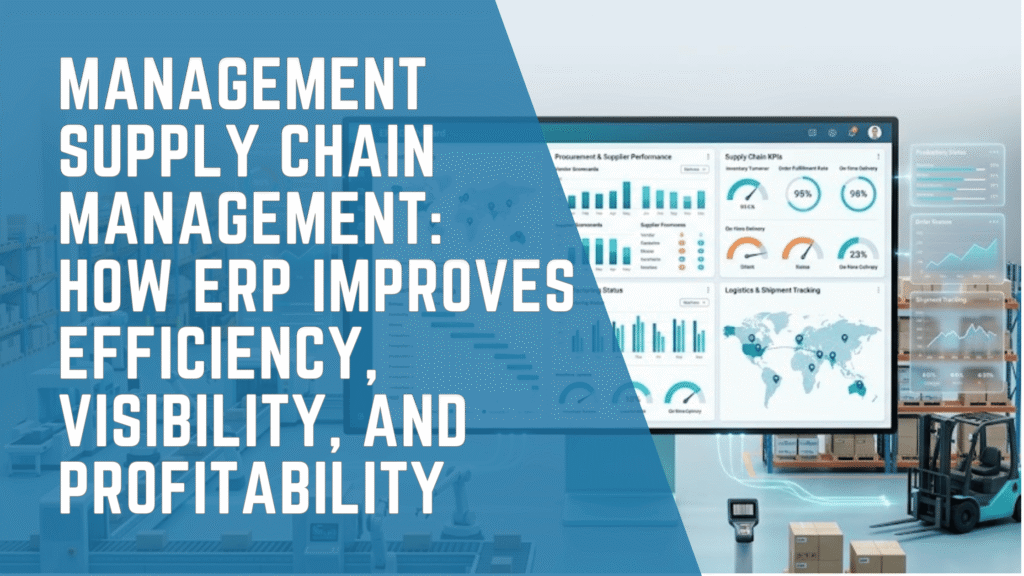
Today’s supply chains are more complex than ever. Manufacturers and distributors must balance customer demand, supplier performance, inventory levels, production schedules, and transportation costs while responding to ongoing market disruptions. A delay in one part of the supply chain can quickly affect operations, customer satisfaction, and profitability.
Many organizations still rely on disconnected spreadsheets, legacy software, or manual processes to manage purchasing, inventory, production, and fulfillment. While these methods may work for smaller operations, they become increasingly difficult to maintain as the business grows. Limited visibility into inventory, supplier lead times, and production capacity often results in stockouts, excess inventory, missed delivery deadlines, and higher operating costs.
This is where management supply chain management becomes a competitive advantage. Rather than treating procurement, manufacturing, warehousing, logistics, and finance as separate functions, effective supply chain management connects every stage of the business into one coordinated process. With accurate, real-time data, decision-makers can respond faster to changing demand, improve resource planning, reduce waste, and deliver better customer experiences.
Modern Enterprise Resource Planning (ERP) software takes this one step further by providing a centralized platform that integrates inventory management, purchasing, production planning, warehouse operations, financial management, and analytics. Instead of waiting for reports from multiple systems, business leaders gain a real-time view of their entire supply chain, allowing them to identify risks, monitor performance, and make informed decisions with confidence.
Whether your organization manufactures products, distributes inventory across multiple locations, or manages a complex supplier network, investing in the right ERP solution can improve operational efficiency, strengthen supply chain resilience, and support long-term business growth.
In this guide, we’ll explain what management supply chain management is, explore the challenges organizations face, discuss the core components of a modern supply chain, and show how ERP solutions such as Sage X3 and Sage 300 help manufacturers and distributors operate more efficiently.
What Is Management Supply Chain Management?
Management supply chain management is the process of planning, coordinating, and optimizing the flow of materials, products, information, and finances throughout the entire supply chain. Its goal is to ensure that products move efficiently from suppliers to manufacturers, warehouses, distributors, retailers, and ultimately to customers while minimizing costs and maintaining service quality.
An effective supply chain involves much more than purchasing materials or shipping finished products. It requires collaboration between multiple departments—including procurement, inventory, production, sales, logistics, finance, and customer service—to ensure every stage of the operation supports business objectives.
When these departments operate in isolation, organizations often experience delays, duplicate work, inaccurate reporting, and inconsistent decision-making. Integrated ERP software helps eliminate these issues by connecting business processes within a single system, giving stakeholders access to consistent, real-time information across the organization.
The Supply Chain Lifecycle
Most manufacturing and distribution organizations manage a supply chain that follows these stages:
- Supplier Management – Selecting and managing vendors that provide raw materials, components, or finished goods.
- Procurement – Purchasing materials based on production schedules, demand forecasts, and inventory requirements.
- Inventory Management – Monitoring stock levels, warehouse locations, safety stock, and inventory movement to maintain optimal inventory levels.
- Production Planning – Scheduling manufacturing activities, allocating resources, and ensuring materials are available when needed.
- Warehouse Operations – Receiving, storing, picking, packing, and preparing products for shipment.
- Transportation and Logistics – Coordinating shipments, managing carriers, tracking deliveries, and optimizing transportation costs.
- Order Fulfillment – Processing customer orders accurately and delivering products on time.
- Returns and Customer Service – Managing product returns, warranty claims, and customer support while maintaining product quality and customer satisfaction.
Each stage depends on accurate information from the previous step. If inventory levels are incorrect or supplier lead times change unexpectedly, production schedules, delivery commitments, and customer satisfaction can all be affected.
Why Management Supply Chain Management Matters
Supply chain management has become a strategic priority for organizations across manufacturing, distribution, wholesale, and industrial sectors. Global supply disruptions, changing customer expectations, labor shortages, and rising operational costs have highlighted the importance of having complete visibility into business operations.
Organizations with well-managed supply chains are better equipped to:
- Improve inventory accuracy and reduce carrying costs
- Minimize stockouts and excess inventory
- Strengthen supplier relationships through better communication
- Improve production planning and resource utilization
- Respond quickly to demand fluctuations
- Reduce operational inefficiencies
- Increase on-time order fulfillment
- Improve customer satisfaction and retention
- Support profitable business growth
Instead of reacting to problems after they occur, businesses with integrated supply chain management can identify trends earlier, anticipate disruptions, and make proactive decisions based on real-time information.
For example, if a supplier experiences production delays, an ERP system can help purchasing teams identify alternative suppliers, notify production managers of potential material shortages, and adjust manufacturing schedules before customer orders are affected. Similarly, if demand unexpectedly increases for a particular product, inventory and production teams can respond quickly using accurate sales forecasts and inventory data.
As organizations grow and operations become more complex, this level of visibility becomes increasingly important. Without a centralized system to connect purchasing, inventory, production, warehousing, logistics, and finance, businesses often struggle to maintain efficiency and profitability.
Common Supply Chain Challenges
Even organizations with experienced supply chain teams face operational challenges that affect productivity, customer service, and profitability. Many of these issues stem from disconnected systems, limited visibility, and manual processes rather than the supply chain itself.
Limited Visibility Across Operations
When purchasing, inventory, production, finance, and sales rely on different software or spreadsheets, decision-makers lack a complete view of business performance. Teams often spend valuable time gathering data from multiple sources instead of acting on accurate information.
Inventory Imbalances
Maintaining the right inventory levels is a constant challenge. Overstocking ties up working capital and increases storage costs, while understocking can lead to production delays, backorders, and lost sales.
Without real-time inventory visibility, organizations may also experience duplicate purchases, obsolete inventory, and inaccurate stock counts.
Demand Forecasting Difficulties
Customer demand changes quickly due to seasonality, market conditions, promotions, and economic trends. Relying on historical sales data alone often results in inaccurate forecasts that create inventory shortages or excess stock.
Modern ERP systems support more accurate forecasting by combining historical data with current sales activity, inventory levels, supplier lead times, and production capacity.
Supplier Performance Issues
Supplier delays, inconsistent quality, and fluctuating lead times can disrupt production schedules and increase operating costs. Organizations need accurate supplier performance data to evaluate vendors, manage purchasing decisions, and reduce supply chain risks.
Manual Processes and Data Entry
Many businesses still manage purchasing approvals, inventory updates, production scheduling, and reporting manually. These repetitive tasks consume valuable employee time while increasing the likelihood of errors.
Automating routine workflows through an ERP system helps improve accuracy, reduce administrative work, and allow employees to focus on higher-value activities.
The Core Components of Supply Chain Management
A successful supply chain relies on several interconnected processes that work together to move products efficiently from suppliers to customers. When each component is managed independently, organizations often experience delays, communication gaps, and inaccurate reporting. An integrated ERP system brings these functions together, providing a single source of truth that improves collaboration, visibility, and decision-making.
Procurement Management
Procurement is responsible for sourcing raw materials, components, and services needed to support production and customer demand. Effective procurement involves much more than purchasing at the lowest price. Businesses must evaluate supplier performance, negotiate contracts, monitor lead times, and ensure materials arrive when needed.
An ERP system centralizes purchasing activities by allowing organizations to:
- Automate purchase requisitions and purchase orders
- Track supplier pricing and performance
- Monitor lead times and delivery schedules
- Reduce duplicate purchasing
- Improve approval workflows
- Maintain accurate procurement records
With better procurement management, organizations can reduce purchasing costs while strengthening supplier relationships and minimizing supply disruptions.
Inventory Management
Inventory is one of the largest investments for many manufacturers and distributors. Maintaining too much inventory increases carrying costs, while insufficient inventory can delay production and customer deliveries.
Modern inventory management focuses on maintaining the right products in the right quantities at the right locations.
ERP software provides organizations with:
- Real-time inventory visibility
- Multi-warehouse inventory tracking
- Lot and serial number traceability
- Automated replenishment
- Cycle counting
- Safety stock management
- Inventory valuation
- Expiration and shelf-life tracking
Instead of relying on periodic inventory counts, managers can monitor inventory movement in real time and make informed purchasing decisions based on current demand.
Demand Planning and Forecasting
Accurate demand forecasting helps organizations purchase materials, schedule production, and allocate resources more effectively.
Traditional forecasting often depends on historical sales alone, making it difficult to respond to changing customer behavior or unexpected market conditions.
Modern ERP systems improve forecasting by combining multiple data sources, including:
- Historical sales trends
- Current customer orders
- Seasonal demand patterns
- Inventory availability
- Supplier lead times
- Production capacity
- Promotional activities
More accurate forecasts reduce stock shortages, excess inventory, and costly production interruptions while improving customer service.
Production Planning
Manufacturers must coordinate materials, labor, machinery, and production schedules to meet customer demand efficiently.
Without integrated planning, production managers often spend valuable time adjusting schedules, locating missing materials, or responding to unexpected delays.
ERP software supports production planning by helping organizations:
- Schedule production orders
- Allocate labor and equipment
- Track work-in-progress
- Monitor production capacity
- Reduce manufacturing bottlenecks
- Improve resource utilization
Better production planning helps manufacturers increase throughput while reducing downtime and waste.
Warehouse Management
Warehouse operations directly affect inventory accuracy, order fulfillment, and customer satisfaction.
An ERP solution helps warehouse teams manage:
- Receiving inventory
- Put-away processes
- Bin locations
- Picking
- Packing
- Shipping
- Transfers between facilities
- Cycle counting
Real-time warehouse visibility helps reduce fulfillment errors while improving productivity and inventory accuracy across multiple locations.
Logistics and Distribution
Transportation costs continue to rise, making logistics optimization increasingly important.
Integrated ERP systems help organizations:
- Coordinate shipments
- Track deliveries
- Manage freight costs
- Optimize shipping routes
- Improve carrier performance
- Provide customers with accurate delivery updates
This visibility helps businesses improve delivery performance while reducing transportation expenses.
Order Management
Customers expect accurate orders and faster delivery times.
Order management connects sales, inventory, warehouse operations, production, and finance into one streamlined process.
ERP software enables organizations to:
- Process orders faster
- Verify inventory availability
- Allocate inventory automatically
- Track order status
- Reduce fulfillment delays
- Improve customer communication
A connected order management process improves customer satisfaction while reducing manual administrative work.
How ERP Improves Management Supply Chain Management
Managing today’s supply chain requires more than individual software solutions for accounting, inventory, purchasing, or production. Modern organizations need a centralized platform that provides visibility across the entire business.
Enterprise Resource Planning (ERP) software connects critical business functions into one integrated system, enabling teams to make faster, more informed decisions based on accurate, real-time information.
Provides Real-Time Visibility Across the Business
One of the greatest advantages of ERP software is complete operational visibility.
Instead of switching between multiple systems, business leaders can monitor purchasing, inventory, manufacturing, warehouse operations, sales, and financial performance from a single dashboard.
Real-time visibility helps organizations:
- Detect inventory shortages before they affect production
- Monitor supplier performance
- Identify production bottlenecks
- Improve demand forecasting
- Track key operational metrics
- Respond quickly to market changes
This visibility enables proactive decision-making instead of reacting to issues after they occur.
Eliminates Data Silos
Many businesses struggle with disconnected systems that require employees to manually transfer information between departments.
ERP software creates a centralized database where every department works from the same information.
Benefits include:
- Consistent reporting
- Fewer manual errors
- Improved collaboration
- Faster approvals
- Better financial accuracy
- More reliable forecasting
Departments no longer rely on outdated spreadsheets or duplicate data entry, resulting in greater efficiency across the organization.
Improves Inventory Accuracy
Inventory errors often lead to excess stock, stockouts, delayed production, and dissatisfied customers.
ERP software automatically updates inventory whenever products are purchased, manufactured, transferred, or shipped.
Organizations benefit from:
- Accurate inventory balances
- Lower carrying costs
- Improved warehouse efficiency
- Better replenishment planning
- Reduced obsolete inventory
- Higher inventory turnover
With greater visibility into inventory levels, businesses can maintain optimal stock while reducing unnecessary expenses.
Automates Procurement
Purchasing teams spend less time processing paperwork and more time managing supplier relationships when procurement is automated.
ERP systems support:
- Purchase requisitions
- Approval workflows
- Purchase orders
- Vendor management
- Contract tracking
- Supplier performance reporting
Automation reduces purchasing delays while improving compliance with internal policies.
Optimizes Production Scheduling
Manufacturing organizations depend on accurate production schedules to maximize equipment utilization and meet customer deadlines.
ERP software helps production managers:
- Balance workloads
- Schedule resources efficiently
- Monitor production progress
- Identify delays early
- Reduce downtime
- Improve on-time production
Better scheduling leads to increased productivity and lower manufacturing costs.
Enhances Warehouse Efficiency
Warehouse teams benefit from real-time inventory information that reduces picking errors and improves fulfillment speed.
ERP capabilities include:
- Barcode scanning
- Mobile inventory updates
- Bin location management
- Warehouse transfers
- Shipping verification
- Cycle counting
Improved warehouse processes increase order accuracy while lowering labor costs.
Supports Better Business Intelligence
Business leaders need more than operational data—they need actionable insights.
ERP reporting tools allow executives to analyze:
- Inventory trends
- Supplier performance
- Customer demand
- Production efficiency
- Financial performance
- Profitability by product
- Warehouse performance
Interactive dashboards make it easier to identify opportunities for improvement and respond quickly to changing business conditions.
Benefits of ERP for Supply Chain Management
Organizations that implement an integrated ERP solution often experience improvements across every stage of the supply chain.
| Traditional Supply Chain | ERP-Enabled Supply Chain |
|---|---|
| Disconnected spreadsheets | Centralized data platform |
| Delayed reporting | Real-time dashboards |
| Manual purchasing | Automated procurement workflows |
| Limited inventory visibility | Real-time inventory management |
| Reactive production scheduling | Data-driven production planning |
| Warehouse inefficiencies | Optimized warehouse operations |
| Manual forecasting | Advanced demand forecasting |
| Separate finance and operations | Integrated financial and operational data |
| Slow decision-making | Faster, data-driven decisions |
| Limited business insights | Interactive reporting and analytics |
These improvements help organizations reduce operational costs, improve service levels, and build more resilient supply chains capable of adapting to changing market conditions.
Key Supply Chain KPIs Every Organization Should Monitor
Measuring performance is essential for continuous improvement. The following key performance indicators (KPIs) help organizations evaluate the effectiveness of their supply chain management strategy.
| KPI | What It Measures | Business Value |
|---|---|---|
| Inventory Turnover | How efficiently inventory is sold and replenished | Reduces carrying costs and improves cash flow |
| Order Fill Rate | Percentage of orders fulfilled from available inventory | Improves customer satisfaction |
| On-Time Delivery | Orders delivered as promised | Strengthens customer relationships |
| Perfect Order Rate | Orders delivered accurately and without issues | Measures fulfillment quality |
| Supplier Lead Time | Time suppliers take to deliver materials | Improves purchasing and production planning |
| Forecast Accuracy | Accuracy of demand predictions | Reduces stockouts and excess inventory |
| Cash-to-Cash Cycle Time | Time between paying suppliers and receiving customer payments | Improves working capital management |
| Days Inventory Outstanding (DIO) | Average time inventory remains in stock | Indicates inventory efficiency |
| Warehouse Order Accuracy | Accuracy of picking and shipping processes | Reduces returns and fulfillment errors |
| Production Schedule Attainment | Percentage of production completed as planned | Measures manufacturing efficiency |
Monitoring these KPIs through an ERP dashboard allows organizations to identify trends, address performance issues early, and make informed decisions that improve operational efficiency and profitability.
Why Real-Time Visibility Is Critical for Supply Chain Success
In today’s business environment, supply chain decisions must be made quickly and with confidence. Delays in receiving inventory updates, supplier information, or production data can result in missed customer deadlines, unnecessary costs, and lost revenue.
Real-time visibility allows organizations to monitor every stage of the supply chain from a centralized dashboard. Instead of waiting for manual reports or reconciling information from multiple systems, managers can access current data whenever they need it.
With complete operational visibility, organizations can:
- Monitor inventory across multiple warehouses and locations
- Track purchase orders and supplier performance
- Identify production delays before they impact customer orders
- View sales trends and demand changes in real time
- Monitor order fulfillment and shipping status
- Analyze financial and operational performance from a single platform
This level of visibility helps departments work together more effectively. Purchasing can see production requirements, warehouse teams can monitor incoming inventory, finance can understand inventory costs, and executives can evaluate business performance using consistent, accurate data.
Instead of reacting to problems after they occur, organizations gain the ability to identify risks early, make proactive decisions, and improve overall operational efficiency.
How Sage X3 Supports Modern Supply Chain Management
For manufacturers, distributors, and process-based organizations with complex operations, Sage X3 provides a comprehensive ERP platform that connects every stage of the supply chain.
Rather than managing purchasing, production, inventory, warehousing, and finance through separate applications, Sage X3 integrates these functions into one centralized system.
Inventory Management
Sage X3 provides real-time inventory visibility across multiple warehouses, companies, and geographic locations.
Organizations can:
- Track inventory balances instantly
- Monitor lot and serial numbers
- Manage expiration dates and shelf life
- Perform cycle counts
- Automate replenishment
- Optimize inventory levels
This helps reduce excess inventory while ensuring products remain available to meet customer demand.
Purchasing and Supplier Management
Purchasing teams can automate procurement activities while maintaining greater control over supplier relationships.
Capabilities include:
- Purchase requisitions
- Purchase orders
- Supplier performance monitoring
- Contract management
- Approval workflows
- Lead time tracking
These tools help reduce purchasing delays while improving supplier accountability.
Manufacturing and Production Planning
Manufacturers can improve production efficiency through integrated planning and scheduling.
Sage X3 supports:
- Bills of materials (BOM)
- Material requirements planning (MRP)
- Work order management
- Capacity planning
- Production scheduling
- Shop floor reporting
- Quality control
Production managers gain better visibility into resource availability, helping reduce downtime and improve manufacturing performance.
Warehouse Management
Warehouse teams benefit from real-time inventory tracking and streamlined warehouse operations.
Features include:
- Multi-location inventory management
- Barcode scanning
- Warehouse transfers
- Bin management
- Picking and packing
- Shipping management
- Inventory traceability
These capabilities improve order accuracy while reducing labor-intensive manual processes.
Business Intelligence and Reporting
Sage X3 provides interactive dashboards and reporting tools that allow decision-makers to monitor operational performance in real time.
Organizations can analyze:
- Inventory trends
- Purchasing performance
- Manufacturing efficiency
- Financial results
- Sales performance
- Customer demand
- Supply chain KPIs
Having immediate access to reliable information enables faster, more confident business decisions.
When Sage 300 Is the Right ERP Solution
Businesses commonly use Sage 300 to improve:
- Financial management
- Inventory control
- Purchasing
- Sales order processing
- Warehouse management
- Multi-company operations
- Multi-currency transactions
- Financial reporting
As organizations expand, Sage 300 helps improve operational efficiency while providing greater visibility into inventory, purchasing, and financial performance.
How to Choose the Right ERP for Supply Chain Management
Selecting an ERP solution is a strategic business decision that affects every department. The right platform should not only address current operational challenges but also support future growth.
When evaluating ERP software, consider the following factors:
Industry Requirements
Manufacturing, distribution, food and beverage, chemical processing, and industrial organizations often have unique operational requirements such as lot traceability, quality management, regulatory compliance, or production scheduling. Choose a solution that aligns with your industry’s processes.
Business Size and Complexity
Your ERP should match both your current needs and future growth plans. Consider the number of users, warehouse locations, production facilities, and business entities you expect to manage over time.
Supply Chain Capabilities
Evaluate how well the solution supports:
- Inventory management
- Purchasing
- Production planning
- Warehouse management
- Logistics
- Demand forecasting
- Reporting and analytics
An integrated platform helps eliminate data silos and improves collaboration across departments.
Reporting and Analytics
Access to real-time dashboards and customizable reports allows leaders to make faster, data-driven decisions. Look for ERP software that provides actionable insights into inventory, production, financial performance, and supply chain KPIs.
Integration
Your ERP should integrate with the business applications you already use, including CRM systems, eCommerce platforms, shipping software, business intelligence tools, and third-party logistics providers.
Scalability
As your organization grows, your ERP should support additional users, locations, product lines, and operational complexity without requiring a complete system replacement.
Implementation Partner
Technology alone does not guarantee success. An experienced implementation partner can help evaluate your business processes, configure the system, train users, and provide ongoing support to maximize your ERP investment.
Frequently Asked Questions
What is management supply chain management?
Management supply chain management is the process of planning, coordinating, and optimizing the movement of materials, products, information, and finances from suppliers to customers. Its goal is to improve efficiency, reduce costs, and deliver products on time while maintaining high customer satisfaction.
Why is supply chain management important?
Effective supply chain management improves operational efficiency, reduces inventory costs, minimizes production delays, strengthens supplier relationships, and enhances customer service. It also helps organizations respond more effectively to market changes and supply chain disruptions.
How does ERP improve supply chain management?
ERP software integrates purchasing, inventory, manufacturing, warehousing, sales, finance, and reporting into one centralized platform. This provides real-time visibility, automates manual processes, improves collaboration, and supports faster, data-driven decision-making.
What are the key stages of supply chain management?
A typical supply chain includes supplier management, procurement, inventory management, production planning, warehouse operations, logistics, order fulfillment, and customer service.
What is supply chain visibility?
Supply chain visibility is the ability to monitor inventory, supplier performance, production, warehouse operations, and customer orders in real time. Greater visibility enables organizations to identify issues early and make informed business decisions.
What is the difference between ERP and supply chain management software?
Supply chain management software primarily focuses on logistics, inventory, and procurement. ERP software includes these capabilities while also integrating finance, accounting, manufacturing, customer management, reporting, and other core business functions into a single platform.
Is Sage X3 a good ERP for manufacturers?
Yes. Sage X3 is designed for manufacturers and distributors that require advanced inventory management, production planning, purchasing, quality control, warehouse management, and financial integration within one ERP system.
When should a business upgrade to an ERP system?
Organizations should consider implementing an ERP system when manual processes, disconnected software, limited visibility, inaccurate reporting, or operational inefficiencies begin to affect productivity, customer service, or profitability.
Conclusion
Effective management supply chain management is essential for organizations that want to improve efficiency, reduce costs, and remain competitive in an increasingly complex business environment. By connecting procurement, inventory management, production planning, warehouse operations, logistics, and order fulfillment, businesses can gain greater visibility into their operations and make faster, more informed decisions.
Modern ERP software takes supply chain management a step further by providing a centralized platform that eliminates data silos, automates routine processes, improves forecasting, and delivers real-time insights across the organization. With integrated data and streamlined workflows, manufacturers and distributors can optimize inventory, strengthen supplier relationships, enhance operational performance, and build a more resilient supply chain.
Whether your organization is modernizing existing processes or planning for future growth, investing in the right ERP solution can provide the foundation for better decision-making, increased productivity, and long-term business success.
At IWI Consulting Group, we help manufacturers and distributors evaluate, implement, and optimize ERP solutions such as Sage X3 and Sage 300. Contact our team to discover how the right ERP platform can help improve your supply chain performance and support sustainable growth.