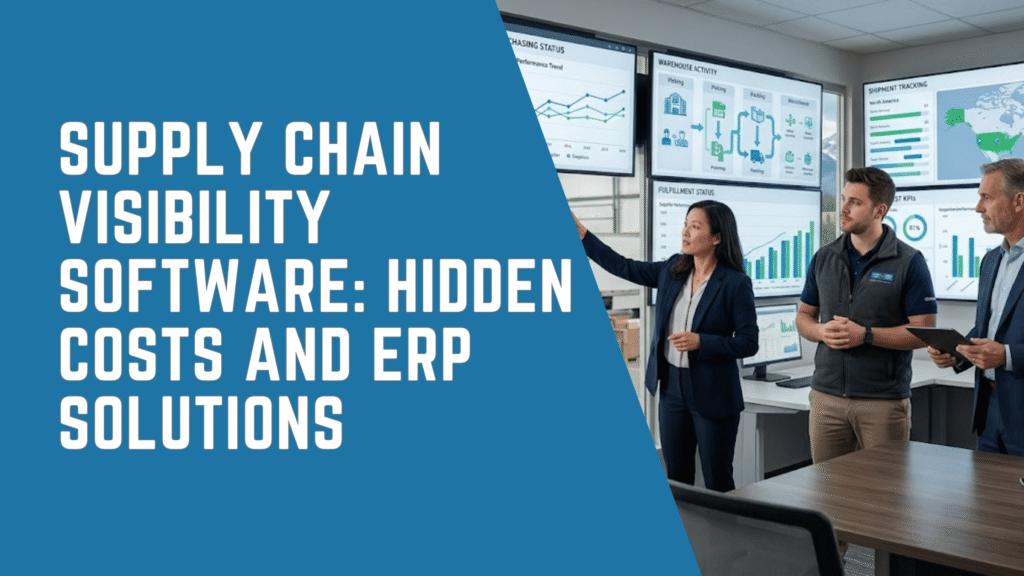
Supply chain visibility has become essential for organizations that need accurate inventory data, reliable procurement insights, faster order fulfillment, and stronger financial control. However, many businesses still rely on disconnected spreadsheets, manual updates, legacy systems, and delayed reports. As a result, leaders may discover supply chain problems only after costs have increased, customers have been affected, or working capital has been tied up in the wrong inventory.
The hidden cost of poor supply chain visibility rarely appears as a single line item on a financial statement. Instead, it appears throughout the business in the form of excess inventory, stockouts, expedited freight, production delays, inaccurate forecasts, margin erosion, and dissatisfied customers. These costs can be difficult to measure until leadership connects operational activity with financial performance.
For manufacturers, distributors, wholesalers, food and beverage companies, construction suppliers, and other inventory-intensive organizations, supply chain visibility is no longer only an operational concern. It directly affects profitability, cash flow, customer service, and scalability. Supply chains also remain vulnerable to global disruptions, supplier constraints, transportation volatility, labour shortages, and changing customer expectations.
Modern ERP systems and supply chain visibility solutions can help organizations move from reactive problem-solving to proactive control. Platforms such as Sage X3 and Sage 300 can connect purchasing, inventory, sales, warehousing, production, and finance data within one integrated environment. This gives leaders a clearer view of supply chain performance and helps them identify risks before they create larger financial or operational consequences.
This article examines the hidden costs of poor supply chain visibility and explains how integrated ERP systems can help organizations improve inventory control, purchasing decisions, order fulfillment, financial reporting, and overall operational performance.
What Is Supply Chain Visibility Software?
Supply chain visibility software helps organizations monitor, manage, and analyze the movement of materials, inventory, orders, suppliers, shipments, production activity, and financial impact across the supply chain.
At a basic level, visibility means knowing what is happening, where it is happening, and how it affects the business. However, true visibility goes further. It connects operational activity with financial outcomes so leaders can understand the cost, margin, service, and cash flow impact of supply chain decisions.
For example, a warehouse manager may need to know whether a product is available in a specific location. Meanwhile, a purchasing manager may need to know whether a supplier shipment will arrive before production starts. In addition, a CFO may need to know how inventory levels affect working capital, gross margin, cash flow, and forecast accuracy.
Supply chain visibility software can support these needs by providing:
- Real-time or near-real-time inventory information
- Purchase order and supplier status tracking
- Warehouse activity visibility
- Demand and replenishment insights
- Sales order and backorder visibility
- Production and material availability data
- Lot, batch, serial, and expiry tracking
- Shipment and fulfillment visibility
- Exception alerts and workflow automation
- Dashboards, KPIs, and operational reporting
- Financial impact analysis across inventory and operations
However, software alone does not create visibility. The organization also needs clean data, integrated workflows, clear business rules, and reliable ERP configuration. Because of this, implementation strategy matters as much as technology selection.
Why Supply Chain Visibility Matters More Than Ever
Supply chains have become more complex, more data-dependent, and more exposed to disruption. Therefore, organizations need faster insight into supplier performance, inventory availability, customer demand, and operational risk.
A 2024 Maersk survey ranked supply chain visibility first among 15 logistics trends, ahead of several other major supply chain priorities. This reflects a broader shift: leaders now view visibility as a strategic requirement, not only an operational enhancement.
McKinsey also reported that 60% of surveyed companies had comprehensive visibility into tier-one suppliers in its 2024 supply chain risk survey. However, it also noted that visibility into deeper supply chain tiers declined. That matters because disruptions often originate beyond direct suppliers.
As a result, organizations can no longer rely only on historical reports or informal supplier communication. They need systems that show what is happening across purchasing, inventory, production, warehouse operations, and finance.
For many mid-market businesses, the issue is not a complete lack of data. Instead, the problem is that data exists in too many places. Inventory may sit in one system. Purchasing may use spreadsheets. Sales may manage demand through CRM notes. Finance may reconcile everything after the fact. Consequently, decision-makers work from delayed, inconsistent, or incomplete information.
This creates a costly gap between operational reality and financial reporting.
The Hidden Costs of Poor Supply Chain Visibility
Poor visibility creates financial leakage throughout the business. However, because the costs appear in different departments, leadership teams may underestimate the full impact.
The following table summarizes common hidden costs and their business impact.
Swipe left or right to view the full table.
| Hidden Cost | How It Appears | Business Impact |
|---|---|---|
| Excess inventory | Too much stock in the wrong products or locations | Higher carrying costs, tied-up cash, storage pressure |
| Stockouts | Products unavailable when demand exists | Lost revenue, backorders, customer dissatisfaction |
| Expedited freight | Rush shipments used to fix planning gaps | Lower margins and unpredictable logistics costs |
| Production delays | Materials unavailable when needed | Lower throughput, overtime, missed delivery dates |
| Manual work | Teams update spreadsheets and reconcile data | Higher labour cost and more errors |
| Poor forecasting | Demand plans use stale or incomplete data | Overbuying, underbuying, and unstable cash flow |
| Supplier performance issues | Late or partial deliveries go unnoticed | Higher risk and weaker procurement control |
| Margin erosion | Costs change faster than pricing decisions | Lower profitability and inaccurate estimates |
| Compliance risk | Lot, batch, or expiry data is difficult to trace | Audit exposure, recall delays, quality issues |
| Customer service issues | Teams cannot provide accurate status updates | Lost trust, slower response times, churn risk |
These costs often compound. For example, inaccurate inventory data can trigger unnecessary purchasing. Then, excess inventory consumes cash and warehouse space. Meanwhile, the business may still experience stockouts because inventory exists in the wrong location or in the wrong product mix.
In addition, poor visibility affects finance. Controllers and CFOs may struggle to trust inventory valuation, landed cost calculations, margin analysis, and forecast assumptions. As a result, finance teams spend more time reconciling data and less time advising the business.
Cost 1: Excess Inventory and Working Capital Pressure
Excess inventory is one of the most visible symptoms of poor supply chain visibility. However, it is often treated as a purchasing issue rather than a data issue.
When teams cannot trust demand forecasts, supplier lead times, or available-to-promise data, they often buy more inventory as a safety buffer. Although this may reduce short-term stockout risk, it can create long-term cash flow strain.
Excess inventory increases carrying costs, insurance, storage requirements, handling effort, obsolescence risk, and write-offs. Furthermore, slow-moving inventory can hide deeper problems in demand planning, product lifecycle management, and sales forecasting.
For CFOs and controllers, the issue becomes more serious when inventory growth outpaces revenue growth. In that situation, cash gets trapped in stock that may not convert into sales quickly enough. Therefore, supply chain visibility becomes a working capital improvement opportunity.
Modern ERP systems help by connecting demand, purchasing, inventory, sales orders, and financial reporting. Consequently, leaders can analyze inventory by item, location, supplier, margin, movement, aging, and forecasted demand.
Cost 2: Stockouts and Lost Revenue
Stockouts create a different financial problem. Instead of tying up too much cash, the organization loses sales because the right products are not available at the right time.
However, stockouts are not always caused by low inventory. In many cases, the business has inventory somewhere, but teams cannot see it accurately. For example, stock may sit in another warehouse, appear available in the system but be physically missing, or be allocated to another order without clear visibility.
This creates service issues for sales, customer service, warehouse teams, and finance. Customers may receive delayed orders or incomplete shipments. Meanwhile, sales teams may make commitments based on inaccurate availability. As a result, customer trust declines.
Supply chain visibility software helps organizations identify inventory availability, open sales orders, backorders, replenishment status, supplier delays, and warehouse movement. In addition, it supports better available-to-promise and capable-to-promise decisions.
For distributors and manufacturers, this can improve service levels while reducing the need for excessive safety stock.
Cost 3: Expedited Freight and Reactive Fulfillment
Expedited freight is often a hidden margin killer. It may appear necessary in the moment, especially when a customer order, production run, or project deadline is at risk. However, frequent expediting usually signals poor planning visibility.
When procurement, warehouse, sales, and production teams do not share the same information, the business reacts late. Therefore, it pays more to fix problems that could have been prevented.
Common causes include:
- Late supplier updates
- Inaccurate reorder points
- Poor demand forecasting
- Manual purchase order follow-up
- Warehouse receiving delays
- Missing inventory reservations
- Lack of exception alerts
- Disconnected sales and operations planning
Over time, expedited freight can distort profitability. A product may look profitable at standard cost but generate weak margins once rush freight, overtime, handling, and rework are included.
An integrated ERP system helps teams see problems earlier. For example, late purchase orders can trigger alerts. Inventory shortages can appear before production starts. Sales orders can be reviewed against available inventory and expected receipts. Consequently, teams have more time to act before costs escalate.
Cost 4: Production Delays and Capacity Waste
Manufacturers face especially high costs when supply chain visibility is weak. Production schedules depend on accurate material availability, labour planning, machine capacity, quality status, and supplier reliability.
If materials are missing or components arrive late, production halts and teams reschedule work orders. Discovering quality issues too late delays finished goods. Consequently, the organization loses capacity and incurs overtime expenses to recover.
In process manufacturing, food and beverage, chemicals, and other regulated environments, visibility becomes even more critical. Teams may need to manage formulas, batches, expiry dates, quality checks, traceability, and compliance documentation.
Sage X3 is especially relevant for complex manufacturing and distribution environments because it connects sales, inventory, purchasing, finance, and manufacturing processes. Sage states that Sage X3 provides integration across sales, inventory, purchasing, finance, and manufacturing so supply chain data reflects the broader business in real time.
Therefore, Sage X3 can be a strong fit for organizations that need visibility across production, procurement, quality, inventory, and financial control.
Cost 5: Manual Work and Spreadsheet Dependency
Many organizations underestimate the cost of manual supply chain work. However, every spreadsheet, duplicate entry, email follow-up, and manual reconciliation increases risk.
Manual processes often appear manageable at first. Yet, as order volumes, locations, suppliers, and product complexity grow, spreadsheets become fragile. Teams spend more time maintaining workarounds than improving performance.
Common manual workarounds include:
- Inventory counts tracked outside the ERP
- Purchase order status updates maintained in spreadsheets
- Sales forecasts emailed between departments
- Warehouse transfers recorded after the fact
- Production schedules updated manually
- Supplier lead times stored in individual files
- Month-end inventory reconciliations performed offline
These workarounds create version control problems. In addition, they reduce accountability because teams may not know which data source is correct.
An ERP implementation can replace many manual processes with automated workflows, shared dashboards, approval controls, and integrated reporting. As a result, teams can spend more time analyzing exceptions and less time collecting data.
Cost 6: Inaccurate Forecasting and Planning
Forecasting depends on reliable data. However, many organizations create forecasts using incomplete sales history, inconsistent inventory records, and limited supplier performance information.
This creates planning errors. For example, a company may purchase inventory based on outdated demand signals. Alternatively, it may underestimate demand because sales orders, open quotations, seasonality, and customer trends are not connected.
Poor forecasting affects more than inventory. It can also affect:
- Labour planning
- Cash flow
- Procurement strategy
- Warehouse capacity
- Supplier negotiations
- Production schedules
- Pricing decisions
Modern supply chain visibility software improves planning by connecting demand signals with operational execution.
ERP dashboards can also display trends across product lines, customers, locations, suppliers, and reporting periods.
However, forecasting should not rely entirely on software-generated predictions. Leadership teams also need disciplined sales and operations planning, clear assumptions, data governance, and regular review cycles.
Because of this, an ERP implementation should include both technology improvements and process design.
Cost 7: Supplier Performance Issues and Procurement Risk
Supplier performance has a direct effect on inventory availability, production schedules, customer service, and cash flow.
However, organizations often lack a reliable way to measure whether suppliers consistently provide the correct products, quantities, quality, documentation, and delivery times.
When supplier information is stored across spreadsheets, emails, and disconnected systems, procurement teams may not recognize recurring problems early enough.
A supplier may repeatedly deliver late, send partial shipments, change prices unexpectedly, or provide materials that fail quality inspections. Yet, these issues may remain hidden until they cause stockouts, production delays, or customer order problems.
Common supplier performance issues include:
- Late or incomplete deliveries
- Incorrect quantities or products
- Unexpected price increases
- Inconsistent product quality
- Long or changing lead times
- Missing compliance documents
- Poor communication regarding delays
- Repeated purchase order discrepancies
These problems can increase purchasing costs and operational risk.
For example, the business may need to place emergency orders with alternative suppliers, pay higher freight charges, maintain additional safety stock, or reschedule production.
Supply chain visibility software helps organizations track supplier lead times, delivery accuracy, purchase order status, quality results, pricing changes, and contract performance.
ERP dashboards can also help procurement teams compare suppliers using consistent performance indicators.
With better supplier data, organizations can identify risks earlier, negotiate from a stronger position, and make more informed sourcing decisions.
Cost 8: Margin Leakage and Poor Cost Control
Poor supply chain visibility can quietly erode profit margins.
This happens when landed costs, freight, duties, supplier price changes, production variances, scrap, spoilage, and handling expenses are not captured accurately or quickly.
For finance leaders, margin leakage is especially concerning because it may remain hidden until month-end or quarter-end reporting.
By that time, the organization may have already accepted unprofitable orders or failed to adjust product pricing.
Margin control requires connected information across procurement, inventory, sales, production, and finance.
For example, a CFO needs to determine whether a decline in margins was caused by:
- Supplier price increases
- Freight and logistics costs
- Customer discounts
- Product mix changes
- Production waste
- Labour inefficiencies
- Inventory adjustments
- Inaccurate product costing
Supply chain visibility software gives finance and operations teams a shared view of these cost drivers.
Therefore, the organization can make pricing, purchasing, production, and fulfilment decisions using current information instead of delayed financial reports.
Cost 9: Compliance, Traceability, and Recall Risk
Compliance and traceability become significant hidden costs when organizations cannot quickly track products, materials, batches, lots, serial numbers, or expiry dates throughout the supply chain.
This risk is especially important for food and beverage, pharmaceutical, chemical, medical device, and other regulated industries.
These organizations may need to demonstrate where materials originated, how products were manufactured, which quality checks were completed, and where finished goods were delivered.
When this information is recorded manually or stored across disconnected systems, preparing for audits can become time-consuming and expensive.
Teams may need to search through spreadsheets, paper records, emails, and separate databases to locate the required documentation.
Poor traceability can create several risks:
- Delayed product recalls
- Difficulty identifying affected customers
- Incomplete audit documentation
- Expired products remaining in inventory
- Missing batch or lot information
- Quality-control failures
- Regulatory penalties
- Reputational damage
- Lost customer trust
The financial impact can become severe when a business cannot isolate affected products during a quality issue.
Instead of recalling one specific batch, the organization may need to recall a much larger quantity because it cannot accurately determine which products were affected.
Modern ERP systems help by connecting purchasing, inventory, production, quality management, sales, and distribution records.
Consequently, teams can trace materials from the supplier through production and delivery to the customer.
Improved traceability allows organizations to respond faster during audits, quality investigations, and product recalls.
Cost 10: Customer Experience Problems
Customers expect accurate order status information, reliable delivery dates, and consistent communication.
However, teams cannot provide strong customer service when they lack visibility across inventory, purchasing, warehousing, production, and delivery.
Poor visibility can lead to:
- Vague delivery promises
- Missed shipment dates
- Partial orders
- Incorrect product substitutions
- Backorders
- Slow issue resolution
- Inaccurate order updates
Consequently, customer service teams absorb the frustration caused by upstream supply chain and data problems.
For distributors and manufacturers, customer experience is closely connected to operational credibility. When customers cannot trust delivery commitments, they may transfer their business to competitors with more reliable service.
Supply chain visibility software helps customer service teams answer important questions quickly:
- Is the product currently available?
- Where is the inventory located?
- Has the order been picked, packed, or shipped?
- Is the supplier purchase order delayed?
- Can another warehouse fulfil the order?
- What is the expected delivery date?
- Are there backorders or approved substitutions?
- What is the financial impact of fulfilling the order differently?
When employees can answer these questions using one connected system, customers receive faster, more accurate, and more consistent service.
As a result, organizations can strengthen customer trust, reduce complaints, improve retention, and protect long-term revenue.
Why Disconnected Systems Make Visibility Hard
Many organizations do not have a supply chain problem in isolation. Instead, they have a systems architecture problem.
A business may use one system for accounting, another for inventory, another for warehouse management, another for purchasing, and spreadsheets for forecasting. Although each tool may serve a purpose, the lack of integration creates blind spots.
Disconnected systems cause several issues:
- Data becomes inconsistent across departments.
- Reports require manual consolidation.
- Employees duplicate work.
- Errors increase.
- Decisions rely on outdated information.
- Finance lacks timely operational context.
- Operations lacks timely financial context.
- Leadership cannot see end-to-end performance.
In addition, legacy systems may not support modern reporting, automation, multi-location inventory, mobile warehouse workflows, or real-time dashboards. As a result, the business grows beyond the capabilities of its systems.
This is where ERP becomes a strategic investment. A modern ERP platform does more than store transactions. It connects processes, standardizes data, improves controls, and creates visibility across the enterprise.
What Effective Supply Chain Visibility Software Should Include
The right supply chain visibility software should match the organization’s operating model, industry requirements, reporting needs, and growth plans. However, most businesses should evaluate several core capabilities.
Swipe left or right to view the full table.
| Capability | Why It Matters |
|---|---|
| Inventory visibility | Helps teams track stock by item, location, status, lot, batch, serial number, or expiry date |
| Procurement visibility | Shows purchase orders, supplier performance, expected receipts, and costs |
| Warehouse visibility | Improves receiving, picking, packing, transfers, and fulfillment |
| Sales order visibility | Connects customer demand with inventory availability and fulfillment status |
| Production visibility | Helps manufacturers manage materials, work orders, capacity, and quality |
| Financial visibility | Links inventory and operations to cost, margin, cash flow, and reporting |
| Reporting and dashboards | Gives leadership faster insight into KPIs and exceptions |
| Automation | Reduces manual follow-up, duplicate entry, and preventable errors |
| Integration | Connects ERP, warehouse, ecommerce, EDI, shipping, CRM, and analytics tools |
| Scalability | Supports more users, entities, locations, products, and transaction volume |
In addition, organizations should look for configurability. Every supply chain has unique rules, workflows, approval requirements, and reporting needs. Therefore, the system must support the business without forcing unnecessary complexity.
ERP Options for Improving Supply Chain Visibility
IWI Consulting Group typically positions Sage X3 and Sage 300 as strong ERP options for supply chain visibility, depending on the organization’s complexity, industry, size, and cloud strategy.
Sage X3 for Complex Manufacturing and Distribution
Sage X3 is a strong fit for manufacturers, food and beverage companies, process manufacturers, distributors, and organizations with complex supply chain requirements.
It supports visibility across sales, purchasing, inventory, manufacturing, finance, and operations. In addition, Sage X3 can help organizations manage production planning, batch traceability, quality control, procurement, and multi-site operations.
Sage X3 is especially relevant when supply chain visibility must connect with production management and financial control. Therefore, it can support organizations that need deeper operational insight than entry-level accounting systems or basic inventory tools can provide.
Sage 300 for Inventory-Intensive and Multi-Location Businesses
Sage 300 remains a practical ERP option for many inventory-intensive organizations. It is commonly used by distributors, construction suppliers, manufacturers, and multi-location businesses that need strong financial management with operational modules.
Sage 300 Inventory Control supports records such as locations, item structures, units of measure, and processing options that connect inventory activity with other Sage 300 modules.
As a result, Sage 300 can help organizations improve inventory tracking, purchasing control, sales order management, and reporting. It can also support businesses that need an ERP platform with mature financial management and operational flexibility.
How to Overcome Poor Supply Chain Visibility
Overcoming poor visibility requires more than buying software. It requires a structured improvement strategy that connects systems, data, processes, reporting, and change management.
1. Identify the Visibility Gaps
First, leadership should identify where visibility breaks down. This may include purchasing, inventory, warehouse operations, production, order fulfillment, supplier management, or financial reporting.
The organization should ask:
- Which decisions are delayed because data is unavailable?
- Which reports require manual consolidation?
- Where do teams rely on spreadsheets?
- Which inventory numbers are not trusted?
- Which customer issues happen repeatedly?
- Which costs are discovered too late?
- Which departments disagree on the data?
This assessment creates a practical roadmap. In addition, it prevents the organization from selecting software before understanding the business problem.
2. Connect Operational and Financial Data
Second, organizations should connect supply chain activity with financial impact. This is critical because operational decisions affect cash flow, margin, working capital, and profitability.
For example, procurement decisions affect inventory value and supplier commitments. Warehouse decisions affect labour cost and fulfillment speed. Production decisions affect material usage and margin. Sales decisions affect availability and service levels.
A modern ERP system helps connect these activities. Therefore, finance and operations can work from a shared source of truth.
3. Standardize Processes Before Automating
Automation works best when processes are clear. However, many businesses automate inconsistent workflows and then struggle with adoption.
Before implementing new supply chain visibility software, organizations should standardize processes for:
- Item setup
- Inventory locations
- Units of measure
- Reorder rules
- Purchase approvals
- Supplier lead times
- Warehouse transfers
- Order allocation
- Backorder management
- Production scheduling
- Cycle counting
- Month-end inventory close
This creates better data quality and stronger reporting. In addition, it reduces confusion during implementation.
4. Improve Inventory Data Quality
Inventory visibility depends on data discipline. Therefore, organizations should review item masters, location structures, costing methods, lot and serial tracking, units of measure, and product statuses.
Poor item data can create errors across purchasing, sales, production, and finance. For example, incorrect units of measure can distort purchasing quantities. Inaccurate lead times can weaken replenishment planning. Incomplete product classifications can limit reporting.
Data cleanup should begin before ERP migration or implementation. As a result, the organization can avoid moving old problems into a new system.
5. Build Role-Based Dashboards and KPIs
Different leaders need different visibility. Therefore, dashboards should reflect the decisions each role must make.
Swipe left or right to view the full table.
| Role | Visibility Needed |
|---|---|
| CFO | Inventory value, margin, working capital, landed cost, cash flow impact |
| Controller | Inventory valuation, adjustments, reconciliations, costing accuracy |
| COO | Service levels, throughput, supplier reliability, operational bottlenecks |
| Operations Manager | Warehouse performance, order status, labour productivity |
| Procurement Manager | Supplier lead times, purchase commitments, late orders, cost changes |
| Inventory Manager | Stock levels, aging, turnover, reorder points, shortages |
| Production Manager | Material availability, work orders, capacity, quality status |
| IT Director | Integrations, data governance, security, system performance |
Dashboards should highlight exceptions, not only activity. For example, leadership should see late purchase orders, inventory shortages, aging stock, margin exceptions, and fulfillment risks before they become larger problems.
6. Integrate Key Systems
ERP is often the central system of record. However, many organizations also need integrations with warehouse management systems, ecommerce platforms, EDI, shipping carriers, CRM systems, demand planning tools, and business intelligence platforms.
Integration reduces duplicate entry and improves timeliness. However, integrations should be designed carefully. Poor integration design can create data conflicts, synchronization issues, and reporting gaps.
IWI Consulting Group helps organizations assess integration requirements during ERP planning. Consequently, the selected architecture supports operational needs without adding unnecessary complexity.
7. Use Change Management to Drive Adoption
Visibility improves only when employees use the system consistently. Therefore, change management is essential.
Employees need to understand new workflows, data expectations, approval processes, dashboards, and reporting responsibilities. In addition, leadership must reinforce process discipline after go-live.
A successful ERP implementation should include training, role-based testing, documentation, communication, and post-go-live support. Because of this, the consulting partner matters.
KPIs That Help Measure Supply Chain Visibility
Organizations should track KPIs that connect visibility to business performance. The following metrics can help leadership evaluate progress.
Swipe left or right to view the full table.
| KPI | What It Measures | Why It Matters |
|---|---|---|
| Inventory accuracy | System quantity versus physical quantity | Improves trust in ERP data |
| Inventory turnover | How often inventory converts into sales | Supports working capital improvement |
| Stockout rate | Frequency of unavailable items | Measures service risk |
| Fill rate | Percentage of demand fulfilled from available stock | Reflects customer service performance |
| On-time supplier delivery | Supplier performance against delivery dates | Improves procurement planning |
| Purchase order cycle time | Time from request to receipt | Identifies procurement bottlenecks |
| Order cycle time | Time from order entry to delivery | Measures fulfillment efficiency |
| Backorder value | Revenue delayed due to unavailable stock | Shows sales and service impact |
| Expedited freight cost | Premium freight caused by urgency | Highlights planning gaps |
| Gross margin by item | Profitability by product or category | Supports pricing and sourcing decisions |
| Inventory aging | Stock held beyond expected movement | Reduces obsolescence risk |
| Forecast accuracy | Forecasted demand versus actual demand | Improves planning and purchasing |
These KPIs should not sit in separate spreadsheets. Instead, ERP dashboards should bring them into regular management reviews. As a result, leaders can act before problems become expensive.
Why IWI Consulting Group Is the Right ERP Partner
Selecting supply chain visibility software is only one part of the transformation. The larger challenge involves choosing the right ERP platform, designing effective processes, migrating accurate data, configuring workflows, integrating systems, training teams, and supporting continuous improvement.
IWI Consulting Group is an ERP consulting and implementation firm serving organizations across the United States and Canada. With more than 22 years of experience and over 500 successful projects delivered, IWI specializes in Sage Intacct, Sage 300 and Sage X3. This experience enables IWI to help organizations evaluate ERP options objectively based on operational complexity, reporting requirements, industry needs, and long-term growth plans.
IWI supports organizations across North America with:
- ERP selection and advisory services
- ERP implementation
- ERP migration
- Data migration and cleanup
- Business process review
- Reporting and dashboard design
- Inventory and distribution process improvement
- Manufacturing and supply chain ERP support
- Integration planning
- User training and post-go-live support
- Long-term ERP optimization
In addition, IWI has experience helping organizations move away from QuickBooks, Sage 50, Sage BusinessVision, Microsoft Dynamics GP, and other legacy systems. This experience is important because many supply chain visibility problems begin when businesses outgrow entry-level accounting software or disconnected operational tools.
Rather than positioning ERP as only a technology project, IWI helps clients treat ERP as a business performance platform. As a result, organizations can improve visibility, reduce manual work, strengthen operational controls, and support sustainable growth.
Conclusion: Visibility Is a Profitability Strategy
Poor supply chain visibility creates hidden costs across inventory, procurement, production, fulfillment, finance, and customer service. However, the cost is often difficult to see because it appears in many parts of the business.
Modern supply chain visibility software helps organizations identify problems earlier, improve inventory control, strengthen supplier management, reduce manual work, and connect operations with financial performance. In addition, ERP systems such as Sage X3 and Sage 300 can provide the integrated foundation needed for better decision-making.
For organizations, the opportunity is clear. Better visibility can improve working capital, reduce unnecessary costs, increase customer reliability, and support scalable growth. However, the right outcome requires the right ERP strategy, implementation approach, and long-term partner.
IWI Consulting Group helps organizations across the United States and Canada modernize ERP systems, improve supply chain visibility, and build stronger operational and financial control. With deep expertise in Sage X3, Sage 300 and ERP migration, IWI provides the strategic guidance businesses need to move from fragmented systems to connected performance.
Ready to uncover hidden supply chain costs and improve operational visibility? Schedule your assessment with IWI Consulting Group today.
FAQ Questions
What is supply chain visibility software?
Supply chain visibility software helps organizations track inventory, purchasing, supplier activity, warehouse operations, production status, shipments, and related financial data. It gives decision-makers better insight into what is happening across the supply chain so they can reduce delays, control costs, and improve service.
Why is supply chain visibility important?
Supply chain visibility is important because it helps organizations identify issues before they become expensive. For example, better visibility can reduce stockouts, excess inventory, expedited freight, production delays, and customer service problems. In addition, it helps finance teams understand the cost and margin impact of operational decisions.
What are the hidden costs of poor supply chain visibility?
The hidden costs include excess inventory, lost sales, rush freight, production downtime, manual reconciliation, inaccurate forecasting, margin leakage, compliance risk, and poor customer experience. These costs often appear across different departments, which makes the total impact difficult to measure without integrated reporting.
How does ERP improve supply chain visibility?
ERP improves supply chain visibility by connecting finance, inventory, purchasing, sales, warehouse, production, and reporting in one system. As a result, teams can work from shared data instead of disconnected spreadsheets or separate applications.
Which ERP system is best for supply chain visibility?
The best ERP system depends on the organization’s industry, complexity, size, and growth plans. Sage X3 is often a strong fit for complex manufacturing, food and beverage, process manufacturing, and distribution. Sage 300 is well suited for inventory-intensive and multi-location businesses.
Is Sage X3 good for supply chain visibility?
Yes. Sage X3 is a strong ERP option for organizations that need visibility across inventory, purchasing, manufacturing, sales, finance, and operations. It is especially relevant for manufacturers, distributors, food and beverage companies, and organizations with complex supply chain requirements.
When should a business replace spreadsheets with supply chain visibility software?
A business should consider replacing spreadsheets when teams cannot trust inventory data, reports take too long to prepare, stockouts or excess inventory are increasing, purchasing is reactive, or leadership lacks timely visibility into operational performance. In addition, spreadsheet dependency becomes risky when the organization adds more products, locations, suppliers, users, or transaction volume.
How long does it take to implement supply chain visibility software?
Implementation timelines vary based on ERP scope, data quality, integrations, reporting needs, user count, and operational complexity. A focused inventory or distribution implementation may be shorter, while a multi-site manufacturing ERP implementation may require a more detailed phased approach. Therefore, organizations should complete an ERP assessment before setting a timeline.
How can IWI Consulting Group help with supply chain visibility software?
IWI Consulting Group helps Canadian organizations assess ERP requirements, select the right system, migrate data, configure workflows, design reporting, integrate systems, train users, and provide long-term support. IWI specializes in Sage X3, Sage 300 and Sage Intacct with more than 22 years of experience and over 500 successful projects delivered.