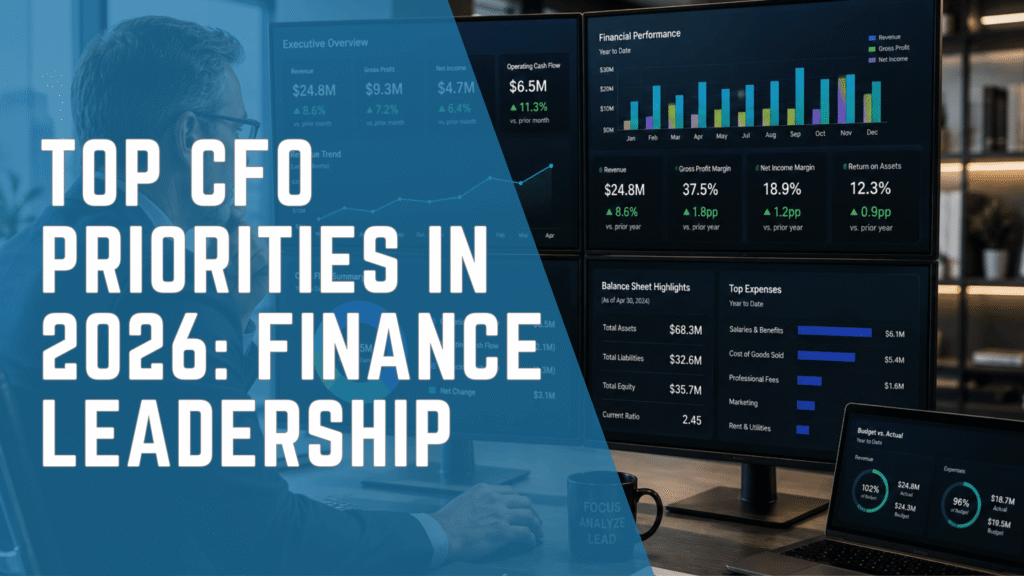
CFO priorities continue to evolve as organizations face increasing economic uncertainty, rising stakeholder expectations, regulatory complexity, and rapid technological change. Today’s Chief Financial Officers are no longer responsible solely for accounting, budgeting, and financial reporting. Instead, they have become strategic business leaders who influence investment decisions, operational performance, and long-term growth.
Finance leaders are expected to provide accurate insights in real time while balancing profitability, risk management, and innovation. At the same time, executive teams increasingly rely on CFOs to guide digital transformation initiatives, improve operational efficiency, and support data-driven decision-making across the organization. Consequently, finance departments must modernize their processes and technology to meet these growing expectations. Manual spreadsheets, disconnected applications, and delayed reporting no longer provide the speed or visibility required in today’s business environment.
Modern Enterprise Resource Planning (ERP) systems play an essential role in helping CFOs achieve these objectives. By centralizing financial and operational data, ERP platforms improve reporting accuracy, automate routine tasks, strengthen governance, and deliver the insights needed for confident decision-making. This article explores the most significant CFO priorities for 2026, explains why they matter, and examines how ERP technology enables finance leaders to create long-term business value.
The Expanding Role of the Modern CFO
The responsibilities of today’s CFO extend well beyond managing the finance department. Increasingly, executive leadership teams expect finance leaders to influence every major business decision.
Historically, finance organizations focused primarily on:
- Financial reporting
- Budget management
- Regulatory compliance
- Tax planning
- Audit preparation
However, today’s business landscape demands much more.
Modern CFOs are expected to:
- Guide corporate strategy
- Improve organizational performance
- Drive digital transformation
- Optimize business processes
- Support mergers and acquisitions
- Manage enterprise risk
- Improve forecasting accuracy
- Deliver actionable business intelligence
As a result, finance departments have become strategic partners rather than back-office functions.
Technology has accelerated this transformation. Executive teams expect financial insights immediately rather than weeks after month-end close. Investors demand greater transparency. Customers expect better service. Meanwhile, regulators continue introducing new compliance requirements. Because of these changes, finance leaders require systems capable of delivering real-time visibility into every aspect of business performance.
Priority 1: Achieving Real-Time Financial Visibility
One of the highest CFO priorities is gaining complete financial visibility across the organization. Many organizations continue to rely on disconnected accounting systems, spreadsheets, and manual reporting processes. Unfortunately, these approaches often produce inconsistent data, delayed reports, and limited confidence in financial results.
Real-time financial visibility enables finance leaders to monitor:
- Revenue performance
- Gross margins
- Operating expenses
- Cash flow
- Accounts receivable
- Accounts payable
- Inventory costs
- Profitability by business unit
- Project performance
- Multi-entity financial results
Instead of waiting until month-end, executives can identify trends as they emerge.
Benefits of Real-Time Visibility
Organizations benefit from:
| Traditional Reporting | Real-Time ERP Reporting |
|---|---|
| Delayed information | Live financial dashboards |
| Manual consolidation | Automated consolidation |
| Spreadsheet dependency | Centralized data |
| Limited forecasting | Predictive insights |
| Slow executive reporting | Instant dashboards |
Furthermore, real-time reporting allows finance teams to spend less time gathering data and more time analyzing business performance.
Priority 2: Strengthening Cash Flow Management
Cash flow remains one of the most critical indicators of organizational health. Even profitable companies can experience operational challenges if cash flow is poorly managed. Consequently, CFOs continue to prioritize liquidity management and working capital optimization.
Effective cash flow management involves:
- Monitoring receivables
- Managing payables
- Improving collections
- Optimizing inventory
- Forecasting future liquidity
- Managing debt obligations
- Planning capital investments
However, fragmented financial systems often prevent finance teams from obtaining a complete picture of organizational liquidity.
Modern ERP solutions address this challenge by consolidating financial data into a single source of truth.
Finance leaders can monitor:
- Daily cash balances
- Outstanding receivables
- Vendor obligations
- Purchase commitments
- Sales forecasts
- Inventory investments
- Operational spending
As a result, organizations improve financial resilience while reducing unnecessary borrowing costs.
Priority 3: Improving Forecasting and Financial Planning
Forecasting has become increasingly complex. Economic volatility, inflation, supply chain disruptions, labor shortages, and changing customer demand make long-term planning more difficult than ever. Consequently, finance leaders are moving beyond static annual budgets toward continuous forecasting models.
Modern finance organizations increasingly adopt:
- Rolling forecasts
- Scenario planning
- Driver-based budgeting
- Predictive analytics
- What-if analysis
These approaches enable CFOs to prepare for multiple economic outcomes rather than relying on a single financial projection. For example, finance teams can evaluate how changes in sales volume, commodity prices, labor costs, or foreign exchange rates affect profitability before making strategic decisions.
ERP platforms significantly improve forecasting by integrating financial, operational, and sales data into unified planning models. This integration provides greater confidence in financial projections while reducing manual effort.
Priority 4: Driving Operational Efficiency Through Automation
Finance teams continue facing pressure to accomplish more with limited resources. Consequently, automation has become a major strategic priority. Manual processes consume valuable time while increasing the likelihood of errors.
Common examples include:
- Invoice processing
- Bank reconciliations
- Expense approvals
- Purchase approvals
- Journal entries
- Financial consolidations
- Revenue recognition
- Fixed asset management
Automation reduces repetitive administrative work, allowing finance professionals to focus on higher-value activities such as analysis, planning, and strategic decision-making.
Key benefits include:
- Faster month-end close
- Improved data accuracy
- Lower operating costs
- Reduced compliance risks
- Increased employee productivity
- Better audit readiness
Furthermore, automation improves employee satisfaction by eliminating repetitive tasks that provide little strategic value. Organizations adopting modern ERP systems frequently experience shorter financial close cycles and more consistent reporting processes.
Priority 5: Enhancing Risk Management and Compliance
Business risk continues to grow across every industry.
Finance leaders must navigate:
- Cybersecurity threats
- Regulatory changes
- Inflation
- Supply chain disruptions
- Data privacy requirements
- Fraud risks
- Market uncertainty
Consequently, CFOs increasingly view enterprise risk management as an ongoing strategic responsibility rather than an annual compliance exercise.
A modern ERP platform strengthens governance by providing:
- Role-based security
- Complete audit trails
- Automated approval workflows
- Segregation of duties
- Standardized financial controls
- Centralized documentation
These capabilities improve transparency while reducing operational and compliance risks.
Moreover, centralized financial information simplifies external audits and regulatory reporting by ensuring data consistency across the organization. As organizations expand into new markets or operate across multiple legal entities, standardized financial controls become even more important for maintaining compliance and supporting sustainable growth.
Priority 6: Leveraging Data for Strategic Decision-Making
Finance leaders are increasingly expected to transform data into actionable business intelligence. While financial reporting remains essential, executive teams now rely on CFOs to provide forward-looking insights that influence strategic planning, operational improvements, and investment decisions.
However, meaningful analysis requires timely, accurate, and comprehensive information. When data is scattered across accounting software, spreadsheets, customer relationship management (CRM) systems, inventory applications, and other disconnected platforms, finance teams spend excessive time reconciling information instead of interpreting it.
A modern ERP system centralizes financial and operational data into a single source of truth. Consequently, CFOs gain access to interactive dashboards and key performance indicators (KPIs) that support informed decision-making.
Examples of executive insights include:
- Gross margin by product or business unit
- Customer profitability
- Revenue trends
- Budget versus actual performance
- Inventory turnover
- Project profitability
- Cash conversion cycle
- Departmental spending
- Operational efficiency metrics
Furthermore, self-service reporting empowers business leaders across departments to access trusted information without relying on finance to create custom reports. As a result, collaboration improves and decisions are made with greater confidence.
Priority 7: Supporting Business Growth and Scalability
Growth introduces new financial and operational complexities. As organizations expand into new regions, acquire businesses, or diversify their product offerings, finance teams must manage increasing transaction volumes while maintaining financial control.
Many organizations discover that entry-level accounting software cannot effectively support this level of complexity. Common challenges include:
- Multiple legal entities
- Multi-currency transactions
- Intercompany accounting
- Complex consolidations
- Global tax requirements
- Increased reporting demands
Consequently, scalability has become a core CFO priority.
Modern ERP platforms provide the flexibility to support organizational growth without requiring finance teams to redesign their processes every few years. Automated consolidations, standardized reporting, and configurable workflows allow finance departments to scale efficiently while maintaining governance and compliance. Moreover, scalable ERP systems reduce the risk of technology becoming a barrier to future expansion.
Priority 8: Accelerating Digital Finance Transformation
Digital transformation is no longer limited to IT initiatives. Finance departments are now leading many enterprise modernization efforts because they oversee the systems and processes that support organizational performance.
Digital finance transformation involves more than implementing new software. It includes redesigning workflows, eliminating manual processes, improving collaboration, and enabling data-driven decision-making.
Common transformation initiatives include:
- Cloud migration
- Workflow automation
- Electronic approvals
- AI-assisted reporting
- Digital document management
- Integrated budgeting
- Automated reconciliations
- Mobile access to financial information
These initiatives enable finance teams to become more agile while improving service levels across the organization.
Furthermore, cloud-based ERP solutions provide continuous innovation through regular updates, enhanced security, and improved accessibility for distributed teams.
Priority 9: Attracting and Retaining Finance Talent
Today’s finance professionals expect modern technology that supports productive and meaningful work. Outdated systems and repetitive manual tasks can contribute to employee frustration and make it more difficult to attract skilled talent.
Automation allows finance teams to focus on higher-value activities such as financial analysis, strategic planning, business partnering, and performance improvement.
By reducing administrative burdens, organizations can improve employee engagement while making better use of their finance team’s expertise.
Additionally, intuitive ERP systems shorten onboarding time for new employees and help standardize processes across departments. As labor markets remain competitive, investing in modern finance technology can support both operational efficiency and talent retention.
Priority 10: Building Organizational Resilience
Economic uncertainty has highlighted the importance of resilience. CFOs must prepare their organizations to respond quickly to changing market conditions, supply chain disruptions, regulatory updates, and unexpected financial challenges.
Resilient organizations share several characteristics:
- Strong financial controls
- Reliable forecasting
- Real-time reporting
- Diversified revenue streams
- Flexible planning capabilities
- Effective risk management
- Scalable technology
ERP systems contribute to organizational resilience by providing timely information, standardized processes, and enterprise-wide visibility. Consequently, finance leaders can evaluate changing conditions, model alternative scenarios, and respond with greater speed and confidence.
How ERP Systems Support Modern CFO Priorities
| CFO Priority | ERP Capability |
|---|---|
| Financial visibility | Real-time dashboards and reporting |
| Cash flow management | Integrated financial management |
| Forecasting | Budgeting and planning tools |
| Automation | Workflow automation and approvals |
| Compliance | Audit trails and internal controls |
| Business intelligence | Interactive dashboards and analytics |
| Scalability | Multi-entity and multi-currency support |
| Digital transformation | Cloud-based architecture |
| Operational efficiency | Integrated business processes |
| Organizational resilience | Centralized enterprise data |
Rather than functioning solely as accounting software, ERP solutions integrate finance with operations, procurement, inventory, projects, and other business functions. This integration enables finance leaders to understand how operational activities affect financial performance.
As a result, CFOs can provide more strategic guidance while improving organizational agility.
Choosing the Right ERP Strategy
Technology alone does not guarantee successful outcomes. Organizations should begin by evaluating their current processes, reporting requirements, growth objectives, and operational challenges.
Key considerations include:
- Current system limitations
- Future growth plans
- Industry-specific requirements
- Reporting complexity
- Integration needs
- Regulatory obligations
- User adoption
- Implementation resources
Selecting an ERP platform that aligns with long-term business objectives is equally important as selecting the software itself. Organizations should prioritize solutions that can adapt as business requirements evolve.
How IWI Consulting Group Supports Finance Transformation
Successfully modernizing finance operations requires more than software implementation. Organizations benefit from an experienced consulting partner that understands financial processes, business strategy, and ERP technology.
For more than 22 years, IWI Consulting Group has helped Canadian organizations transform their finance operations through ERP consulting, implementation, migration, optimization, and ongoing support. With more than 500 successful projects delivered, IWI works closely with finance leaders to align ERP initiatives with broader business objectives.
IWI specializes in leading ERP solutions, including Sage Intacct, Sage 300, and Sage X3. Rather than focusing solely on software deployment, IWI emphasizes process improvement, financial visibility, automation, and long-term scalability.
By combining technical expertise with industry knowledge, IWI helps CFOs reduce complexity, improve reporting, streamline operations, and create a foundation for sustainable growth.
Conclusion
The responsibilities of today’s CFO continue to expand as organizations navigate economic uncertainty, digital transformation, and increasing demands for strategic leadership.
The most important CFO priorities in 2026 include improving financial visibility, strengthening cash flow management, enhancing forecasting, automating finance operations, managing risk, leveraging business intelligence, supporting scalable growth, advancing digital transformation, developing finance talent, and building organizational resilience.
Meeting these priorities requires more than incremental process improvements. Finance leaders need integrated technologies that provide accurate information, automate routine work, and support informed decision-making across the enterprise.
Modern ERP systems have become a critical enabler of finance transformation. By centralizing data and connecting business functions, ERP platforms empower CFOs to move beyond transactional accounting and become strategic partners in driving organizational success. Organizations that invest in the right ERP strategy today will be better positioned to improve operational performance, respond to market changes, and achieve sustainable long-term growth.
Frequently Asked Questions
1. What are the top CFO priorities in 2026?
The leading priorities include improving financial visibility, strengthening cash flow, enhancing forecasting, automating finance processes, managing risk, supporting business growth, and leading digital transformation initiatives.
2. Why is real-time financial visibility important for CFOs?
Real-time visibility enables finance leaders to monitor business performance continuously, identify issues earlier, and make faster, more informed strategic decisions.
3. How does an ERP system help CFOs?
ERP systems centralize financial and operational data, automate manual processes, improve reporting accuracy, strengthen compliance, and provide analytics that support executive decision-making.
4. What role does automation play in modern finance?
Automation reduces repetitive tasks such as invoice processing, reconciliations, approvals, and consolidations, allowing finance teams to focus on analysis and strategic planning.
5. Why is cash flow management a major CFO priority?
Strong cash flow supports daily operations, reduces financial risk, enables investment opportunities, and improves organizational resilience during periods of uncertainty.
6. How does ERP improve financial forecasting?
ERP systems integrate data from across the business, enabling rolling forecasts, scenario planning, and more accurate budgeting based on real-time information.
7. What should organizations consider when selecting an ERP system?
Organizations should evaluate scalability, reporting capabilities, industry requirements, integration needs, security, user experience, and long-term business objectives.
8. How does cloud ERP support finance transformation?
Cloud ERP provides real-time access to information, continuous software updates, stronger collaboration, improved security, and reduced infrastructure management.
9. When should a company replace its accounting software with ERP?
Organizations should consider ERP when they experience reporting delays, manual processes, multi-entity complexity, limited visibility, or growth that exceeds the capabilities of their current accounting system.
10. How can IWI Consulting Group help CFOs?
IWI Consulting Group helps organizations modernize finance operations through ERP consulting, implementation, migration, optimization, and long-term support. Its experienced consultants work with finance leaders to improve visibility, automate processes, and align technology investments with strategic business goals.