ERP supply chain planning helps distributors make smarter purchasing decisions by improving demand forecasting, inventory visibility, procurement, and supplier management. With Sage 300 and Sage X3, businesses can reduce stockouts, control costs, and build a more efficient and responsive supply chain.
Scaling a SaaS business is exciting. However, it often becomes complex as operations grow. With new customers, increased transactions, and more stakeholders, your early systems, such as spreadsheets or basic accounting software, can quickly become bottlenecks. If you’re experiencing disjointed workflows, cash flow blind spots, or constant reporting chaos, it’s time to consider the next step: implementing an ERP for SaaS companies.
Modern ERP solutions such as Sage Intacct are designed to help growing SaaS companies centralize financial management, reporting, automation, and operational data as they scale.
1. Your Billing System Is Costing You Time (and Cash)
Early-stage SaaS startups often rely on manual billing and basic invoicing tools. As your customer base grows, so do complexities like:
Recurring billing cycles
Usage-based pricing
Deferred revenue management
Multiple revenue streams or locations
Without automation, billing errors increase, collections slow down, and revenue recognition becomes a nightmare.
Why ERP matters: Sage Intacct, for example, offers automated ASC 606-compliant billing and multi-entity revenue management, so your finance team can scale with your growth—not slow it down.
2. You Lack Real-Time Cash Flow and KPI Visibility
If your reporting still depends on exported CSVs or manual calculations, you’re flying blind. Investors, board members, and your executive team need to know:
MRR, ARR, LTV, CAC
Churn and renewal rates
Budget vs. actuals
Burn rate and runway
Without real-time dashboards, it’s impossible to make agile, data-driven decisions.
Why ERP matters: Sage Intacct provides real-time financial dashboards and reporting that help SaaS finance teams monitor performance, cash flow, budgets, and key business metrics without relying on disconnected spreadsheets.
3. Your Teams Are Operating in Silos
Sales uses one tool, finance uses another, and operations has its own spreadsheets. Sound familiar? This siloed approach causes:
Communication breakdowns
Delayed decision-making
Duplicate or conflicting data
When your tools don’t talk to each other, your team wastes time reconciling data instead of acting on it.
Why ERP matters: Sage Intacct can integrate with CRM, billing, payroll, and other business applications, helping finance teams create a more connected source of financial and operational information while reducing manual data entry.
4. Forecasting Feels Like Guesswork
Investors expect SaaS startups to make sharp, data-backed decisions. But when your projections rely on outdated data, gut instinct, or cobbled-together spreadsheets, you risk over-hiring or under-investing.
Why ERP matters: Modern ERP for SaaS companies includes scenario planning, budgeting, and cash flow forecasting tools that update automatically as you scale.
Bonus: Sage Intacct’s Dynamic Allocations feature allows finance leaders to shift budgets mid-cycle based on real-time performance, keeping you agile in fast markets.
5. Audits, Due Diligence, or Fundraising Slow You Down
Are you prepping for Series B or acquisition? The due diligence process demands clean, detailed records of:
Revenue streams
Customer contracts
Expense categories
Deferred revenue schedules
If pulling these together takes weeks, or worse, you can’t produce them, you’ll lose investor confidence fast.
Why ERP matters: Sage Intacct helps SaaS companiesmaintaindetailed financial records, strengthen audit trails, improve reporting, and make financial information easier to access during audits, due diligence, and fundraising.
Why Sage Intacct for Growing SaaS Companies?
Sage Intacct is particularly well suited to growing SaaS organizations that need stronger financial visibility, automation, reporting, and scalability. It can help finance leaders manage increasingly complex operations while reducing their dependence on spreadsheets and disconnected accounting processes.
Key capabilities for growing SaaS companies can include:
Multi-entity financial management
Revenue management
Real-time financial reporting and dashboards
Budgeting and planning
Financial controls and audit visibility
Integration with other business applications
For CFOs and finance teams, this creates a stronger financial foundation for scaling, fundraising, forecasting, and strategic decision-making.
Partner with IWI Consulting Group
Implementing an ERP is a major decision; however, you don’t have to do it alone. At IWI Consulting Group, we specialize in guiding high-growth tech startups through ERP evaluation, implementation, and optimization.
With 20+ years of experience, our team helps you:
Choose the right ERP based on your growth goals
Migrate data without disrupting your operations
Customize dashboards and reporting for SaaS KPIs
Train your teams and drive adoption
Ready to future-proof your tech stack and scale with confidence? Contact IWI Consulting Group today to book a free ERP readiness consultation.
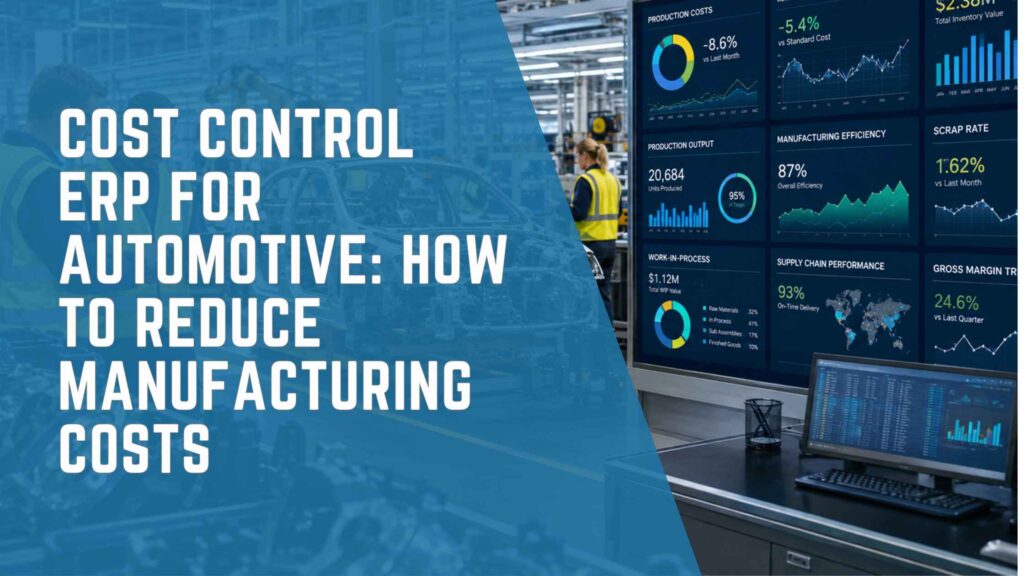
Automotive manufacturers and suppliers face constant pressure to reduce manufacturing costs without sacrificing product quality, delivery performance, production capacity, or customer satisfaction. Rising material and labor costs, supplier disruptions, excess inventory, production inefficiencies, and complex customer requirements can quickly reduce margins. Effective cost control therefore requires more than periodic financial reports, it depends on connected visibility across finance, production, purchasing, inventory, labor, and supply chain operations.
This article explores how a cost control ERP for automotive manufacturing can help organizations identify cost drivers, monitor production and purchasing variances, improve inventory management, measure operational efficiency, and protect profitability. It also examines the role of Sage X3 in supporting complex automotive manufacturing environments and how an experienced ERP partner such as IWI Consulting Group can help manufacturers align ERP technology with their processes, reporting needs, cost-reduction priorities, and long-term growth strategy.
Why Cost Control Has Become a Strategic Priority in Automotive Manufacturing
Automotive manufacturing has always required disciplined cost management. However, the level of operational complexity continues to increase.
Manufacturers may manage hundreds or thousands of components. In addition, they often work with multiple suppliers, customer-specific specifications, production schedules, quality requirements, inventory locations, and contractual pricing arrangements.
Small inefficiencies can therefore become expensive at scale. For example, excessive raw material inventory creates carrying costs. Production scrap reduces margins. Meanwhile, inaccurate bills of material can distort product costing. Supplier price changes may also affect profitability before finance teams can identify the impact.
Consequently, finance leaders need to understand manufacturing economics at a much more detailed level than general ledger reporting alone can provide.
Typical cost pressures include:
Raw material and component price volatility
Supplier price increases
Freight and logistics costs
Production scrap and rework
Machine downtime
Overtime expenses
Excess inventory
Obsolete inventory
Inefficient production scheduling
Unplanned purchasing
Quality-related costs
Warranty expenses
Labor inefficiencies
Energy consumption
Expedited shipping
Inaccurate product costing
Low-margin customer contracts
Although every manufacturer has different cost structures, the underlying challenge is similar: financial information must connect directly with operational activity. Without that connection, management teams may know that margins are declining without understanding exactly why.
What Is Cost Control ERP for Automotive Manufacturing?
A cost control ERP for automotive manufacturing is an enterprise resource planning system that connects financial management with manufacturing, inventory, purchasing, supply chain, production, costing, and reporting processes.
Instead of maintaining separate spreadsheets and disconnected applications, ERP creates a central operating environment.
Therefore, business leaders can analyze how operational decisions affect financial results.
An automotive manufacturing ERP system can help connect:
Business Area
Cost Control Impact
Purchasing
Supplier pricing, purchase commitments, material costs
Material requirements and expected production costs
Routing
Labor and operational requirements
Finance
Actual costs, margins, expenses, profitability
Sales
Pricing, customer profitability, demand
Supply Chain
Lead times, sourcing, logistics
Reporting
Variance analysis and cost visibility
This integration matters because manufacturing costs do not originate inside the accounting department.
They originate throughout the organization. As a result, effective cost control requires finance, operations, production, procurement, and supply chain information to work together.
How ERP Helps Reduce Manufacturing Costs
ERP does not reduce manufacturing costs simply because software has been installed.
Instead, ERP creates the information infrastructure that allows management teams to identify inefficiencies, improve decisions, automate processes, and enforce stronger operational controls.
Several areas typically offer significant opportunities.
1. Improve Material Cost Visibility
Materials often represent one of the largest components of manufacturing cost.
Therefore, automotive manufacturers need accurate visibility into purchase prices, supplier performance, material consumption, inventory levels, and cost variances.
An integrated ERP platform can help management teams compare:
Standard material cost
Actual purchase cost
Historical purchase cost
Supplier pricing
Material usage
Production consumption
Scrap levels
Inventory valuation
Purchase price variances
For example, if the cost of a critical component increases, finance teams should be able to understand which products, customer programs, and margins will be affected.
Without integrated information, that analysis may require manual spreadsheet work. In contrast, ERP can provide a more structured view of how purchasing activity affects manufacturing economics.
2. Reduce Excess Inventory
Inventory protects production continuity. However, too much inventory ties up working capital and increases storage, handling, insurance, damage, and obsolescence costs.
Automotive manufacturers often carry additional inventory because they lack confidence in demand forecasts or supplier reliability. Consequently, inventory becomes a buffer against uncertainty.
A modern ERP system can improve visibility into:
Inventory quantities
Material requirements
Open purchase orders
Production demand
Lead times
Inventory turnover
Slow-moving inventory
Safety stock
Reorder requirements
Multi-location inventory
Better information allows organizations to make more informed inventory decisions.
Therefore, manufacturers may be able to reduce unnecessary stock without increasing production risk. The financial benefit can extend beyond inventory itself. Lower inventory levels can also improve working capital and cash flow.
3. Identify Production Variances Faster
Production variances can reveal where expected manufacturing costs differ from actual performance.
However, these variances only help management when they are visible, timely, and actionable.
ERP can help compare planned and actual results for areas such as:
Material consumption
Labor usage
Production quantities
Scrap
Yield
Machine time
Work center performance
Production overhead
Work-in-process
Finished goods cost
Suppose a product consistently consumes more material than its bill of material indicates. That difference may suggest scrap, inaccurate standards, process problems, or incorrect data.
Similarly, labor variances may indicate scheduling problems, training requirements, production bottlenecks, or inefficient workflows. As a result, variance reporting can become a management tool rather than simply an accounting exercise.
Nevertheless, organizations sometimes manage purchasing through fragmented processes, emails, spreadsheets, and limited approval controls. This can create unnecessary costs.
For example, buyers may place orders with non-preferred suppliers. Employees may also purchase outside negotiated contracts. In addition, urgent orders may generate higher freight expenses.
ERP can strengthen procurement through:
Supplier records
Purchasing workflows
Approval controls
Purchase orders
Pricing history
Supplier comparison
Contract visibility
Receipt tracking
Purchase commitments
Spend reporting
Therefore, procurement teams gain better information before making purchasing decisions. Finance leaders also gain visibility into committed expenses before invoices arrive.
5. Improve Production Planning
Poor production planning can increase overtime, machine downtime, inventory, work-in-process, and expedited shipping.
Automotive manufacturers frequently operate under tight customer delivery expectations. Therefore, scheduling must balance capacity, material availability, demand, labor, and equipment. A manufacturing ERP platform can help provide visibility into these dependencies.
For example, operations teams can better understand:
What needs to be produced
Which materials are required
Whether inventory is available
When purchased materials are expected
Which work centers are involved
Production priorities
Current production status
Better coordination can help manufacturers avoid costly last-minute decisions. Moreover, accurate planning can reduce the need for excessive safety stock and emergency procurement.
6. Reduce Scrap and Rework Costs
Scrap and rework directly reduce profitability. However, finance teams may only see the total financial impact after the cost has already accumulated. Manufacturing ERP systems can provide operational data that helps organizations investigate problems earlier.
For example, management can analyze scrap by:
Product
Production order
Facility
Work center
Material
Shift
Process
Time period
These insights can help manufacturing teams identify patterns.
Therefore, ERP becomes an important foundation for continuous improvement initiatives. Even modest reductions in scrap can create meaningful savings when production volumes are high.
7. Improve Product Costing Accuracy
One of the most important capabilities in manufacturing finance is accurate product costing. Without reliable costing, organizations may unknowingly sell products at insufficient margins.
Automotive products can involve multiple components, labor activities, production stages, overhead allocations, subcontracting, and other cost elements. Therefore, simple spreadsheet costing models can become difficult to maintain.
ERP can help create a structured costing environment based on:
Bills of material
Material costs
Routings
Labor
Machine rates
Overhead
Subcontracted operations
Actual production activity
Better costing allows finance teams to compare expected and actual profitability. In addition, sales leaders can use cost information when evaluating pricing decisions.
8. Improve Customer and Product Profitability Analysis
Revenue growth does not always equal profit growth. Some customer programs may require expensive materials, frequent schedule changes, specialized packaging, small production runs, expedited freight, or substantial administrative effort. Therefore, automotive manufacturers need to evaluate profitability at more detailed levels.
ERP reporting can help management analyze financial performance by dimensions such as:
Customer
Product
Product family
Business unit
Facility
Program
Region
Production line
This analysis can change strategic decisions.
For example, management may renegotiate certain contracts, adjust pricing, redesign production processes, or discontinue low-margin products. Consequently, ERP supports not only cost reduction but also margin improvement.
Key Manufacturing Costs ERP Should Help Monitor
Cost reduction starts with measurement.
Therefore, automotive manufacturers should establish a consistent set of financial and operational KPIs.
Material Cost Percentage
Material cost percentage shows how much of revenue or production cost comes from raw materials and purchased components.
Increasing material costs may indicate supplier increases, unfavorable purchase pricing, product mix changes, or material usage problems.
Purchase Price Variance
Purchase price variance compares expected material prices with actual purchase prices.
This metric helps procurement and finance teams understand how supplier pricing changes affect margins.
Scrap Rate
Scrap rate measures the percentage of materials or production output that cannot be used.
Therefore, even small changes can have significant financial consequences at high production volumes.
Inventory Turnover
Inventory turnover measures how efficiently inventory is used.
Low turnover may indicate excess inventory, slow-moving products, or poor demand alignment.
Days Inventory Outstanding
Days inventory outstanding estimates how long inventory remains before being sold or consumed.
Consequently, it can help finance teams evaluate working capital efficiency.
Labor Cost Per Unit
Labor cost per unit helps organizations compare workforce costs against production volumes.
Changes may indicate productivity issues, overtime, training requirements, or process inefficiencies.
Manufacturing Overhead
Manufacturing overhead includes indirect costs associated with production.
Accurate allocation is important because poor overhead assumptions can distort product profitability.
Excessive WIP can indicate bottlenecks, scheduling problems, material shortages, or inefficient production flow.
Gross Margin by Product
Product-level gross margin helps finance leaders understand which products generate the strongest economic returns.
Therefore, it should form an important part of manufacturing performance analysis.
Why Spreadsheets Are Not Enough for Manufacturing Cost Control
Spreadsheets remain useful analytical tools. However, they should not function as the primary operating system for complex automotive manufacturing.
As manufacturing organizations grow, spreadsheet-based cost management can create several problems.
These include:
Multiple versions of the same data
Manual data entry
Formula errors
Delayed reporting
Limited audit trails
Inconsistent costing assumptions
Difficult consolidation
Limited operational visibility
Dependence on individual employees
Time-consuming reconciliations
For example, finance may maintain one inventory report while operations maintains another.
Meanwhile, procurement may use separate supplier spreadsheets., As a result, management meetings can focus on reconciling numbers instead of improving performance.
ERP creates a common data environment. Therefore, teams can spend more time analyzing information and less time assembling it.
Sage X3 is well suited to manufacturers that require more than basic financial management. It combines financial, manufacturing, inventory, purchasing, supply chain, and operational capabilities within an integrated ERP environment. For automotive manufacturers, this structure can support stronger visibility across business processes that directly influence cost.
Key areas include:
Manufacturing Management
Manufacturers can connect production planning, material requirements, bills of material, routings, production activity, and costing.
Therefore, operations and finance teams can work from connected information.
Inventory Management
Automotive organizations frequently manage large quantities of components and finished goods across multiple locations. Sage X3 can support inventory control within a broader operational environment.
Consequently, organizations can improve visibility into stock levels, movement, requirements, and valuation.
Purchasing and Supplier Management
Purchasing teams need visibility into supplier information, pricing, orders, and receipts.
Integrated procurement can help strengthen purchasing discipline and improve cost analysis.
Financial Management
Finance leaders need to understand the financial consequences of manufacturing activity.
Sage X3 connects financial management with operational information. Therefore, reporting can provide a more complete view of business performance.
Multi-Site Operations
Automotive manufacturers may operate multiple plants, warehouses, or business entities.
A scalable ERP platform can provide a common operating structure while supporting visibility across locations.
Reporting and Analytics
Cost reduction depends on actionable information.
Therefore, organizations need reporting that connects financial and manufacturing data. Sage X3 can help establish the foundation for more consistent operational and financial reporting.
Sage X3 vs. Basic Accounting Software for Automotive Manufacturing
Growing manufacturers sometimes attempt to manage complex production operations while keeping entry-level accounting software at the center of the business.
However, the operational gap becomes increasingly difficult to manage.
Capability
Basic Accounting Software
Sage X3 ERP
General Accounting
Yes
Yes
Manufacturing Management
Limited
Strong
Production Planning
Limited
Integrated
Bills of Material
Often external
Integrated
Inventory Control
Basic to moderate
Advanced
Purchasing
Basic
Integrated
Multi-Site Operations
Limited
Designed for complexity
Manufacturing Costing
Limited
Comprehensive
Operational Reporting
Limited
Integrated
Supply Chain Visibility
Limited
Broader operational support
Scalability
Moderate
High
Process Integration
Limited
Enterprise-wide
Basic accounting systems can work well for small organizations with simple operational requirements. However, automotive manufacturing introduces complexity that often requires a broader ERP architecture.
Therefore, the decision should not focus only on accounting functionality. Management should evaluate whether the system can support the entire manufacturing value chain.
How CFOs Can Use ERP to Drive Manufacturing Cost Reduction
The CFO’s role in manufacturing has expanded beyond financial reporting.
Today, finance leaders increasingly participate in operational planning, supply chain decisions, technology investment, pricing, and performance management.
ERP can strengthen that role.
Instead of asking what happened last month, CFOs can begin asking more strategic questions:
Which products are losing margin?
Where are purchase price variances increasing?
Which customers generate the strongest contribution?
How much cash is tied up in inventory?
Which materials are creating the most cost volatility?
Where is scrap increasing?
Which production areas generate unfavorable variances?
Are supplier costs affecting specific customer programs?
Which locations are operating most efficiently?
These questions connect finance with operations.
Consequently, ERP becomes a platform for management decision-making rather than simply transaction processing.
How COOs and Operations Leaders Benefit from Cost Control ERP
Operations leaders focus on production output, quality, resource utilization, scheduling, inventory, and customer delivery.
However, operational decisions always have financial consequences. For example, increasing production may improve output but also increase overtime. Carrying additional inventory may reduce material shortages but weaken working capital.
ERP allows COOs and operations leaders to evaluate those trade-offs more effectively. Therefore, organizations can pursue operational efficiency without losing sight of profitability.
Signs an Automotive Manufacturer Needs Better Cost Control ERP
Several warning signs indicate that existing systems may no longer provide sufficient cost visibility.
These include:
Management relies heavily on spreadsheets for costing.
Management cannot easily connect production activity with financial results.
Legacy systems require substantial manual work.
Reporting depends heavily on specific employees.
If several of these conditions exist, ERP modernization may become a strategic priority rather than an IT project.
Building an ERP Cost Reduction Strategy
Technology alone will not fix inefficient processes.
Therefore, automotive manufacturers should approach ERP as a business transformation initiative. A strong cost reduction strategy typically includes several stages.
First: Identify the Largest Cost Drivers
Management should identify where the greatest financial impact exists.
For example:
Materials
Labor
Inventory
Scrap
Freight
Overtime
Purchasing
Production downtime
This creates a measurable business case.
Second: Define Cost Control KPIs
Organizations should determine which metrics management needs to monitor consistently.
For example, dashboards may include:
Gross margin
Material variance
Purchase price variance
Scrap percentage
Inventory turnover
Labor cost per unit
Production efficiency
WIP
Customer profitability
Consequently, ERP design can align with actual management requirements.
Third: Standardize Processes
Organizations should determine which metrics management needs to monitor consistently.
For example, dashboards may include:
Gross margin
Material variance
Purchase price variance
Scrap percentage
Inventory turnover
Labor cost per unit
Production efficiency
WIP
Customer profitability
Consequently, ERP design can align with actual management requirements.
Fourth: Improve Data Quality
Manufacturing ERP depends on reliable data.
Important areas include:
Item masters
Bills of material
Routings
Supplier records
Customer records
Cost information
Inventory balances
Units of measure
Poor master data can undermine even a well-designed ERP system. Therefore, data preparation deserves significant attention during implementation.
Fifth: Connect Finance and Operations
Manufacturing cost control should not be owned by finance alone. Operations, procurement, supply chain, production, and finance should agree on performance definitions and reporting requirements.
As a result, management can operate from a common understanding of the business.
ERP Implementation Considerations for Automotive Manufacturers
ERP implementation requires careful planning because manufacturing processes are interconnected.Changing one area may affect several others.
For example, item structures affect inventory, production, purchasing, and costing.Therefore, implementation should include both functional and operational stakeholders.
Important considerations include:
Business process mapping
ERP requirements
Manufacturing workflows
Inventory processes
Purchasing controls
Financial reporting
Data migration
Integrations
User roles
Security
Testing
Training
Go-live planning
Post-implementation optimization
Automotive organizations should also avoid simply reproducing every legacy process inside the new ERP system.
Instead, implementation creates an opportunity to determine which processes should remain, which should change, and which can be automated.
ERP Migration and Data Considerations
Many manufacturers operate systems that have been in place for years or even decades.
Therefore, ERP migration requires careful decisions about historical data, open transactions, master data, reporting requirements, and integrations. IWI Consulting Group has experience helping organizations migrate from platforms such as QuickBooks, Sage 50, Sage BusinessVision, Microsoft Dynamics GP, and other legacy environments.
A successful migration strategy should determine:
Which historical data should move
Which data should be archived
How item records will be cleaned
How customer and supplier records will be standardized
How bills of material will be validated
How inventory will be reconciled
How financial balances will be confirmed
Which integrations must be rebuilt
Which reports must be recreated
Therefore, migration should begin well before the final cutover.
Integrating ERP With the Automotive Technology Environment
Automotive manufacturers rarely operate ERP in isolation.
Other systems may support quality, warehousing, production equipment, electronic data interchange, customer requirements, logistics, payroll, or specialized manufacturing functions. Therefore, integration planning should form part of the ERP architecture from the beginning.
Potential integration areas may include:
EDI platforms
Warehouse systems
CRM
Payroll
Business intelligence
Shipping systems
Banking
Customer portals
Supplier systems
Quality management systems
Production applications
Well-designed integration reduces duplicate entry and improves data consistency.
In contrast, poorly planned integrations can create new operational silos.
How Better Reporting Supports Manufacturing Cost Reduction
Reporting is often one of the strongest business cases for ERP modernization.
Finance teams may spend days collecting information from multiple systems before management can review performance. However, cost control requires timely information. Automotive executives should be able to monitor performance at multiple levels.
Therefore, reporting requirements should be designed around decisions rather than simply recreating old reports.
The Business Case for Reducing Manufacturing Costs by Small Percentages
Automotive manufacturers do not always need dramatic operational changes to produce meaningful financial results.
Consider a manufacturer with $40 million in annual production-related costs.
A 1% improvement represents:
$400,000 in annual cost reduction.
A 2% improvement represents:
$800,000.
A 3% improvement represents:
$1.2 million.
Of course, actual results depend on the organization and its cost structure. However, the example illustrates why visibility into small inefficiencies matters.
When organizations operate at scale, small improvements in inventory, purchasing, scrap, labor productivity, and production efficiency can create substantial financial impact. Therefore, ERP investments should be evaluated against measurable operational improvements rather than software features alone.
Why ERP Cost Reduction Should Focus on Visibility Before Automation
Automation attracts significant attention in manufacturing.However, automating an inefficient process can simply make the inefficiency happen faster. Therefore, organizations should first establish process visibility.
Management needs to understand:
What is happening?
Why is it happening?
What should the process look like?
Which steps can be standardized?
Which steps should be automated?
Once those questions are answered, ERP automation can produce stronger outcomes. For example, automated purchasing approvals can improve control. Automated reporting can reduce spreadsheet work. In addition, integrated inventory transactions can reduce duplicate entry.
Consequently, visibility and process design should come before aggressive automation.
Why Automotive Manufacturers Need a Long-Term ERP Partner
ERP implementation is not a one-time technology purchase. Manufacturing requirements change as companies add customers, products, facilities, acquisitions, regulations, integrations, and reporting requirements.
Therefore, manufacturers benefit from working with an ERP consulting partner that understands both the software and the underlying business processes.
IWI Consulting Group is a North American ERP consulting and implementation firm with more than 25 years of experience and over 500 successful projects delivered. The firm specializes in Sage Intacct, Sage 300, and Sage X3.
For automotive and complex manufacturing organizations, IWI can support:
ERP assessment
ERP selection strategy
Sage X3 implementation
ERP migration
Business process review
Financial configuration
Manufacturing configuration
Inventory optimization
Reporting
Integrations
User training
ERP optimization
Ongoing support
Moreover, IWI positions ERP as a business platform rather than simply software. That approach matters because manufacturers ultimately invest in ERP to improve performance, visibility, control, and scalability.
Why Sage X3 and IWI Consulting Group Are a Strong Fit for Automotive Cost Control
Automotive manufacturers need an ERP environment that can connect financial management with manufacturing operations.
Sage X3 provides a strong foundation for organizations managing complex production, inventory, purchasing, supply chain, and financial requirements. However, software capability is only part of the equation.
Implementation decisions determine how effectively ERP supports the business. Therefore, IWI Consulting Group works with organizations to understand processes, reporting needs, integrations, cost structures, and operational priorities before configuring the ERP environment. This consultative approach can help manufacturers create a system that supports both day-to-day operations and executive decision-making.
The objective of cost control is not simply to spend less. Instead, successful manufacturers need to understand which costs create value, which costs represent waste, and where operational changes can improve profitability without compromising customers or quality.
That requires reliable information. A modern manufacturing ERP system can provide the connected data foundation needed to analyze production, purchasing, inventory, finance, and supply chain performance together.
Therefore, organizations that want to reduce manufacturing costs should evaluate whether their existing systems give management sufficient visibility into the true drivers of cost. For automotive manufacturers with complex operational requirements, Sage X3 can provide a scalable ERP foundation for stronger cost control, manufacturing visibility, and financial management.
IWI Consulting Group can help organizations assess existing systems, define ERP requirements, plan migrations, implement Sage X3, improve reporting, and optimize processes over the long term. Ultimately, the strongest cost reduction programs combine technology, process improvement, accurate data, and disciplined management. ERP provides the foundation that brings those elements together.
Looking for better visibility into automotive manufacturing costs?
IWI Consulting Group helps manufacturers evaluate ERP requirements, improve cost visibility, modernize legacy systems, and implement Sage X3 around real operational and financial objectives. Organizations considering an ERP replacement or looking to improve an existing Sage environment can engage IWI for an ERP assessment and strategic review.
Frequently Asked Questions
How can ERP help automotive manufacturers reduce manufacturing costs?
ERP can help automotive manufacturers reduce manufacturing costs by connecting production, purchasing, inventory, supply chain, and financial information. As a result, management can identify material variances, scrap, excess inventory, inefficient purchasing, production issues, and profitability trends more quickly. ERP also creates a stronger foundation for process standardization and automation.
How much does an automotive manufacturing ERP system cost?
ERP pricing varies based on the number of users, business complexity, manufacturing requirements, modules, integrations, implementation scope, data migration, and reporting requirements. Therefore, automotive manufacturers should evaluate total project cost against measurable outcomes such as lower inventory, improved productivity, reduced manual work, better reporting, and stronger margin control. An ERP assessment can help establish a realistic investment range.
Is Sage X3 scalable for automotive manufacturers?
Sage X3 is designed for organizations with complex financial, manufacturing, inventory, purchasing, and supply chain requirements. Therefore, it can be a strong option for automotive manufacturers that need greater operational scalability than basic accounting software can provide. The appropriate architecture should still be evaluated against locations, users, transaction volumes, manufacturing processes, integrations, and growth plans.
How difficult is migrating from a legacy ERP system to Sage X3?
Migration complexity depends on the quality of existing data, number of integrations, business processes, historical data requirements, and system complexity. A structured migration plan should address master data, inventory, open transactions, financial balances, bills of material, reporting, integrations, testing, and training. IWI Consulting Group supports ERP migrations from systems including QuickBooks, Sage 50, Sage BusinessVision, Microsoft Dynamics GP, and other legacy environments.
Can Sage X3 integrate with other automotive manufacturing systems?
Sage X3 can operate as part of a broader business technology environment. Depending on the organization’s requirements, integrations may involve EDI, warehouse systems, CRM, shipping, business intelligence, payroll, banking, customer systems, supplier platforms, or specialized manufacturing applications. Therefore, integration architecture should be evaluated during ERP planning rather than after implementation.
What reporting should automotive manufacturers use to control costs?
Automotive manufacturers should monitor a combination of financial and operational KPIs. Important examples include purchase price variance, material usage variance, scrap rate, labor cost per unit, inventory turnover, days inventory outstanding, work-in-process, gross margin, production efficiency, and profitability by product or customer. ERP can help connect these measures so leadership teams can identify cost trends and investigate their causes.
Automotive manufacturers need more than accounting software to manage complex production, supply chains, inventory, quality, and financial reporting. This guide explains how ERP for the automotive industry can connect operations and how Sage X3 supports growing automotive manufacturers.
Retail ERP solutions help growing retailers connect finance, inventory, purchasing, reporting, and multi-location operations. Learn how Sage 300 can provide the control and visibility retailers need to scale efficiently.
Retail management software can help retailers control inventory costs, improve financial visibility, automate manual processes, and operate more efficiently. This guide explains how an ERP platform such as Sage 300 can support stronger retail cost management across finance, inventory, purchasing, and multi-location operations.
Sage 300 (formerly Sage Accpac) is a flexible ERP solution for growing Canadian businesses, but pricing varies based on users, modules, and deployment choice. This guide breaks down Sage 300 costs to help you budget accurately and choose the right setup for your business.
Healthcare accounting software can help healthcare organizations simplify audits by improving financial controls, maintaining detailed audit trails, automating workflows, and making supporting documentation easier to access. This guide explains what healthcare finance leaders should look for in a modern accounting platform and how Sage Intacct can support stronger audit readiness.
Ensuring compliance in the manufacturing industry is a multifaceted challenge that requires precision, diligence, and robust systems to meet ever-changing regulatory and quality standards. Enterprise Resource Planning (ERP) systems have emerged as indispensable tools for manufacturers aiming to stay compliant while optimizing operations. In this article, we will explore how an ERP can ensure compliance, enhance operational efficiency, and meet the needs of financial executives in high-level management positions.
The Importance of Compliance in the Manufacturing Industry
Compliance in the manufacturing industry is critical for maintaining brand reputation, avoiding penalties, and ensuring customer satisfaction. Non-compliance can lead to severe financial losses, including hefty fines, lawsuits, or even shutdowns. Additionally, adhering to quality standards is essential for maintaining market competitiveness and securing certifications required to operate in various regions.
Key Regulatory Challenges in Manufacturing
Environmental Regulations: Manufacturers must comply with environmental laws such as waste management, emissions control, and sustainable practices.
Health and Safety Standards: Occupational health and safety guidelines ensure the well-being of workers and mitigate workplace hazards.
Product Quality Standards: Compliance with ISO, FDA, and other international standards is vital for delivering high-quality products.
Data Security and Reporting: Compliance with GDPR, SOC, and other data protection regulations ensures secure handling of sensitive information.
How ERP Systems Address Compliance in Manufacturing
Centralized Data Management – ERP systems consolidate data from multiple departments, providing a single source of truth. This centralization ensures accuracy and real-time access to critical information, essential for compliance audits and reporting.
Automated Compliance Monitoring – Modern ERPs come with built-in compliance modules that automate the tracking of regulations. They provide alerts for non-compliance, generate reports, and maintain records that can be easily accessed during audits. Including examples of how these features have helped companies streamline their compliance efforts can add more depth to this section.
Quality Control Integration – An ERP ensures that quality checks are seamlessly integrated into production processes. For instance, Sage X3 enables manufacturers to track quality metrics, flag defects, and ensure compliance with product specifications. Consider mentioning a case study or hypothetical example to illustrate the value of this feature.
Key Features of ERP for Regulatory Compliance
Real-Time Reporting – Real-time data insights allow manufacturers to monitor compliance continuously. Customizable dashboards and automated report generation simplify the auditing process. Adding examples of specific metrics that financial managers might track can make this section more relatable.
Traceability and Lot Tracking – Manufacturers can trace raw materials and finished goods throughout the supply chain. This is critical for compliance with food safety, pharmaceutical regulations, and recalls. For example, using Sage X3’s traceability features, a manufacturer can quickly identify and isolate defective products during a recall.
Risk Management Tools – ERP systems identify and mitigate risks associated with regulatory changes by maintaining updated libraries of applicable standards and laws. Elaborating on the specific risks manufacturers face and how ERP mitigates them would strengthen this section.
Audit Trail Maintenance – A robust ERP records every transaction and process change, creating a comprehensive audit trail. This transparency simplifies audits and demonstrates regulatory adherence. Including a brief mention of how this helps financial leaders plan and budget for compliance-related activities can add value.
Financial Implications of Non-Compliance
For financial leaders, understanding the cost of non-compliance is essential. Non-compliance can lead to:
Direct Financial Penalties: Fines and sanctions from regulatory bodies.
Operational Disruptions: Production halts due to regulatory violations.
Reputational Damage: Loss of customer trust and market share.
Investing in an ERP system reduces these risks by ensuring regulatory compliance, providing peace of mind to C-level executives and financial managers. Adding data or examples on how companies have saved costs through ERP implementation could make this section more impactful.
Comprehensive Compliance Features – Sage X3 offers advanced compliance capabilities tailored for manufacturing. It supports environmental, health, safety, and quality standards seamlessly integrated into operational workflows.
Scalability and Flexibility – Sage X3 adapts to the unique needs of your organization, scaling as your operations grow and regulatory requirements evolve.
Financial Oversight – For CFOs and financial directors, Sage X3 provides detailed financial insights, ensuring that compliance-related costs are accounted for and managed effectively.
Conclusion: The ERP Advantage in Compliance in the Manufacturing Industry
ERP systems are no longer optional in the manufacturing industry; they are vital for ensuring compliance and sustaining business growth. From automating processes to generating real-time insights, an ERP like Sage X3 empowers manufacturers to navigate the complexities of modern regulations.
For companies seeking assistance in migrating to a new ERP system, IWI Consulting Group is your trusted Sagepartner. With extensive expertise in ERP implementation, we ensure a smooth transition, helping you achieve compliance and operational excellence. Contact us today to learn how we can support your journey.
In today’s rapidly evolving financial landscape, adopting cutting-edge technology is not just a strategic advantage—it’s essential. Traditional financial management systems are no longer adequate to keep up with the demands of modern businesses. This is where a cloud-based Enterprise Resource Planning (ERP) system comes in. For organizations in the financial services industry, using ERP in financial services can significantly streamline operations, enhance compliance management, and improve reporting accuracy.
In this article, we will explore why the financial sector needs to shift to cloud-based ERP solutions like Sage Intacct. The focus will be on key areas such as compliance, financial reporting, and scalability.
The Evolving Challenges of Financial Management
The financial services sector is subject to stringent regulatory requirements, market volatility, and the growing complexity of global operations. As businesses expand, managing these challenges becomes a daunting task, especially with legacy systems. In the age of digital transformation, companies must ensure accuracy, visibility, and compliance in their financial operations to avoid costly mistakes and inefficiencies.
Complex Compliance Requirements
One of the biggest challenges for the financial sector is staying compliant with regulations that change frequently. Whether it’s IFRS, GAAP, or local regulatory standards, businesses must ensure their financial data is accurate, up to date, and easily auditable. Failing to comply can lead to penalties, reputational damage, and, in some cases, severe legal consequences.
A cloud-based ERP in financial services, like Sage Intacct, can help organizations automatically adjust to regulatory changes, ensuring that their systems remain compliant with current laws. Such ERPs often include built-in compliance tools that facilitate real-time monitoring and reporting, giving businesses peace of mind.
Why Cloud-Based ERP is the Future of Financial Services
Scalability and Flexibility
The financial sector is highly dynamic, with fluctuating market conditions, changing regulations, and varying levels of business activity. Cloud-based ERP solutions are highly scalable and flexible, allowing organizations to adjust quickly to new demands. Unlike traditional on-premise systems that require costly upgrades, cloud-based systems like Sage Intacct can scale up or down without disruption, offering seamless flexibility.
This agility is crucial for financial services firms, which may need to integrate new functions or respond to unexpected changes in their operational landscape. ERP in financial services gives companies the ability to stay ahead, regardless of the market conditions.
Cost Efficiency
Legacy financial systems often involve significant upfront investments in hardware and software, followed by recurring maintenance costs. Cloud-based ERP systems eliminate many of these expenses, as they operate on a subscription basis and do not require on-premise infrastructure. This reduces both the capital expenditure and the total cost of ownership.
For financial services organizations, this is a game-changer. Instead of worrying about hardware upgrades, IT maintenance, or unplanned outages, businesses can focus their resources on growth and innovation.
Enhancing Financial Reporting with Cloud-Based ERP
Real-Time Financial Visibility
Accurate financial reporting is crucial for the financial sector. Organizations require real-time access to financial data to make informed decisions and meet regulatory requirements. However, traditional systems often fall short by not providing real-time insights, forcing decision-makers to rely on outdated or incomplete data.
Cloud-based ERP in financial services not only offers real-time reporting capabilities but also allows businesses to access financial information on demand. Moreover, with a platform like Sage Intacct, you can generate accurate financial reports at any time, which is essential for regulatory compliance, investor relations, and strategic decision-making.
Customizable Reporting Options
One of the most significant advantages of cloud-based ERP systems is their ability to customize financial reports based on the specific needs of the business. In fact, financial services companies often need to generate complex reports for various stakeholders, ranging from regulators to investors.
Sage Intacct, for example, offers customizable dashboards and reporting tools that allow businesses to view financial data from multiple perspectives. These customizable reports can be set up to meet specific compliance needs. This ensures that financial institutions are always prepared for audits and regulatory reviews.
Managing Risk with Cloud-Based ERP Solutions
Enhanced Security Features
Security is always a top concern for financial institutions. Cloud-based ERP solutions come with robust security features that often exceed the capabilities of on-premise systems. Data is stored in highly secure, encrypted data centers, and cloud providers typically offer multi-layered security protocols.
Financial services organizations use ERP in financial services not only to protect sensitive financial data against cyber threats, data breaches, and unauthorized access but also to maintain customer trust. Furthermore, this is crucial for meeting stringent regulatory requirements related to data protection.
Disaster Recovery and Business Continuity
In the financial sector, downtime or data loss can be catastrophic. Consequently, cloud-based ERP systems are designed with disaster recovery and business continuity in mind. Additionally, with regular data backups and fail-safe mechanisms in place, businesses can rest assured that their critical financial data is safe, even in the event of a disaster.
Cloud-based systems provide automatic backups. They also allow for real-time replication of data across multiple servers, minimizing the risk of data loss. This kind of built-in redundancy is vital for the financial services industry. Even a minor system failure can lead to significant losses.
The Future of Financial Services: Why Sage Intacct is the Ideal ERP Solution
Sage Intacct offers a complete solution for financial services organizations seeking to modernize their operations and stay competitive. It is specifically designed to provide real-time visibility into financial operations, ensure compliance, and streamline complex financial processes. With its user-friendly interface, robust reporting capabilities, and scalability, Sage Intacct stands out as a top choice for companies in the financial sector.
By utilizing a cloud-based ERP in financial services like Sage Intacct, companies can ensure that they remain compliant with changing regulations. They can also gain greater insight into their financial operations and reduce costs related to outdated systems. The platform is designed to grow with your business. This makes it an invaluable asset for financial services firms of any size.
What is the best ERP in financial services, and why is it Sage Intacct?
Sage Intacct brings together the key benefits that financial services organizations need: compliance, real-time reporting, scalability, and security. By adopting Sage Intacct, businesses in the financial sector can reduce operational costs, improve reporting accuracy, and enhance their overall performance. In a fast-paced, regulated industry, having an ERP system that provides real-time data and compliance tools is no longer optional—it’s necessary.
IWI Consulting Group: Your Partner in ERP in Financial Services
For businesses in the financial sector looking to migrate to a modern, cloud-based ERP solution, IWI Consulting Group not only offers the expertise needed to ensure a smooth transition but also specializes in ERP implementations. Moreover, we have a proven track record of helping companies successfully adopt Sage Intacct. Therefore, if your organization is ready to take the next step in digital transformation, IWI Consulting Group is here to assist.