Outgrowing your accounting software can create reporting bottlenecks, operational inefficiencies, and limited visibility. This guide explains the warning signs and how modern ERP solutions help growing organizations improve financial management and scalability.
Sage 300 Integration helps finance and IT departments connect ERP data with business-critical systems, reduce manual processes, improve reporting accuracy, and build a more scalable technology environment. This guide explains key integration use cases, benefits, challenges, best practices, and how Canadian organizations can use Sage 300 as a connected ERP platform for stronger financial visibility and operational control.
Mid-market businesses often struggle with disconnected systems and inefficient processes that limit growth and visibility. This guide explores how Sage X3 unifies operations, automates workflows, and delivers real-time insights to help companies scale with confidence.
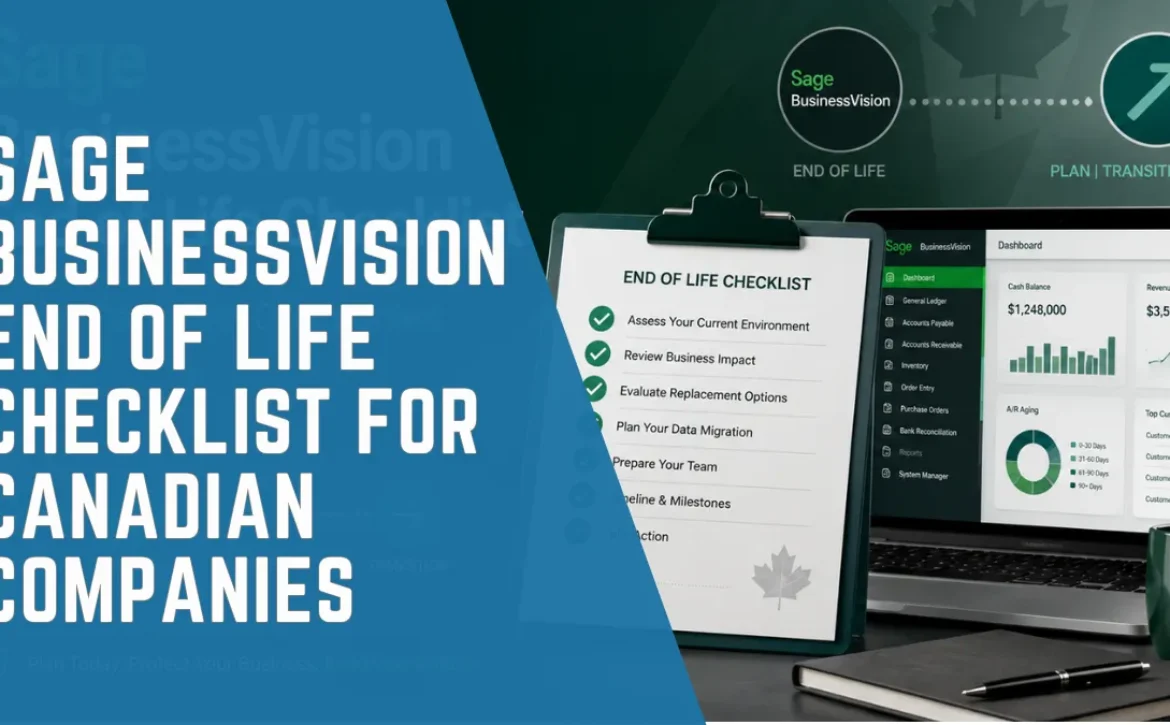
Prepare for Sage BusinessVision End of Life on December 31, 2026 with a practical checklist covering risk assessment, replacement options, data migration, testing, training, and transition planning for Canadian companies.
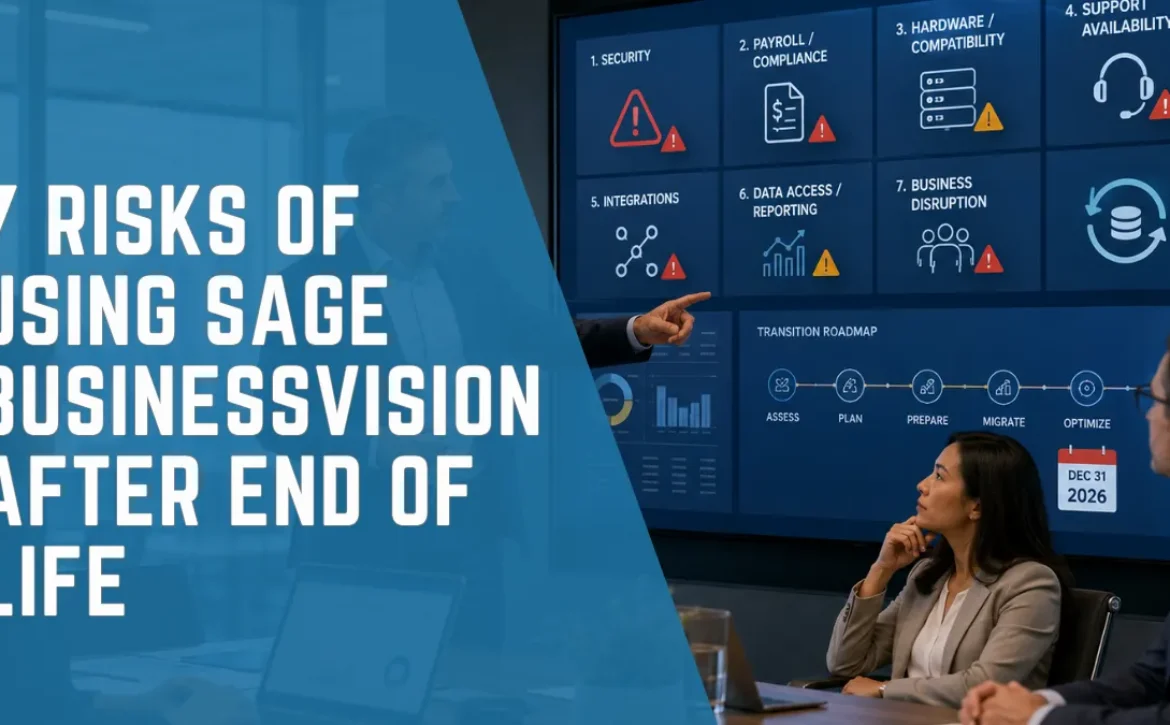
Learn the seven key risks of using Sage BusinessVision after End of Life, including security, payroll, compatibility, support, integrations, data access, and business continuity—and how to prepare before support ends.
Transform your manufacturing processes by mastering essential KPIs. Drive efficiency and boost productivity with actionable insights and trusted strategies.
In today’s evolving retail landscape, leveraging the right technology is no longer a luxury; it’s a necessity. CEOs and CFOs of retail businesses face mounting pressure to optimize operations, improve financial visibility, and deliver exceptional customer experiences. This is where ERP software for the retail industry comes in, transforming how companies manage inventory, sales, finances, and supply chains through integrated, intelligent platforms.
Modern ERP systems like Sage 300 are helping drive this technological evolution by incorporating capabilities that enable retailers to improve efficiency and support sustainable growth. This article explores how modern ERP solutions leverage emerging technologies to help retailers grow efficiently and compete effectively in an increasingly complex market.
Why ERP Software for Retail Industry is Essential for Growth
Retail businesses juggle multiple channels, locations, and complex inventory flows. Without a unified system, managing financials, supply chain, sales, and customer data becomes inefficient and error-prone.
ERP software for retail industry provides a centralized platform that integrates these critical functions, offering:
Real-time visibility into inventory and sales across all stores and e-commerce channels
Automated financial management and reporting for accurate forecasting and compliance
Scalable solutions that grow with your business as you add stores or expand product lines
Enhanced customer experience through better stock management and faster order fulfillment
With the retail sector rapidly evolving, ERP systems that embrace emerging technologies enable businesses to stay agile and ahead of the curve.
Emerging Technologies Driving Growth in Retail ERP
Leading ERP platforms now incorporate advanced technologies that drive efficiency, insight, and automation. The key trends include:
1. Cloud Computing and Mobility
Cloud-based ERP platforms allow retailers to access real-time data from anywhere, which is especially important for multi-location operations and remote management. Mobile capabilities also empower store managers and executives to make data-driven decisions on the go.
Modern cloud-based ERP solutions provide web and mobile access, user-friendly interfaces, and seamless integrations through technologies such as REST APIs. These capabilities help retailers operate more flexibly, improve connectivity across locations, and scale without many of the constraints associated with traditional on-premise systems.
2. Artificial Intelligence (AI) and Machine Learning (ML)
AI-powered analytics and ML algorithms help retailers forecast demand, detect anomalies, and automate workflows. This leads to improved inventory management, reduced stockouts or overstocks, and smarter purchasing decisions.
3. Omnichannel Integration
Customers expect seamless experiences across physical stores, online marketplaces, and mobile apps. ERP software integrates POS systems, e-commerce platforms such as Shopify and Amazon, and inventory management to help maintain consistent pricing, promotions, and stock availability.
Sage 300 supports omnichannel retail operations through various ISV add-ons, integrations, and EDI connectivity, helping retailers connect sales channels, inventory, and financial processes more effectively.
4. Advanced Business Intelligence (BI) and Reporting
Real-time dashboards and customizable reports give retail CFOs and CEOs actionable insights into sales performance, cash flow, and operational bottlenecks. These tools enable proactive decision-making and strategic planning.
Sage 300’s Data & Analytics BI toolkit provides powerful dashboards and reporting capabilities, helping retail leaders monitor financial and operational performance and make more informed business decisions.
Sage 300, formerly known as Sage ACCPAC, is a trusted ERP solution for mid-market retailers seeking robust financial and operational management. It offers:
Comprehensive Financial Control: From general ledger and accounts payable/receivable to multi-currency and inter-company consolidations, Sage 300 delivers mature financial capabilities that support global retail operations.
Inventory and Order Management: Powerful tools for inventory control, purchase and sales orders, warehouse management, and lot/serial tracking ensure accurate stock levels and order fulfillment.
Flexible Deployment Options: Available on-premise or via certified cloud partners, Sage 300 supports both SQL and Pervasive databases and offers scalable editions (Standard, Advanced, Premium) tailored to business size and complexity.
Strong Ecosystem and Extensibility: With a rich ISV partner network, open APIs, and advanced BI tools, retailers can customize Sage 300 to fit unique operational requirements and gain actionable insights.
By leveraging Sage 300, retailers gain a stable, scalable platform designed to optimize cost, improve compliance, and enhance financial visibility,key factors for sustained growth in competitive markets.
How IWI Group Supports Your Retail ERP Journey
Selecting and implementing the right ERP software for retail industry is a critical step that requires expertise, planning, and ongoing support. At IWI Group, we specialize in helping retail businesses make informed ERP decisions and maximize their investment.
Our services include:
ERP requirements assessment and benchmarking
Vendor shortlisting and strategic selection
Custom rollout planning, data migration, and comprehensive user training
BI dashboard design and financial reporting setup
Ongoing support, extension deployment, and change management
Partnering with IWI Group ensures you confidently navigate your ERP selection and implementation, enabling your retail business to thrive with technology that drives growth and operational excellence.
Frequently asked questions: ERP software for the retail industry
What is ERP software for the retail industry?
ERP (Enterprise Resource Planning) software for the retail industry is an integrated platform that centralizes and automates core business functions — including inventory management, financial reporting, supply chain operations, sales tracking, and customer data — across all retail channels. Instead of managing separate systems for your store, e-commerce, and back office, a retail ERP unifies everything in one place, giving you real-time visibility and control.
Why do retail businesses need ERP software?
Retail businesses operate across multiple channels, locations, and complex inventory flows. Without a unified system, managing data manually across disconnected tools leads to errors, stockouts, poor financial visibility, and slow decision-making. ERP software solves this by integrating financials, inventory, supply chain, and sales into a single source of truth — enabling accurate forecasting, faster order fulfillment, and scalable growth.
What features should I look for in a retail ERP system?
Key features to evaluate include: real-time inventory tracking across all channels, POS and e-commerce integrations (Shopify, Amazon, BigCommerce), automated financial management and multi-currency support, demand forecasting and AI-powered analytics, omnichannel order management, warehouse and lot/serial tracking, customizable BI dashboards and reporting, and scalable, modular licensing. The best system depends on your business size, IT infrastructure, and growth plans.
How does ERP software improve inventory management for retailers?
Retail ERP systems provide real-time stock visibility across stores and online channels, automate reorder triggers, and use AI and machine learning to forecast demand. This reduces costly stockouts and overstocks, improves purchase order accuracy, and enables lot and serial number tracking for full traceability — leading to better margins and a smoother customer experience.
What is omnichannel ERP integration and why does it matter?
Omnichannel ERP integration connects your physical stores, e-commerce platforms, marketplaces, and mobile sales channels into a single system. It ensures consistent pricing, promotions, and stock availability wherever customers shop. For retailers selling on platforms like Shopify, Amazon, or BigCommerce, omnichannel ERP integration eliminates manual data syncing, reduces fulfillment errors, and improves the overall customer experience.
Is cloud ERP better than on-premise ERP for retail businesses?
Cloud ERP offers several advantages for modern retailers: lower upfront costs, anytime/anywhere access for multi-location teams, automatic updates, and easy integration with third-party platforms. On-premise ERP may suit businesses with specific data security requirements or existing IT infrastructure. Hybrid options — like Sage 300 deployed via cloud partners — offer a middle ground. The right choice depends on your operational model, IT resources, and scalability needs.
What is Sage 300 and is it suitable for retail businesses?
Sage 300 (formerly Sage ACCPAC) is a mature, mid-market ERP solution offering robust financial and operational management capabilities. It is well-suited for retail businesses that need comprehensive general ledger, accounts payable/receivable, multi-currency support, inventory control, purchase and sales order management, and warehouse tracking. It supports both on-premise and cloud deployment and scales across Standard, Advanced, and Premium editions.
What retail integrations does Sage 300 support?
Sage 300 supports a wide range of integrations through its ISV (Independent Software Vendor) partner network, including EDI connectivity, POS systems, and e-commerce platforms. Its open APIs allow custom integrations with other retail tools. The Data & Analytics BI toolkit provides powerful dashboard and reporting capabilities tailored to retail financial management.
How much does ERP software for retail cost?
Retail ERP costs vary widely depending on the platform, number of users, modules, and deployment model. Cloud-based solutions typically use subscription or modular pricing, allowing businesses to pay based on the functionality and resources they need. On-premise or hybrid solutions like Sage 300 may involve upfront licensing costs along with ongoing maintenance and support expenses.
Working with an ERP partner like IWI Consulting Group can help retailers compare options, estimate implementation costs, and determine the right investment level based on business size, operational requirements, and growth plans.
How long does it take to implement retail ERP software?
Implementation timelines vary based on business complexity, data migration scope, and the number of integrations required. A straightforward mid-market deployment can take 3–6 months, while more complex multi-location or omnichannel rollouts may take 6–12 months or longer. A phased approach — starting with financials and inventory, then adding e-commerce integrations and advanced reporting — can reduce disruption and accelerate time to value.
How do I choose the right ERP for my retail business?
Start by assessing your core requirements: number of locations, sales channels (in-store, online, marketplace), current pain points (inventory accuracy, financial reporting, order fulfillment), IT infrastructure, and budget. Then evaluate solutions based on retail-specific functionality, scalability, total cost of ownership, and vendor support. Partnering with an experienced ERP consultant like IWI Group ensures you shortlist the right vendors, avoid costly mismatches, and set up your implementation for long-term success.
In today’s healthcare sector, CFOs and CEOs are under constant pressure to maintain financial stability, ensure regulatory compliance, and optimize operational efficiency. Choosing the best ERP healthcare systems like Sage Intacct is crucial for healthcare finance leaders to mitigate risks and control costs effectively. The complexity of healthcare billing, multi-entity organizations, and the need for accurate reporting make risk management more challenging than ever.
Common Financial Challenges Facing Healthcare CFOs with ERP Healthcare Systems
Healthcare finance leaders grapple daily with numerous risk factors that can severely impact an organization’s financial health, including:
Complex billing and reimbursement cycles: With multiple payers and fee schedules, manual billing processes can lead to errors and revenue leakage.
Delayed or denied reimbursements: Inaccurate claims or insufficient documentation often cause slow payments, which strain cash flow.
Budget overruns and cost control difficulties: Lack of integrated financial data hinders accurate budgeting and forecasting.
Disparate systems and manual reconciliations: Healthcare organizations often run on multiple legacy systems, leading to fragmented data and manual processes that increase error risk and delay reporting.
Regulatory compliance pressures: CFOs must ensure adherence to HIPAA, HITECH, and SOX standards to avoid costly penalties.
These issues result in financial inefficiencies, increased risk of audit findings, and limited ability for proactive decision-making.
Sage Intacct: The Core Solution for ERP Healthcare Systems
Sage Intacct stands out as the premier ERP healthcare system designed specifically to address the complex financial needs of healthcare organizations. Its comprehensive cloud-based financial management platform delivers:
Accounts Payable Automation: Streamlines invoice processing and payments to reduce errors and free staff time.
Multi-Dimensional General Ledger: Enables detailed financial tracking by department, location, provider, or CPT code, providing granular insights.
Advanced Audit Trails: Full transparency with timestamps and user IDs supports rigorous audit and compliance requirements.
Multi-Entity Management: Simplifies financial consolidation across multiple healthcare entities and locations.
EMRConnect Integration: Connects financial data with clinical systems for a unified view of patient care costs and revenues.
Security and Compliance: HIPAA- and HITECH-certified with robust encryption and user authentication, supporting SOX compliance.
Future-ready Innovations: Includes AI-powered analytics and cloud flexibility to adapt and grow with healthcare organizations.
Deep Dive: How Sage Intacct Solves Challenges in ERP Healthcare Systems
Sage Intacct is designed to meet healthcare’s unique financial management demands through specialized features:
Accounts Payable Automation: Automates invoice capture, approval workflows, and payment processing, significantly reducing manual effort and errors.
Multi-Dimensional General Ledger: Allows tagging transactions by department, location, provider, or CPT code, giving CFOs granular insight into revenue and cost drivers.
Advanced Audit Trail and Compliance: Tracks every transaction change with time stamps and user IDs, providing transparency and accountability for audits.
Multi-Entity Management: Supports consolidation and elimination across multiple healthcare facilities or legal entities, streamlining reporting and compliance.
EMRConnect Integration: Directly pulls clinical and billing data from electronic medical records, enhancing financial analysis with patient care insights.
Automation’s Role in Reducing Errors and Fraud Risk with ERP Healthcare Systems
Manual data entry and spreadsheet-based processes expose healthcare organizations to costly errors and fraud. Sage Intacct’s automation tackles these risks by:
Eliminating manual workflows: Automating procure-to-pay and order-to-cash processes cuts human error in data entry, coding, and approvals.
Enforcing approval hierarchies: Built-in workflows ensure invoices and expenses are reviewed and approved by the right personnel, preventing unauthorized spending.
Providing real-time audit trails: Every change is logged, enabling rapid fraud detection and regulatory audit readiness.
Improving segregation of duties: Role-based access controls reduce the risk of internal fraud by limiting system access.
Automation not only improves accuracy but frees finance staff from tedious tasks, allowing them to focus on value-added activities such as financial analysis and risk assessment.
Integration Benefits: Unifying Clinical, Financial, and Operational Data in ERP Healthcare Systems
One of the greatest advantages of Sage Intacct lies in its ability to integrate with EMRs, practice management, billing, and procurement systems to:
Provide a unified financial and clinical view: CFOs gain insight into the true cost of patient care, linking clinical outcomes to financial performance.
Streamline workflows: Seamless integration reduces duplicate data entry and accelerates billing and revenue cycle processes.
Enhance budgeting and forecasting: Real-time data from multiple sources improves accuracy in resource allocation and financial planning.
Improve compliance: Centralized data simplifies audits and regulatory reporting.
For instance, with EMRConnect, clinical data like patient visits and procedures automatically feed into financial ledgers, helping healthcare organizations analyze profitability by treatment type or provider — critical for cost control and strategic planning.
Regulatory Compliance and Risk Management with Sage Intacct ERP Healthcare Systems
Healthcare organizations face hefty fines for failing to comply with regulations such as HIPAA and HITECH. Sage Intacct minimizes this risk by:
Offering HIPAA- and HITECH-certified security features: Including advanced encryption and user authentication.
Providing a Business Associate Agreement (BAA): Ensuring Sage’s compliance responsibilities align with healthcare clients’ needs.
Maintaining detailed audit logs: Supporting compliance audits with transparent, immutable records of financial transactions.
Supporting SOX compliance: With internal control workflows and segregation of duties.
Non-compliance can lead to fines reaching up to $1.5 million per violation, so mitigating these risks is critical to protecting organizational assets and reputation.
Future-Proofing Healthcare Finance
The healthcare finance landscape is evolving rapidly, with AI, predictive analytics, and cloud adoption playing growing roles. Sage Intacct is at the forefront of these trends:
AI-powered insights: Tools like Sage Intacct Copilot offer intelligent anomaly detection and predictive analytics to spot risks before they escalate.
Cloud-native flexibility: Cloud deployment means faster upgrades, remote access, and scalable infrastructure that adapts as organizations grow.
Enhanced collaboration: Cloud platforms enable better collaboration across departments and sites.
Mobile accessibility: Executives and finance teams can access dashboards and approve workflows anywhere, anytime.
By investing in Sage Intacct, healthcare organizations position themselves to leverage these innovations to stay competitive and efficient.
Quantifying ROI and Cost Savings for Healthcare Organizations
In today’s data-driven, mission-focused landscape, nonprofit organizations are expected to meet increasing demands for transparency, efficiency, and measurable impact. Donors, grantmakers, and boards require accurate and timely financial data. However, many nonprofits still rely on outdated systems and manual processes that hinder performance. This is where ERP for nonprofits comes in, providing a modern, cloud-based foundation for financial management, compliance, and organizational growth. In this article, we’ll explore how ERP software like Sage Intacct empowers nonprofits to scale their impact, manage complex funding, and build donor trust.
The Challenges Nonprofits Face Without ERP Systems
Nonprofit finance teams often struggle with:
Managing multiple funding sources and program budgets
Manual reconciliations and inconsistent data
Delayed reporting and lack of real-time visibility
Difficulty maintaining audit readiness
Time wasted on spreadsheets and redundant processes
These obstacles can limit growth, affect compliance, and erode donor confidence. ERP for nonprofits addresses these pain points by automating processes and centralizing data.
What Is ERP for Nonprofits?
ERP (Enterprise Resource Planning) for nonprofits is a financial management platform that integrates fund accounting, donor and grant tracking, reporting, budgeting, and compliance in a single system. Unlike general-purpose accounting software, nonprofit ERP software is designed to handle:
Restricted and unrestricted funds
Multi-entity and multi-location reporting
Program-based budgeting and cost allocation
Compliance with regulations like GAAP and FASB
Integration with fundraising platforms and CRM
This comprehensive approach allows nonprofits to focus on their mission instead of managing disconnected systems.
Key Benefits of ERP for Nonprofits
1. Improved Financial Transparency
ERP systems like Sage Intacct provide real-time visibility into your organization’s financial health. Customizable dashboards and automated reports make it easy to:
Track spending by program or fund
Report on grant utilization
Monitor budget variances
Present clean, audit-ready financials to stakeholders
This level of transparency builds trust with donors and strengthens your credibility.
2. Automated Compliance and Audit Readiness
Nonprofits must comply with evolving financial reporting standards. Sage Intacct is built for nonprofit compliance, supporting FASB, GAAP, and 990 reporting with:
Automated audit trails
Built-in internal controls
Role-based access and approval workflows
This reduces the burden on finance teams and ensures regulatory confidence.
3. Grant and Fund Management Made Easy
ERP for nonprofits simplifies the tracking of restricted, temporarily restricted, and unrestricted funds — including grants, donations, and endowments. With Sage Intacct, you can:
Automatically assign transactions to funding sources
Generate real-time reports for individual grantors
Monitor compliance with funding requirements
This helps maximize funding and reduce the risk of grant clawbacks.
4. Streamlined Budgeting and Planning
Sage Intacct allows organizations to move away from static spreadsheets by enabling:
Collaborative budgeting by department
Rolling forecasts and scenario planning
Budget-to-actual comparisons in real time
This makes it easier to pivot strategically when conditions change — whether due to donor behavior, economic shifts, or program adjustments.
5. Integration with Your Ecosystem
Modern solutions integrate easily with your existing tools such as:
Donor databases (e.g., Salesforce, Bloomerang)
Fundraising platforms (e.g., Classy, Givebutter)
Payroll and HR systems
This improves data accuracy and creates a unified view of your organization’s performance.
Sage Intacct is the only AICPA-endorsed ERP system for nonprofits. Trusted by thousands of charitable organizations, Sage Intacct is purpose-built to support:
Multi-entity management
Multi-currency support
Role-based dashboards and KPIs
Advanced automation and workflows
Continuous audit functionality
Organizations like The Ford Family Foundation and World Learning have successfully used Sage Intacct to improve financial stewardship and scale their missions.
Choosing the Right ERP for Nonprofits
When evaluating ERP software for your nonprofit, consider the following:
Does it support nonprofit-specific reporting and compliance?
Is it scalable to meet future growth?
Can it integrate with your existing tools?
Is the vendor experienced in nonprofit implementations?
Does it offer cloud access and mobile capability?
Make sure your implementation partner understands the nonprofit sector and can provide local support.
Work with IWI Consulting Group
At IWI Consulting Group, we specialize in helping Canadian nonprofit organizations implement and optimize Sage Intacct. From discovery to go-live and beyond, our team works closely with your staff to ensure success. We’ve helped nonprofits reduce administrative burden, improve reporting, and gain insight into their financial health.
Whether you’re managing multiple grants or planning long-term growth, IWI Consulting Group can help you harness the full power of ERP for nonprofits.
Frequently Asked Questions (FAQs) About ERP for Nonprofits
What is ERP for nonprofits?
ERP for nonprofits (Enterprise Resource Planning) is a cloud-based financial management system that integrates fund accounting, grant tracking, budgeting, reporting, and compliance into one platform. Unlike basic accounting tools, nonprofit ERP solutions are designed to handle restricted funds, multi-entity reporting, and regulatory requirements.
Why do nonprofits need ERP software?
Nonprofits need ERP software to improve financial transparency, automate manual processes, and ensure compliance with standards like GAAP and FASB. It helps organizations manage multiple funding sources, streamline reporting, and provide real-time insights to donors, grantmakers, and board members.
How does ERP for Nonprofits help with grant and fund management?
ERP systems enable nonprofits to track restricted, unrestricted, and grant-based funds in real time. They automate transaction tagging, generate grant-specific reports, and ensure compliance with funding requirements—reducing the risk of misallocation or grant clawbacks.
How does ERP for Nonprofits support compliance and audits?
ERP systems include built-in audit trails, internal controls, and automated workflows. These features help nonprofits comply with financial regulations and simplify the audit process by ensuring accurate, traceable records.
How long does it take to implement an ERP for a nonprofit?
Implementation timelines vary depending on the organization’s size and complexity, but most nonprofit ERP implementations take between 2 to 6 months. Working with an experienced partner can help streamline the process.
What is the difference between ERP and accounting software for nonprofits?
Accounting software focuses mainly on basic financial tracking, while ERP systems provide a comprehensive platform that includes fund accounting, grant management, budgeting, reporting, and integrations—making ERP a more powerful solution for growing nonprofits.
In today’s complex nonprofit landscape, financial transparency, compliance, and operational efficiency are more critical than ever. Nonprofit organizations face unique challenges managing restricted funds, donor reporting, grants, and regulatory requirements; all while maximizing impact with limited resources. Choosing the best ERP software for nonprofits is a strategic decision that can transform how your organization operates, delivers programs, and demonstrates accountability to stakeholders.
Why an ERP Software for Nonprofits is Essential for Financial Management
Nonprofits rely on accurate financial management to maintain donor trust and meet compliance standards. According to a 2022 survey by the Nonprofit Technology Network (NTEN), 63% of nonprofits reported inefficient manual processes as a major challenge to financial management. Manual processes, disconnected systems, and spreadsheets create risks of errors and inefficiencies that can hurt both operations and reputation.
Enterprise Resource Planning (ERP) software integrates core business functions into one system — including accounting, fund management, grant tracking, budgeting, and reporting. This integration enables nonprofits to:
Increase financial visibility with real-time data and dashboards
Ensure compliance with fund restrictions, audits, and government regulations
Streamline grant management and donor reporting
Improve operational efficiency by automating workflows and reducing manual tasks
Scale easily as programs and funding grow
For financial and executive leaders, ERP software is no longer a luxury but a necessity to drive sustainable growth and impact.
Key Features of an ERP Software for Nonprofits
When evaluating ERP solutions for your nonprofit, keep these critical features in mind:
Fund Accounting and Grant Management Capabilities
Unlike traditional businesses, nonprofits must track multiple funds and grants separately. Your ERP must support fund accounting, enabling you to manage restricted and unrestricted funds, allocate expenses properly, and generate detailed reports for donors and auditors.
Financial Reporting and Real-Time Dashboards
Robust, customizable reporting capabilities are essential. Look for solutions offering real-time dashboards, KPI tracking, and drill-down functionality to give CFOs and boards actionable insights at any moment.
Flexible Budgeting and Forecasting Tools
Flexible budgeting and forecasting modules help nonprofit leaders plan strategically, monitor actual vs. budgeted performance, and adjust quickly to funding changes.
Integration with Fundraising and Donor Management Systems
Your ERP should easily integrate with fundraising platforms, CRM systems, payroll, and other nonprofit tools to create a seamless technology ecosystem.
Cloud-Based Accessibility and Enhanced Security
Cloud ERP solutions provide anytime, anywhere access while offering enhanced security and disaster recovery capabilities — essential for nonprofit data protection.
Why Sage Intacct Is the Best ERP Software for Nonprofits
Among the many ERP options available, Sage Intacct stands out as a leading cloud ERP designed to meet the specific needs of nonprofits. According to the official Sage Intacct nonprofit page, Sage Intacct offers powerful financial management capabilities trusted by thousands of nonprofit organizations worldwide.
Fund Accounting Excellence with Sage Intacct
Sage Intacct’s fund accounting module simplifies complex nonprofit accounting by supporting multi-fund, multi-entity, and multi-currency transactions. It enables precise tracking of funds, grants, and donations to ensure compliance and transparency.
Comprehensive Financial Reporting and Dashboards
Sage Intacct provides a library of pre-built nonprofit financial reports, including Statement of Financial Position, Statement of Activities, and Cash Flow statements. Its custom report writer lets finance teams build tailored reports and dashboards to monitor KPIs in real-time, empowering faster and more informed decisions.
Automation That Increases Efficiency
The platform automates repetitive tasks like journal entries, interfund allocations, and approvals, freeing finance staff to focus on higher-value activities. Integration with fundraising and donor management software ensures smooth data flow without manual re-entry.
Cloud Native Benefits for Modern Nonprofits
As a cloud-native solution, Sage Intacct offers secure access anytime from anywhere, supporting remote work and multiple locations seamlessly. The system is continuously updated with the latest compliance standards and technology innovations without disruption.
Scalability and Flexibility to Grow with Your Nonprofit
Whether your nonprofit is just starting or managing multiple programs across regions, Sage Intacct scales effortlessly. Its modular design means you pay for only what you need and add features as your organization grows.
Research from Sage shows nonprofits using Sage Intacct reduce their month-end close time by up to 50% and improve reporting accuracy, giving finance leaders more time to focus on strategic initiatives.
How to Choose and Implement the Best ERP Software for Your Nonprofit
#1: Assess Your Current Systems and Financial Management Needs
Identify pain points and inefficiencies in your current financial and operational processes
Define must-have features based on your grant, fund, and reporting requirements
#2: Evaluate ERP Vendors with a Focus on Nonprofit Expertise
Review solutions focused on nonprofits, like Sage Intacct
Request demos and trial periods
Talk to other nonprofits about their experiences
#3: Plan for Change Management and User Adoption
Prepare your team for new workflows
Design training programs to ensure smooth adoption
#4: Partner with Experts to Maximize Your ERP Investment
Implementing ERP successfully requires deep expertise. Working with a trusted partner like the IWI Group helps nonprofits:
Customize Sage Intacct to fit your unique fund accounting and reporting needs
Migrate data securely and accurately
Train your staff and provide ongoing support
Maximize ROI with best practices tailored to nonprofit operations
Ready to Transform Your Nonprofit’s Financial Management?
Choosing the best ERP software for nonprofits is a strategic investment that delivers financial clarity, operational efficiency, and donor confidence. Sage Intacct’s cloud ERP solution offers nonprofit financial leaders a comprehensive, scalable, and user-friendly platform built specifically for fund accounting and compliance.
Take the next step:
Schedule a personalized Sage Intacct demo to see how it fits your nonprofit’s needs
Download our free guide on nonprofit ERP best practices
Contact IWI Group for a free consultation and expert guidance on ERP implementation
With the right ERP and partner, your nonprofit can focus more on its mission and less on administrative burdens.
FAQs: ERP Software for Nonprofits
What is ERP software for nonprofits?
It’s a system that unifies accounting, fund tracking, grants, and reporting to improve financial management and transparency.
Why do nonprofits need ERP software?
To reduce manual work, improve compliance, track restricted funds, and get accurate real-time financial data.
What features should nonprofit ERP include?
Fund accounting, grant management, budgeting, reporting dashboards, integrations, and cloud access.
What is fund accounting?
It tracks donations and grants separately to ensure proper use of restricted and unrestricted funds.
Is cloud ERP good for nonprofits?
Yes. It offers secure, remote access, scalability, and automatic updates with lower IT costs.
How does ERP Software for Nonprofit improve reporting?
It provides real-time dashboards and automated financial reports for faster, more accurate insights.