IWI Consulting Group - authorized Sage partner Ontario, Canada

Category: Inventory Management

ERP Warehouse Management: Essential for Modern Distributors

ERP warehouse management

Warehousing used to be a back-end operation. Now, it’s a central driver of speed, accuracy, and profitability in modern distribution. With customer expectations rising and supply chains growing more complex, distributors can no longer afford inefficiencies in the warehouse. That’s why ERP warehouse management has become a strategic priority for companies looking to scale without chaos.

Modern ERP solutions like Sage 300 and Acumatica are designed to optimize warehouse operations from the ground up—offering real-time inventory tracking, automated workflows, and full visibility across every touchpoint. More importantly, these tools help CFOs and CEOs make data-driven decisions that drive growth, not just control costs.

The Shifting Role of the Warehouse in Distribution

Warehousing isn’t just about storage anymore. It’s about efficiency, accuracy, and agility. Whether you’re managing one facility or ten, poor visibility, manual processes, and disconnected systems lead to errors, delays, and rising operational costs.

Distributors today face:

  • Rapid increases in SKUs and product complexity
  • Demands for faster delivery and real-time tracking
  • Rising labor costs and fulfillment expectations
  • A need to integrate warehouse data with purchasing, finance, and sales

ERP warehouse management bridges the gap between warehouse operations and business strategy. It gives you the power to respond to customer demands, manage inventory intelligently, and reduce waste—all while scaling efficiently.

What Is ERP Warehouse Management?

ERP warehouse management is more than inventory control. It integrates warehouse data directly into your enterprise resource planning system, enabling synchronized decision-making across departments.

With a robust ERP in place, distributors can:

  • Track inventory in real-time across multiple locations
  • Automate picking, packing, and shipping workflows
  • Reduce manual entry errors and stock discrepancies
  • Improve fulfillment speed and order accuracy
  • Gain insights into stock movement, turnover, and reordering

As a result, you get a connected, intelligent operation that supports your entire business ecosystem—from finance to frontline staff.

Comparing Sage 300, Sage X3, and Acumatica for Warehouse Management

Here’s a side-by-side comparison to help you evaluate which ERP system best fits your warehouse operations:

Feature/Benefit Sage 300 Sage X3 Acumatica
Deployment On-premises or hosted Cloud, on-premises, or hybrid Cloud-native (SaaS)
Inventory Management Real-time, multi-location with serial/lot tracking Real-time multi-site inventory with lot, serial, and license plate tracking Real-time, multi-location with mobile access
Automation Automated reordering, integrated order entry Mobile-enabled warehouse management with barcode scanning and picking automation Barcode scanning, mobile picking/receiving
Forecasting Replenishment alerts and demand planning Demand forecasting and replenishment to minimize stockouts and excess inventory AI-enhanced forecasting and demand planning
User Access Role-based desktop access Mobile and desktop access for warehouse and field teams Accessible from any device, ideal for remote teams
Integration with Finance Deep financial and accounting integration Integrated logistics, finance, and order management Seamless integration with financial, CRM, and sales modules
Customization & Scalability Modular with industry-specific add-ons Enterprise-grade scalability for complex, multi-site distribution Highly configurable and scalable for growing businesses
Best For Mid-sized distributors needing strong accounting + ops Enterprise distributors needing advanced warehouse & logistics control Agile distributors prioritizing mobility, scalability, and UX

Key Benefits of ERP Warehouse Management

1. Real-Time Inventory Visibility

Outdated systems cause delays, inaccurate stock counts, and missed opportunities. ERP gives you an always-on, real-time view of your inventory across locations.

Result: Better forecasting, fewer stockouts, and more efficient reordering.

2. Faster, More Accurate Fulfillment

Manual picking is error-prone and time-consuming. With barcode scanning, task automation, and real-time routing, ERP reduces mistakes and accelerates shipping.

Result: Higher customer satisfaction and lower return rates.

3. Data-Driven Purchasing Decisions

Warehouse data is no longer siloed. ERP integrates it with purchasing and finance so you can make smarter buying decisions based on true demand.

Result: Reduced carrying costs and less overstock.

4. Optimized Labor and Warehouse Layouts

ERP systems help identify process bottlenecks and labor inefficiencies. Use heat maps and performance dashboards to optimize warehouse flow.

Result: More orders fulfilled per labor hour.

5. Scalable Systems for Growth

As your operations expand, ERP systems scale with you. Add locations, products, and workflows without overhauling your tech stack.

Result: Growth without growing pains.

6. Proven ROI from ERP Systems

ERP implementation is not just about operational improvements—it delivers real financial results. According to Nucleus Research, organizations earn an average of $7.23 in return for every $1 invested in ERP. These gains come from reduced labor costs, fewer inventory errors, and improved decision-making across departments.

Result: Tangible cost savings and accelerated profitability.

Emerging Technologies: The Future of ERP in Warehousing

Modern ERP systems are integrating next-gen tech to take warehouse management even further:

  • IoT (Internet of Things): Sensors track product movement and warehouse temperature.
  • AI & Machine Learning: Predictive analytics optimize inventory levels and supplier performance.
  • Cloud Mobility: Access warehouse systems from any device, anywhere.

Sage 300 and Acumatica are continuously evolving to integrate these innovations, keeping your distribution business ahead of the curve.

Maximize the ROI with the Right ERP Partner

Choosing the right software is important, but so is choosing the right ERP implementation partner. That’s where IWI Consulting Group comes in.

With decades of experience in the distribution sector, IWI helps companies:

  • Evaluate which ERP (Sage 300 or Acumatica) fits best
  • Customize workflows to fit your warehouse processes
  • Train your team and ensure successful adoption
  • Provide long-term support and system optimization

Contact IWI Consulting Group today to book a free demo and discover how Sage 300 or Acumatica can help you build a smarter, scalable warehouse operation.


ERP warehouse management isn’t just about inventory. It’s about empowering your entire business to run leaner, faster, and stronger. Let IWI Group help you make it happen.

Read More

ERP Supply Chain Planning: The Key to Smarter Purchasing Decisions

ERP supply chain

In today’s fast-paced distribution and logistics world, guessing your purchasing needs is a costly gamble. The stakes are high: inventory pile-ups drain cash flow, stockouts hurt customer trust, and operational chaos slows growth. So, how can you stop the guesswork? The answer is ERP supply chain planning. This technology is revolutionizing how distribution companies make smarter purchasing decisions. Leading platforms like Sage 300, Sage X3 and Acumatica empower businesses to forecast demand with precision, automate procurement, and gain clear visibility across their supply chains.

The Distribution Dilemma: Why Traditional Methods Fail

Imagine coordinating dozens of suppliers, warehouses, and fluctuating customer demands—all while relying on spreadsheets and disconnected systems. This often leads to disaster. Overstocked inventory and costly rush orders become regular headaches. Missed sales opportunities pile up.

Companies without integrated ERP supply chain systems waste up to 30% of inventory costs due to poor purchasing. Meanwhile, e-commerce growth exceeds 20% annually, increasing pressure to get every order right, every time. Additionally, supply chains are under constant threat from global disruptions, from pandemics to geopolitical tensions, making agile planning more critical than ever.

What Makes ERP Supply Chain Planning Your Secret Weapon?

At its core, ERP supply chain planning connects every link in your distribution chain. It integrates procurement, inventory, vendor relations, and order fulfillment into one platform. This approach provides:

  • Real-time, AI-powered demand forecasting, turning raw data into clear insights. Modern ERP uses AI to sense changes in demand patterns faster than traditional methods.

  • Automated purchase orders triggered by intelligent inventory thresholds, reducing errors and freeing staff from tedious tasks.

  • Supplier portals that speed up communication and approvals, improving collaboration with vendors.

  • Scenario planning tools to prepare your team for market disruptions or demand spikes before they happen.

  • Seamless integration of purchasing, finance, sales, and warehouse operations—breaking down silos that slow growth.

  • Integration with IoT devices to track inventory in real-time and blockchain for transparent, secure supplier data.

As a result, you reduce mistakes, optimize inventory, and improve cash flow; a must-have for CFOs and CEOs.

Why Sage 300, Sage X3 and Acumatica Excel in Supply Chain Planning

Sage 300: Built for Growing Distributors

Sage 300 offers:

  • Multi-warehouse inventory management with real-time visibility.

  • Automated procurement workflows to keep stock lean but ready.

  • Tight financial integration for cash flow control and compliance.

  • Modular design that grows with your business.

Acumatica: The Agile Cloud ERP

Acumatica delivers:

  • Real-time inventory tracking is accessible anytime, anywhere.

  • AI-driven demand forecasting and purchasing automation.

  • Mobile-friendly dashboards for teams on the move.

  • Scalability and flexibility to meet changing market needs.

Sage X3: Enterprise-Grade Planning for Complex Supply Chains

Sage X3 is built for larger distributors and enterprises managing complex, multi-site operations:

  • End-to-end supply chain visibility from purchasing to warehousing and fulfillment

  • Intelligent demand planning and forecasting to align purchasing with real-time trends

  • Automated replenishment using EOQ, min/max, and time-based inventory triggers

  • Supplier collaboration tools and real-time vendor performance tracking

  • Integrated logistics and transportation management for streamlined order execution

How ERP Supply Chain Planning Transforms Purchasing Decisions

1 – Pinpoint Demand Accuracy
Say goodbye to guesswork. ERP tools analyze sales history and real-time data to forecast demand accurately. This helps prevent overbuying and stockouts, reducing inventory carrying costs by up to 20%.

2 – Automate the Tedious, Focus on Strategy
Automated purchase orders free your team from repetitive tasks, cutting procurement processing time by up to 40%. This allows more time to build supplier relationships and negotiate better deals.

3 – Vendor Performance at Your Fingertips
Instant insights into supplier reliability and lead times help optimize procurement strategies and reduce delays.

4 – Financial & Operational Harmony
ERP connects purchasing with finance, improving accuracy, speeding up payments, and enhancing cash flow management.

5 – Scenario Planning: Be Ready for Anything
‘What-if’ simulations help you foresee risks and prepare backup plans before disruptions impact your supply chain.

6 – Global Compliance Made Easy
For distributors working internationally, ERP simplifies regulatory compliance and documentation, reducing costly delays and penalties.

Empower Your Team and Improve Collaboration

ERP supply chain planning doesn’t just help CFOs and procurement. It empowers purchasing teams, warehouse managers, and suppliers to collaborate seamlessly through shared dashboards and mobile access. This transparency improves decision-making, responsiveness, and ultimately customer satisfaction.

Future-Proof Your Supply Chain with IWI Group’s Expertise

In distribution, agility and foresight win. Whether you choose Sage 300’s or Sage X3’s powerful on-premises system or Acumatica’s cloud platform, ERP supply chain planning helps you make smarter purchases and scale smoothly.

However, selecting software is only the start. IWI Group specializes in ERP consulting, implementation, and support tailored to your needs. We ensure smooth adoption, thorough training, and ongoing help to maximize your ROI.

Ready to Transform Your Purchasing Process?

Don’t let outdated methods hold you back. Schedule a free demo with IWI Group today and see firsthand how ERP supply chain planning can unlock efficiency, accuracy, and profitability in your distribution business.

Read More

Effective Real-Time Inventory with Sage X3 Gun Scanners

Effective inventory management is critical for companies to survive in a global marketplace now predicated on supply chain uncertainty.

Knowing exactly what’s in stock, where it’s located, and how quickly it can be collected and shipped can make the difference between successful quarters and significant losses. Companies also need to consider the costs of carrying too much inventory — as noted by the Wall Street Journal, inventory carrying costs rose 26% in 2021 compared to 2020, while transportation costs increased by 22%.

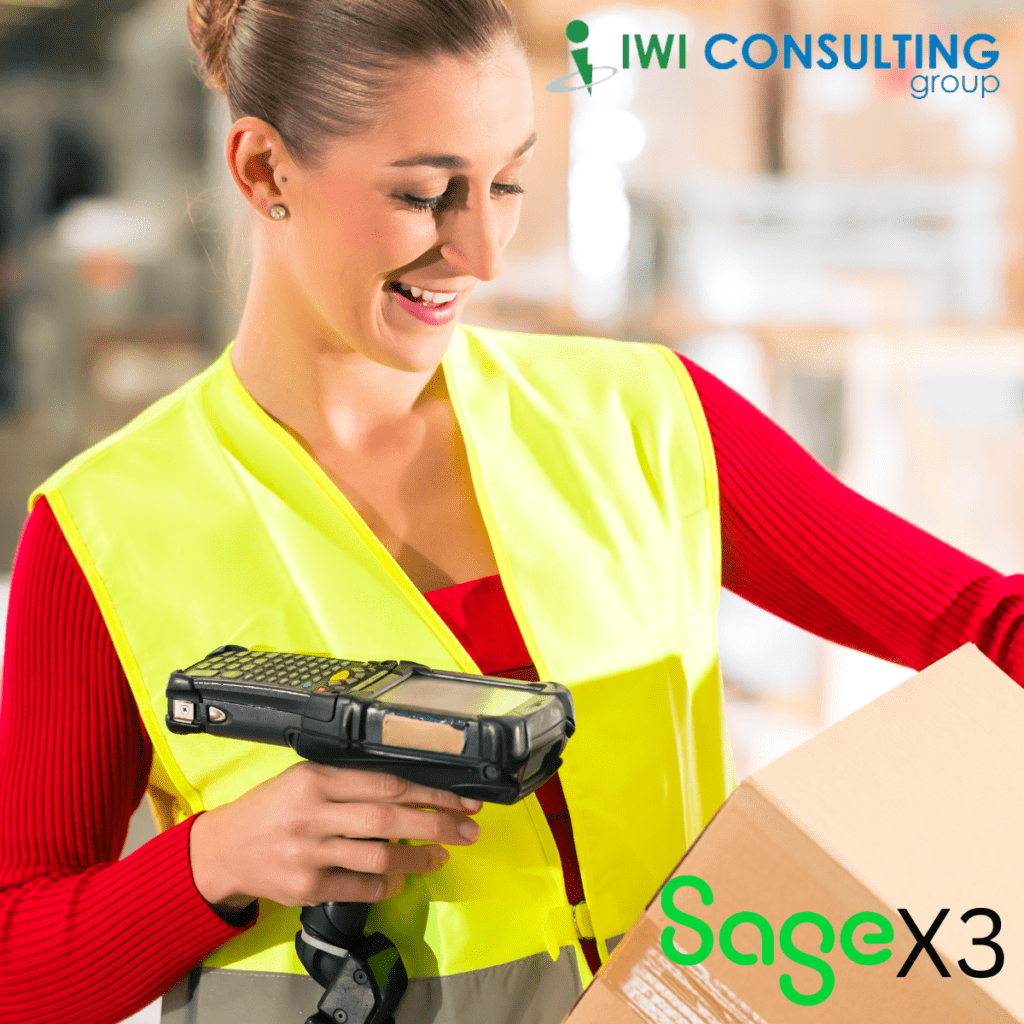
The result? Accurate, real-time inventory information is essential for companies to minimize costs without sacrificing market performance. To help bridge the gap between knowledge and action, SageX3 supports a wide variety of hand-held gun scanners to streamline this process.

Gun Scanner

Taking Aim at Inventory Success

Gun scanners, also called barcode or radio frequency (RF) scanners, are hand-held devices used by staff to quickly capture product information. The marker for scanners is predicted to grow at a CAGR of 9% over the next four years as companies look to streamline inventory processes and ensure they have accurate data on-hand to drive better supply chain and logistics decision-making.

Some of the biggest benefits of gun scanners include:

Portability

Gun scanners can be either standalone devices or applications that leverage smartphone camera technology to record inventory details. This makes them ideal for both smaller businesses and larger warehouses since the number of scanners can be easily scaled up or down as needed.

Ease of use

These scanners are designed for ease of use: Staff simply point-and-click to capture and store barcode information. This reduces the amount of time required for device onboarding and increases the willingness of staff to use these scanners since they don’t require in-depth training or specialized knowledge.

Accuracy

Manual capture of product data can lead to errors or inconsistencies which in turn cause mismatches between shipment manifests and on-hand product volumes. In the best-case scenarios, these mismatches are quickly detected, and staff take time to correct them. Worst case? Companies using incorrect data believe they have inventory that simply isn’t there.


The Sage X3 Advantage

It’s one thing for companies to capture key product and inventory data — it’s another to ensure this data is effectively transferred into relevant ERP systems. With Sage X3, however, support for gun scanners comes standard. As a result, businesses are better able to achieve key capabilities such as:

Real-time inventory data integration

With full support for scanner guns, Sage X3 allows companies to easily integrate product data into ERP systems. Users simply scan products or pallets and relevant data — such as shipment origin, product dimensions, and inventory value — are automatically added to the company’s Sage X3 ERP deployment.

Location management

Where is inventory stored? How long has it been there? What is its eventual destination? Rather than forcing staff to sort through massive databases looking for an answer, support for scanner guns means that employees can simply walk up to any product, pull the trigger, and get relevant inventory information.

Quality control

Quality control is critical to ensure that inventory items meet company standards and are ready to ship at a moment’s notice. One of the most effective ways to conduct quality control? Random checks. By having staff regularly assess the quality of items across warehouses and compare them to ideal specifications, businesses can reduce the risk of shipping broken, damaged, or out-of-spec items.

Scanner guns streamline this process by removing the need for staff to manually enter and track data about potential product defects.

Current inventory balances

As pandemic pressures have begun to ease, stock levels are rising. It makes sense: High consumer demand during the past two years has begun to ebb, even as additional products ordered by companies to fill this inventory gap have finally arrived in force.

The result? Many companies are now dealing with over- rather than under-stock issues. To help mitigate monetary losses, businesses need ways to accurately assess current inventory balances and make strategic decisions, such as selling items at a loss or offering them in bulk. Integrated inventory balance management paired with gun scanner support reduces the time required to compile this data.

Import tracking

With supply chains diversifying, import tracking is critical: Where are products coming from, when, and how much has arrived? Gun scanners offer the front-line data needed for this process, while real-time data monitoring with Sage X3 lets companies take action to ensure they have the right mix of products to meet evolving demand.

Ensure your inventory practices deliver accurate, real-time data with comprehensive gun scanner support from Sage X3. Ready to pull the trigger? See how IWI Consulting Group can help. Let’s talk.

Read More

6 Cloud Inventory Features for Better Warehouse Operations

The right cloud inventory management features can help streamline warehouse operations and improve business outcomes.

Read More

Time to Move Your Wholesale Distribution Software to Cloud?

Supply chain and distribution is changing as consumer expectations, inventory management and reporting expectations evolve. Cloud-based wholesale distribution software offers total package potential to overcome key challenges.

Read More
#zikzag_button_69561a0580221 { color: rgba(255,255,255,1); }#zikzag_button_69561a0580221:hover { color: rgba(49,49,49, 1); }#zikzag_button_69561a0580221 { border-color: rgba(49,49,49, 1); background-color: rgba(87,143,68,1); }#zikzag_button_69561a0580221:hover { border-color: rgba(49,49,49, 1); background-color: rgba(255,255,255,1); }#zikzag_button_69561a058029d { color: rgba(255,255,255,1); }#zikzag_button_69561a058029d:hover { color: rgba(49,49,49, 1); }#zikzag_button_69561a058029d { border-color: rgba(49,49,49, 1); background-color: rgba(2,122,192,1); }#zikzag_button_69561a058029d:hover { border-color: rgba(49,49,49, 1); background-color: rgba(255,255,255,1); }