Manufacturing leaders need clear, measurable indicators to improve output, control costs, and reduce waste. This guide explains the most important KPI for manufacturing industry performance, what each metric measures, why it matters, and how to apply it to drive real operational improvements.
You’ll learn the fundamentals behind KPIs for the manufacturing industry, see practical manufacturing KPI examples, understand how efficiency metrics improve throughput and quality, and discover how ERP systems support reliable KPI tracking for manufacturing industry operations. We also share best practices for setting targets, reviewing results, and using data to build a culture of continuous improvement.
What Are KPIs for the Manufacturing Industry and Why Are They Crucial?
Manufacturing KPIs are numeric measures that show how well production processes meet goals. They reveal performance across efficiency, quality and throughput so teams can spot problems and act with data, not guesswork. When KPIs are clear and aligned to business objectives, they create a single view of what success looks like and where to focus improvement effort.
Academic and industry research consistently highlight the practical impact KPIs have on organizational and operational performance.
Using KPIs to Improve Organizational and Operational Performance
Management performance measurement built around Key Performance Indicators (KPIs) is widely adopted across organizations. This review identifies and classifies KPIs to support better management and operational results. Properly designed KPIs can influence behaviour, improve business outcomes, and sustain continuous performance measurement—making KPIs an effective tool for managing organizations over time.
A systematic literature review of key performance indicators (KPIs) implementation, I Setiawan, 2020
How Do KPIs for the Manufacturing Industry Measure Production Success?
KPIs translate production activity into actionable insight. Examples include production output, defect rate and lead time. Output shows the units produced over a set period; defect rate shows the share of parts that fail quality checks; lead time captures how long an order takes from start to finish. Tracking these trends helps teams diagnose performance issues and take corrective action before small problems become costly.
Key Performance Indicators for Manufacturing Industry Efficiency
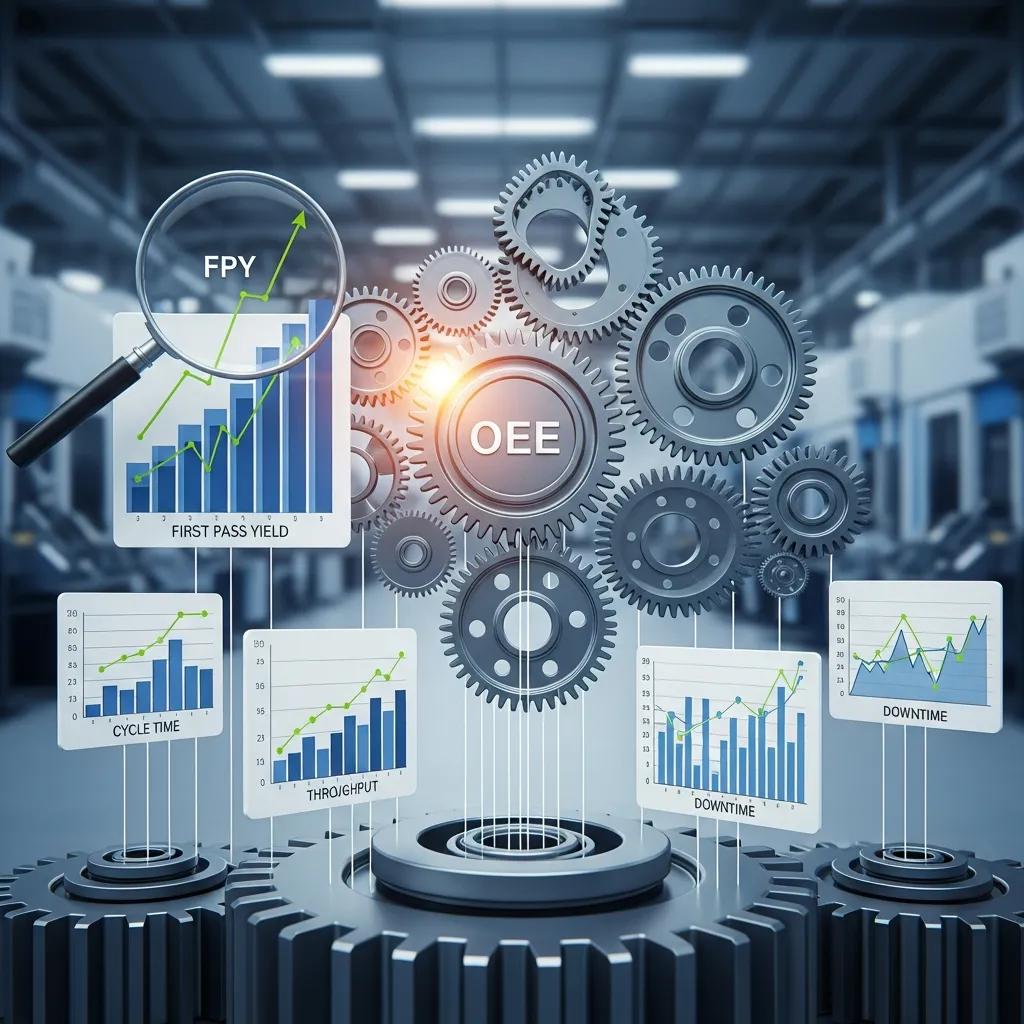
Several KPIs have a direct influence on how efficiently a plant runs. The most impactful include:
- Overall Equipment Effectiveness (OEE): Shows how fully equipment is used versus its maximum potential, combining availability, performance and quality.
- First Pass Yield (FPY): The share of units produced correctly the first time without rework—an essential quality indicator.
- Production Downtime: Time lost when operations stop due to breakdowns, maintenance or other interruptions.
Keeping these KPIs in focus helps teams make targeted improvements that raise throughput and reduce waste.
What Are the Most Important KPI Examples for the Manufacturing Industry?
Here are core KPIs every manufacturer should consider when building a performance dashboard:
- Cycle Time: Total elapsed time to complete a process or produce an item—useful for spotting bottlenecks.
- Scrap Rate: Percentage of materials discarded during production, a direct signal of quality and cost loss.
- Inventory Turnover: How frequently inventory is sold and replenished over a period—an indicator of working capital efficiency.
Tracking KPI for Manufacturing Industry Output and Production Performance
To effectively track a kpi for manufacturing industry operations, organizations should combine technology with disciplined routines. Use real-time data collection where possible, standardize shop-floor reporting, and review performance regularly.
Reliable dashboards paired with periodic audits ensure that manufacturing industry KPIs remain accurate, trusted, and actionable.
Which Quality Control KPI for Manufacturing Industry Ensures Product Excellence?
Quality KPIs keep products dependable and customers satisfied. Key measures include:
- Defect Density: Number of defects per unit produced—helps judge manufacturing consistency.
- Customer Complaints: Logged complaints indicate real-world performance and areas for corrective action.
- Return Rate: Percentage of products returned by customers, pointing to recurring quality issues.
Tracking these metrics gives teams early warning on quality trends and guides targeted corrective actions.
How Can Manufacturing Efficiency Metrics Drive Operational Improvements?
Efficiency metrics reveal how well resources—people, machines and materials—are being used. By analyzing these numbers, teams can prioritize process changes, reallocate capacity and reduce non-value-added work. Over time, this data-driven approach delivers measurable gains in productivity and cost control.
What Are Common Efficiency Metrics in Manufacturing?
Common efficiency metrics include:
- Utilization Rate: Portion of available production time that’s actively used for manufacturing.
- Throughput: Quantity of product produced in a given time frame—an overall measure of output.
- Lead Time: End-to-end time from order placement to delivery—critical for customer satisfaction.
These measures help teams identify where capacity is wasted and where improvements will yield the biggest returns.
How to Use Efficiency Data to Reduce Waste and Costs?
Use efficiency data to spot non-value steps and apply lean methods to eliminate them. Regular metric reviews reveal recurring losses—like long changeovers or excessive scrap—so you can target fixes that lower costs and free up capacity. Reducing cycle time or downtime often produces immediate cost savings and better resource allocation.
How Do ERP Solutions Support Manufacturing KPIs Tracking?

ERP systems centralize data across production, inventory, maintenance and finance—making KPI tracking reliable and actionable. Solutions like Acumatica, Sage X3, and Sage 300, for example, pull in shop-floor and business data, allowing dashboards and reports to reflect the true state of operations in near real time.
What Features Should ERP Systems Have for KPI Monitoring?
An effective ERP platform for kpi for manufacturing industry analysis should offer:
- Real-Time Data Analytics: Current data to spot issues and measure improvements as they happen.
- Customizable Dashboards: Role-specific views so operators and managers see the KPIs that matter to them.
- Reporting Tools: Flexible reports to analyze trends and support continuous improvement projects.
These features turn ERP platforms into the backbone of a strong KPI program.
How to Integrate ERP Data for Real-Time KPI Analysis?
Integrating ERP data requires connecting shop-floor systems, sensors and other sources using APIs or middleware. Ensure data definitions are consistent, automate feeds where possible, and validate inputs so dashboards reflect accurate, timely information. Proper integration lets teams react quickly to performance shifts and drill down into root causes.
How to Set and Monitor Manufacturing KPIs for Continuous Performance Improvement?
Sustained improvement requires discipline. Set clear targets for each kpi for manufacturing industry performance, review results consistently, and assign accountability. Use KPIs to guide experiments, measure impact, and standardize successful changes.
What Are Best Practices for Setting Manufacturing KPI Targets?
Use these practices when setting targets:
- SMART Criteria: Make targets Specific, Measurable, Achievable, Relevant and Time-bound.
- Benchmarking: Use industry or historical benchmarks to set realistic, meaningful targets.
- Stakeholder Involvement: Involve floor staff, supervisors and managers to ensure buy-in and practical targets.
These steps ensure targets drive the right behaviors and lead to measurable improvement.
How to Use KPI Dashboards for Effective Performance Tracking?
Well-designed dashboards make kpi for manufacturing industry monitoring intuitive. They surface critical metrics at a glance while allowing users to drill into root causes. Dashboards should be role-based and combine real-time data with historical trends.
| KPI Type | Description | Importance |
|---|---|---|
| OEE | Measures overall equipment effectiveness | High |
| FPY | Indicates quality of production | High |
| Cycle Time | Reflects efficiency of production processes | Medium |
| Efficiency Metric | Definition | Impact |
|---|---|---|
| Utilization Rate | Percentage of production time used | High |
| Throughput | Amount of product produced | High |
| Lead Time | Time from order to delivery | Medium |
Manufacturing KPIs provide the clarity teams need to improve output, lower waste and raise product quality. When paired with ERP-driven data and disciplined review routines, KPIs enable ongoing, measurable performance gains across the operation.
Frequently Asked Questions
What challenges do manufacturers face when implementing KPIs?
Common obstacles include employee resistance to change, unclear metric definitions, and weak data collection processes. Companies also struggle when KPIs aren’t aligned with business goals or when measurement is inconsistent. Overcome these issues by defining clear metrics, training teams on why they matter, and embedding KPI review into regular workflows.
How often should manufacturing KPIs be reviewed?
Review cadence depends on the KPI: many organizations review most KPIs monthly or quarterly, while critical production or quality metrics may need daily or shift-by-shift monitoring. Establish a review rhythm that matches the speed of the process and the decision cycle required to act on the data.
Can KPIs be customized for different manufacturing sectors?
Absolutely. KPIs should reflect sector-specific priorities—food plants will track food-safety and compliance metrics, while automotive manufacturers may emphasize defect rates and takt time. Tailoring KPIs ensures relevance and drives decisions that matter for your industry and operation.
What role does employee engagement play in KPI success?
Employee engagement is essential. When people understand how KPIs link to their daily work and the company’s goals, they’re more likely to act on the data. Include staff in target-setting, communicate progress clearly and recognize improvements to build ownership and sustain performance gains.
How can technology enhance KPI tracking in manufacturing?
Technology improves KPI tracking through automation, real-time analytics and centralized reporting. ERP systems, IIoT sensors and dashboard tools reduce manual data entry and speed up insight generation, so teams can detect issues earlier and measure the impact of changes more reliably.
What is the impact of poor KPI tracking on manufacturing performance?
Poor tracking leads to missed problems, inconsistent decision-making and wasted effort. Without reliable KPIs, teams can’t prioritize fixes or measure progress, which increases costs and hurts product quality. Strong tracking practices are essential to remain competitive and continuously improve.
Conclusion
Manufacturing KPIs are essential for driving efficiency, quality, and overall operational success. By leveraging these metrics, organizations can identify bottlenecks, enhance productivity, and align their processes with strategic goals. Implementing a robust KPI tracking system, especially with the support of ERP solutions, can lead to significant improvements in performance. Start optimizing your manufacturing processes today by exploring our comprehensive resources on KPI management.