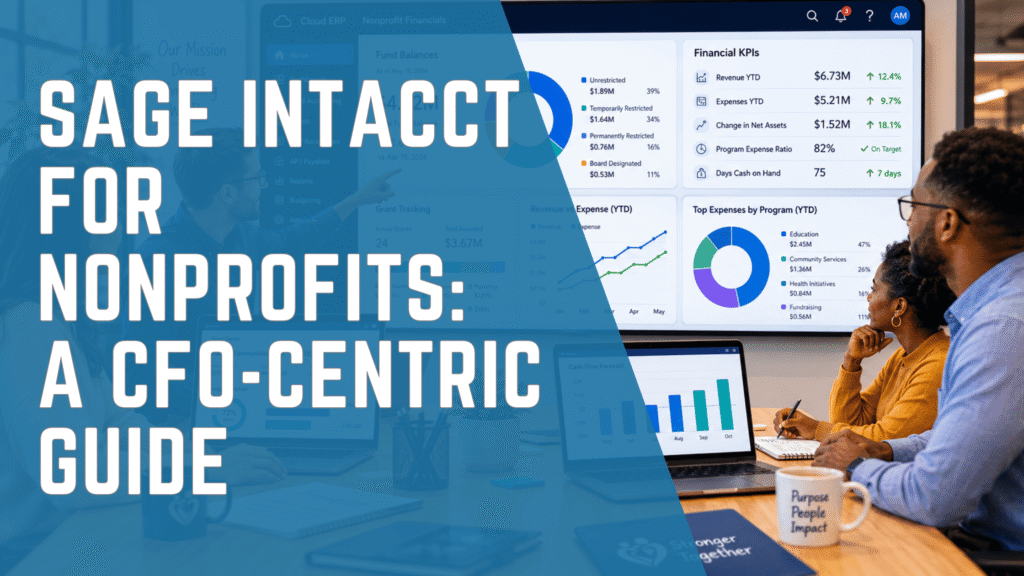
Sage Intacct for Nonprofits is transforming how finance leaders manage transparency, compliance, and accountability in mission-driven organizations. In today’s environment, CFOs, Finance Directors, and Controllers face increasing pressure to deliver real-time financial visibility while ensuring strict fund accounting compliance.
Because of this growing complexity, traditional accounting systems are no longer sufficient. Therefore, many organizations are shifting toward cloud-based ERP platforms such as Sage Intacct to modernize their financial operations.
Moreover, nonprofit organizations must manage restricted funds, grants, donor reporting, and board-level transparency simultaneously. As a result, CFOs require a system that goes beyond basic accounting and provides true financial intelligence. Sage Intacct addresses this need by offering advanced fund accounting, automated reporting, and real-time dashboards designed specifically for nonprofit governance.
In addition, IWI Consulting Group, a Canadian ERP advisory firm with over 22 years of experience and 500+ successful implementations, helps nonprofits across Canada modernize financial systems using Sage Intacct and other leading ERP platforms.
Financial Challenges Facing Nonprofit Organizations Today
Nonprofit finance leaders operate in a uniquely complex environment. However, many organizations still rely on outdated spreadsheets or legacy accounting systems that limit visibility and control.
Key Challenges Include:
- Limited real-time financial reporting
- Difficulty tracking restricted vs. unrestricted funds
- Manual grant and donor reporting processes
- Fragmented systems across departments
- Lack of audit-ready financial data
- Inefficient month-end close cycles
- Inconsistent financial consolidation across entities
Furthermore, these challenges create operational inefficiencies that reduce the organization’s ability to focus on its mission. Consequently, CFOs are increasingly prioritizing digital transformation initiatives to modernize financial systems.
Meanwhile, stakeholders, including donors, boards, and regulators, are demanding higher transparency. Therefore, finance leaders must adopt systems that deliver accurate, real-time insights.
What Is Sage Intacct for Nonprofits?
Sage Intacct for Nonprofits refers to the specialized use of Sage Intacct tailored for nonprofit financial management, including fund accounting, grant tracking, and donor reporting. Specifically, it is a cloud-based financial management system designed to help nonprofit organizations:
- Manage fund accounting with precision
- Automate financial reporting
- Improve grant and donor accountability
- Streamline consolidation across multiple entities
- Provide real-time visibility into financial performance
However, what truly differentiates Sage Intacct is its ability to deliver deep financial intelligence without adding administrative complexity. In contrast to legacy systems, it eliminates manual reconciliation and improves financial accuracy.
Moreover, it is built with scalability in mind, making it suitable for small nonprofits as well as large multi-entity organizations.
Core Financial Capabilities of Sage Intacct for Nonprofits
1. Advanced Fund Accounting
Fund accounting is essential for nonprofit organizations. Therefore, Sage Intacct enables CFOs to track restricted, unrestricted, and designated funds with complete accuracy. In addition, it ensures that every dollar is allocated correctly according to donor or grant requirements.
2. Real-Time Financial Reporting
Unlike traditional systems, Sage Intacct provides real-time reporting dashboards. Consequently, finance leaders can make faster, data-driven decisions. Moreover, reports can be customized for board presentations, audits, and internal management reviews.
3. Multi-Entity and Consolidation Management
Many nonprofits operate across multiple programs, regions, or legal entities. Therefore, consolidation can become complex. However, Sage Intacct simplifies this process by automating inter-entity transactions and consolidations.
4. Automated Accounts Payable and Receivable
Manual AP and AR processes are time-consuming. As a result, Sage Intacct automates invoice processing, approvals, and payment workflows. Furthermore, automation reduces errors and accelerates financial close cycles.
Nonprofit-Specific Features That Drive Financial Accountability
Sage Intacct includes several features specifically designed for nonprofit organizations.
Grant Management and Tracking
Grant tracking is critical for compliance. Therefore, Sage Intacct allows organizations to:
- Track grant budgets in real time
- Monitor spending against grant restrictions
- Generate automated grant reports
Donor and Contribution Reporting
Donor transparency is essential for maintaining trust. Consequently, Sage Intacct enables detailed donor reporting that aligns contributions with fund usage.
Budgeting and Planning Tools
In addition, nonprofits can build scenario-based budgets that support strategic planning and funding forecasts.
Audit-Ready Financial Records
Because compliance requirements are strict, Sage Intacct maintains a continuous audit trail. Therefore, organizations are always audit-ready without additional manual effort.
CFO Dashboards and Strategic Financial Visibility
Modern CFOs require more than financial reports—they need actionable insights. Therefore, Sage Intacct provides interactive dashboards tailored to nonprofit leadership.
These dashboards include:
- Fund balance visibility
- Grant utilization tracking
- Cash flow forecasting
- Program-level financial performance
- Expense allocation breakdowns
Moreover, dashboards can be customized for executive leadership and board members.
As a result, CFOs gain a complete financial picture that supports better strategic decision-making.
Compliance, Transparency, and Audit Readiness
Compliance is a top priority for nonprofit organizations. However, manual processes often introduce risks and inconsistencies.
Sage Intacct improves compliance through:
- Automated financial controls
- Role-based access permissions
- Real-time audit trails
- Standardized reporting frameworks
Furthermore, it ensures adherence to regulatory requirements and donor restrictions. In contrast to legacy systems, Sage Intacct reduces audit preparation time significantly. Consequently, finance teams can focus more on strategic planning rather than manual documentation.
Automation and Operational Efficiency in Nonprofit Finance
Automation plays a critical role in improving nonprofit efficiency. Therefore, Sage Intacct automates key financial processes such as:
- Invoice approvals
- Expense tracking
- Revenue recognition
- Fund allocations
- Financial consolidations
Moreover, automation reduces dependency on manual spreadsheets. As a result, finance teams experience:
- Faster month-end close cycles
- Improved accuracy
- Reduced administrative workload
- Better resource allocation
Integration Capabilities and Ecosystem Flexibility
Modern nonprofits rely on multiple systems. Therefore, integration is essential.
Sage Intacct integrates with:
- CRM systems
- Donation platforms
- Payroll systems
- Budgeting tools
- Payment gateways
Furthermore, its open API architecture ensures flexibility for future growth. In addition, integration eliminates data silos, enabling a unified financial ecosystem.
Implementation Considerations for Nonprofits
Implementing Sage Intacct requires careful planning. Therefore, CFOs should consider the following:
1. Data Migration Strategy
Legacy data must be cleaned and structured properly.
2. Fund Accounting Configuration
Proper setup ensures compliance from day one.
3. Reporting Framework Design
Reports must align with board and donor expectations.
4. Change Management
Staff training is essential for adoption.
Moreover, working with an experienced ERP partner ensures a smoother transition.
Common Challenges During ERP Transformation
Although Sage Intacct offers significant benefits, implementation can present challenges.
These include:
- Resistance to change
- Data migration complexity
- Integration issues
- Reporting restructuring
- Initial setup configuration
However, with the right consulting partner, these risks can be mitigated effectively.
Why Sage Intacct Is Superior to Legacy Systems for Nonprofits
In contrast to traditional accounting software, Sage Intacct offers:
- Real-time financial visibility
- Advanced fund accounting capabilities
- Scalable cloud infrastructure
- Strong automation features
- Superior reporting flexibility
Therefore, it is increasingly becoming the preferred ERP solution for growing nonprofit organizations. Moreover, it supports long-term digital transformation strategies for finance leaders.
How IWI Consulting Group Supports Nonprofit Financial Transformation
IWI Consulting Group is a Canadian ERP consulting and implementation firm with over 22 years of experience and more than 500 successful projects delivered.
The firm specializes in:
For nonprofit organizations, IWI provides:
- ERP strategy and assessment
- Sage Intacct implementation
- Fund accounting configuration
- Financial reporting optimization
- ERP migration from legacy systems
- Ongoing ERP support
Furthermore, IWI acts as a strategic advisor—not just a software implementer. As a result, nonprofits gain a long-term partner focused on financial transformation and operational excellence.
In addition, IWI’s experience across industries ensures best practices are applied to nonprofit-specific challenges.
Conclusion: The Future of Nonprofit Financial Management
Sage Intacct for Nonprofits represents a major shift in how organizations manage financial transparency, accountability, and operational efficiency. Because nonprofit organizations face increasing pressure from donors, regulators, and boards, modern ERP systems are no longer optional—they are essential.
Therefore, CFOs and Finance Directors must prioritize cloud ERP adoption to ensure long-term sustainability. Ultimately, organizations that adopt Sage Intacct gain a significant advantage in financial visibility, compliance, and strategic decision-making.
Connect with IWI Consulting Group to schedule a consultation and assess how Sage Intacct can improve financial visibility, streamline reporting, and strengthen accountability across your organization.
Frequently Asked Questions (FAQ)
1. What is Sage Intacct for Nonprofits used for?
It is used for fund accounting, financial reporting, grant tracking, and donor management in nonprofit organizations.
2. Is Sage Intacct suitable for small nonprofits?
Yes, it is scalable and suitable for both small and large nonprofit organizations.
3. How does Sage Intacct improve fund accounting?
It automates fund tracking, ensuring accurate allocation of restricted and unrestricted funds.
4. Can Sage Intacct integrate with donor management systems?
Yes, it integrates with CRM and fundraising platforms through APIs and connectors.
5. Does Sage Intacct support multi-entity nonprofits?
Yes, it provides built-in consolidation for multi-entity financial structures.
6. How does Sage Intacct improve audit readiness?
It maintains real-time audit trails and standardized financial records.
7. What makes Sage Intacct different from QuickBooks?
It offers advanced fund accounting, automation, and scalability not available in QuickBooks.
8. How long does Sage Intacct implementation take?
Implementation timelines vary but typically range from several weeks to a few months.
9. Can Sage Intacct handle grant reporting?
Yes, it includes built-in grant tracking and reporting capabilities.
10. Why choose IWI Consulting Group for Sage Intacct implementation?
Because IWI has 22+ years of ERP experience, 500+ successful projects, and deep expertise in nonprofit financial transformation across Canada.